A toddler asks for water in one language, then points to it using a word from another. For many parents, this moment can bring both delight and worry. What helps toddlers learn two languages is not perfect separation or early drilling. It is a steady experience of being understood, included and invited to communicate in both languages throughout everyday life.
Young children have a remarkable capacity to notice sounds, patterns and meaning. Yet bilingual development is not a race to produce equal vocabulary in two languages by a certain age. It is a relationship-based process. When each language has a real purpose, warm interactions and regular opportunities to be heard, toddlers can build communication skills with confidence.
What Helps Toddlers Learn Two Languages Most
The strongest foundation is frequent, meaningful exposure. A toddler learns language through repeated experiences: hearing a familiar phrase at breakfast, naming vegetables while helping to prepare dinner, singing during tidy-up time, and sharing a story before bed. Words become memorable because they are connected to people, actions and feelings.
Quality matters as much as quantity. A child who hears a language in responsive conversation learns more than a child who only hears it from a screen or in the background. Pause for their response, even when it is a look, gesture or single word. Add to what they say. If your child says, “Dog run,” you might respond, “Yes, the dog is running fast!” This gentle expansion gives them richer language without making them feel corrected.
Consistency also helps. This does not mean every adult must follow rigid rules, but children benefit when they can predict where and with whom each language is used. One parent may naturally speak Mandarin at home while another uses English. A grandparent may share family stories in Tamil, Malay or another heritage language. At preschool, teachers can create purposeful opportunities to hear and use both languages across play, routines and group learning.
Give Each Language a Meaningful Place
Toddlers are motivated by connection, not by worksheets. They need reasons to use both languages. One language might be used for family conversations, favourite songs and cultural celebrations; the other may be used at school, in stories or with friends. Neither language needs to be confined to a narrow role, but both should feel useful in the child’s real life.
For families in Singapore, this can be especially valuable. English may be part of daily education and the wider community, while a Mother Tongue language carries family history, humour and closeness with relatives. Continuing to speak a home language does not hold a child back from learning English. A secure foundation in any language supports the broader skills children use to understand, express ideas and connect with others.
It is also helpful to choose a pattern your family can sustain. Some households use one parent, one language. Others use one language at home and another outside it. Some switch naturally according to the activity or the people present. There is no single formula that suits every family. The most effective approach is one that allows adults to speak warmly and fluently, rather than forcing a language they do not feel comfortable using.
Language Mixing Is a Normal Stage
A toddler may use words from both languages in one sentence. This is often called code-mixing, and it is usually a sign that the child is drawing from all the words available to express an idea. It does not mean they are confused.
Rather than asking a child to repeat the sentence correctly, model the language you would like them to hear. If they say, “I want bao,” you can reply, “You would like a bun. Let’s have a bun.” They remain understood, while hearing a clear and natural model. Over time, as vocabulary and awareness grow, children become better able to choose words for different listeners and settings.
Build Language Into Play and Daily Routines
Toddlers learn best when language is active. During pretend play, they practise dialogue, take turns and use imaginative vocabulary. During outdoor play, they describe movement, space and sensations. During self-help routines, they learn practical words for dressing, washing hands and packing away.
Small moments add up. While travelling, talk about what you can see: the bus stopping, the rain on the window, the construction vehicles at work. At the supermarket, invite your child to find red fruit or count bananas. When getting dressed, name clothing and let them choose between two options. These exchanges are far more valuable than testing whether they remember a word.
Songs, rhymes and rhythm also have an important place. Repetition makes sound patterns easier to notice, while melody can support recall and confidence. Music should not replace conversation, but it can make language feel joyful and memorable. At A2E Kids, music enrichment through violin and piano sits alongside communication-rich experiences, helping children listen attentively, respond to patterns and express themselves with growing assurance.
Read, Repeat and Respond
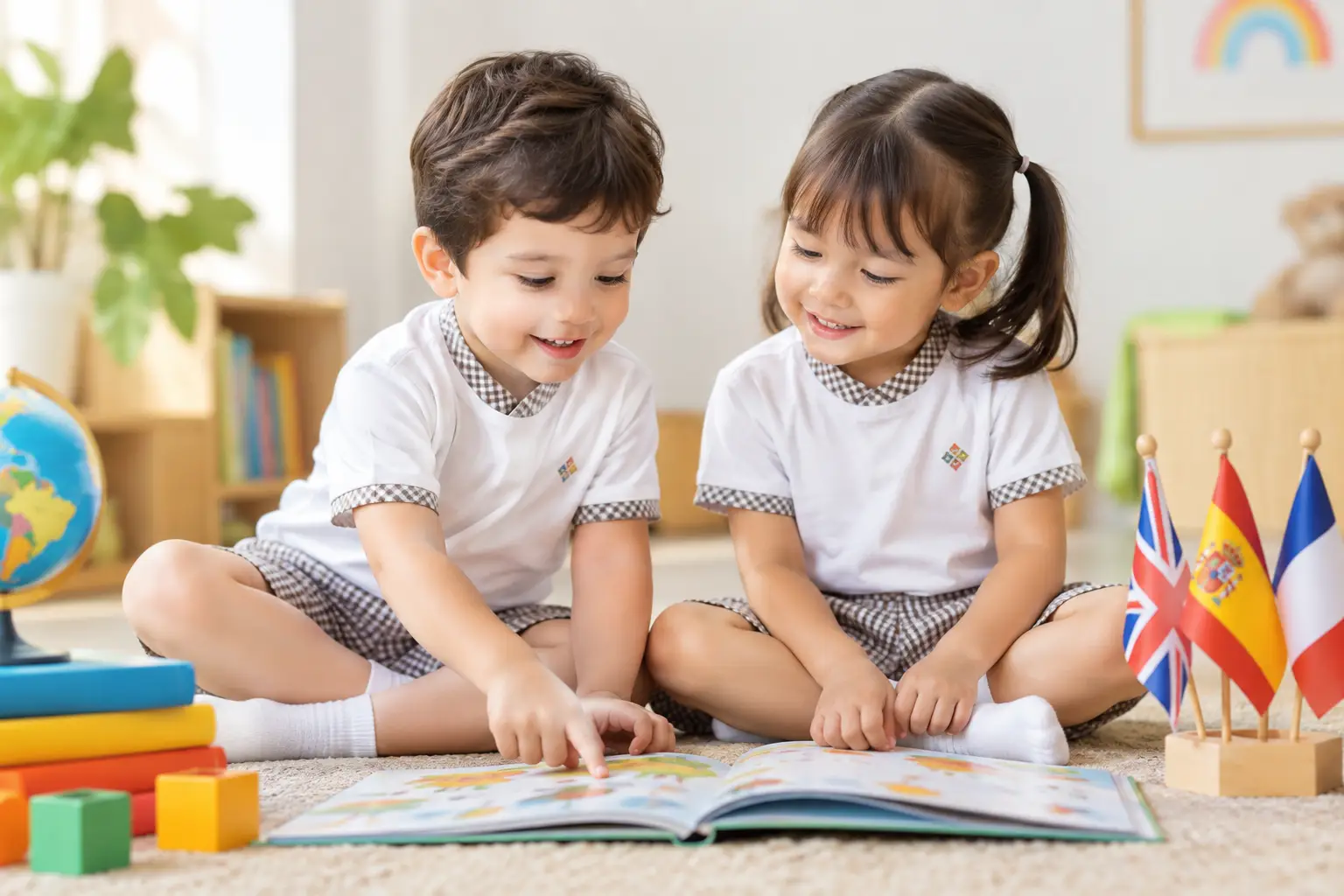
Shared reading is one of the simplest ways to strengthen two languages. Choose books with clear pictures, familiar routines and language your child can enjoy. You do not need to read every word. Point, wonder aloud, ask what they notice and allow them to turn pages or retell the story in their own way.
Reading the same book in both languages can work well, particularly when a child already knows the story. You might read one version on Monday and another later in the week. Alternatively, tell the story in your home language while using an English picture book. The goal is not a word-for-word translation. It is to build understanding, enjoyment and a rich store of ideas in both languages.
Toddlers also thrive on repetition. The tenth reading of the same favourite book is not wasted time. Familiar phrases let children anticipate, join in and practise language safely. Their growing participation is a meaningful sign of learning.
A Bilingual Environment Needs Patient Adults
Children develop at different rates. One toddler may speak confidently in both languages early on, while another understands a great deal before saying much. Some children use one language more strongly for a period, especially if it dominates their preschool or social environment. This can change as their experiences change.
Avoid comparing vocabulary word by word with another child. Consider the child’s total communication: the words they know across both languages, what they understand, how they use gestures, whether they enjoy interaction and whether they can make their needs known. A child may know “apple” in English and another word for it in a home language. That is two useful labels, not evidence that either language is lacking.
If you have concerns about speech or language development, discuss them with your child’s educator or a qualified speech and language professional. The key question is not whether bilingualism causes delay – it does not – but whether communication skills are developing as expected across all of the child’s languages. Early, informed support can be reassuring and constructive.
How Educators Can Strengthen Bilingual Confidence
A thoughtful early childhood setting gives children repeated language experiences across the day, not only during a designated language lesson. Educators can narrate routines, introduce vocabulary through sensory and kinaesthetic exploration, encourage peer conversation and revisit new words in stories, music and creative activities.
The environment should feel emotionally safe. A toddler who is afraid of getting a word wrong is less likely to speak. When adults listen attentively, celebrate attempts and give children enough time to respond, language becomes a tool for belonging. Small-group interactions are particularly valuable because children have more opportunities to be heard.
Purposeful bilingual learning also respects the whole child. Communication develops alongside attention, memory, movement, social confidence and creativity. A child building a tower can describe balance and height. A child learning a song can practise listening and turn-taking. A child caring for a classmate can discover the words for feelings. These experiences make language practical, personal and lasting.
The most encouraging sign is not that a toddler can recite two sets of flashcards. It is that they reach for language to share a joke, ask a question, tell a story or seek comfort from someone they trust. Keep both languages present in these ordinary, affectionate moments. Your child is not simply learning words – they are learning that their voice can belong in more than one world.
Leave a Reply