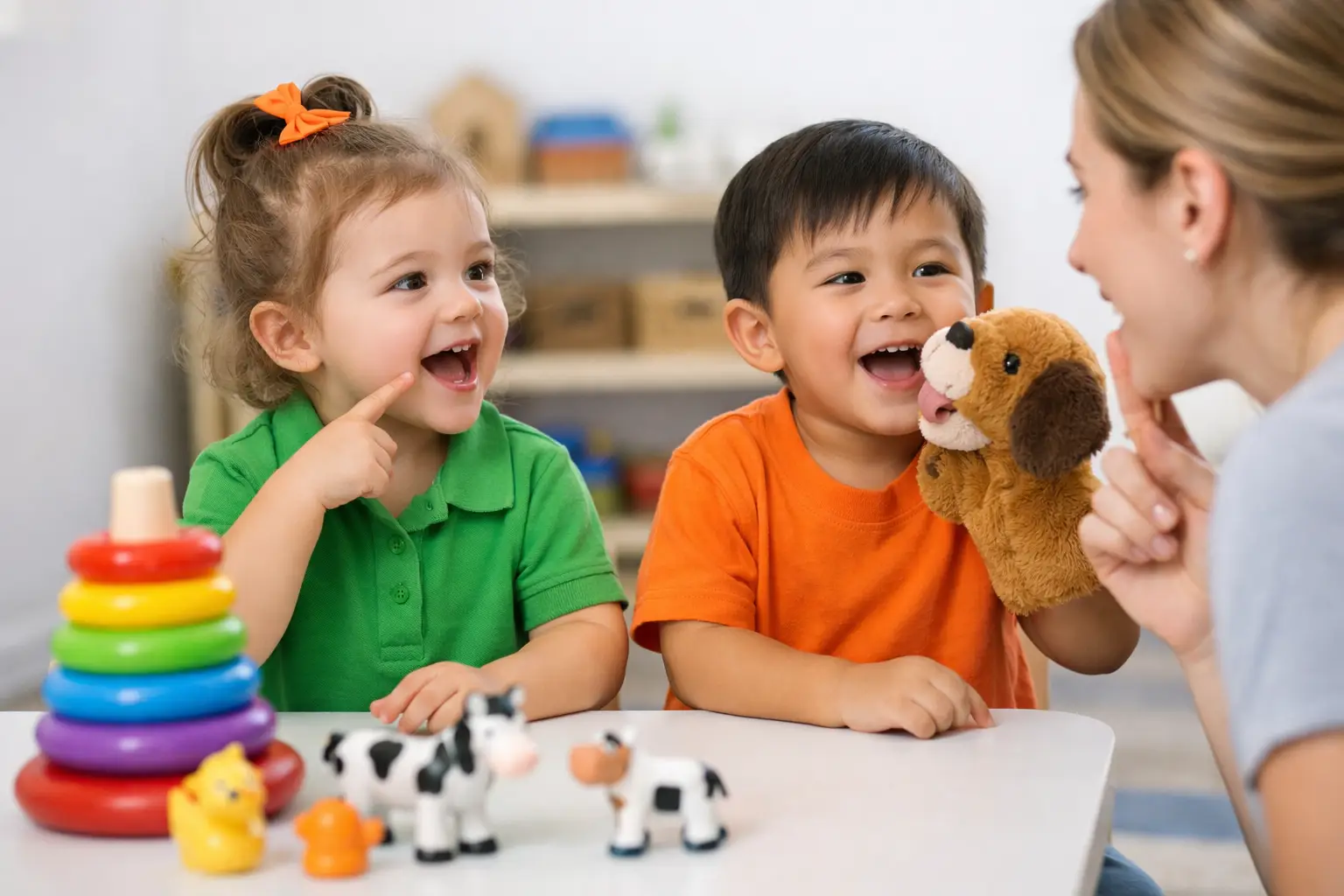
A toddler who points at the banana but cannot quite say the word yet is already communicating a great deal. That moment matters. Speech development activities for toddlers work best when they build on these everyday attempts to connect, rather than turning language into a lesson. For young children, speech grows through warm interaction, repetition, movement, music and meaningful routines.
Parents often ask whether they should be doing more at home. The reassuring answer is yes, simple daily interactions can make a genuine difference, but more is not always better. What matters most is consistency, responsiveness and choosing activities that match your child’s current stage of development. Some toddlers are eager talkers. Others take in language quietly before using it. Both patterns can be perfectly normal.
Why speech development in the toddler years matters
The toddler years are a period of rapid change in communication. Children are learning to understand words before they can always say them clearly. They are also developing attention, memory, listening skills, turn-taking and confidence, all of which support spoken language.
This is why strong speech development is not only about pronouncing words. It also involves understanding meaning, using gestures, noticing rhythm and sound patterns, and learning that communication gets a response. When adults consistently speak, sing, pause, listen and reply, toddlers begin to see language as powerful and enjoyable.
For families who value whole-child development, this is especially important. Speech sits alongside social-emotional growth, cognitive development and self-expression. A child who can ask for help, name a feeling or join in a song is not simply learning words. They are building independence and connection.
10 speech development activities for toddlers
1. Narrate everyday routines
Some of the best language opportunities happen during ordinary moments. Nappy changes, bath time, getting dressed and preparing meals all give you a natural reason to repeat useful words. Try describing what is happening in short, clear phrases such as, “Socks on”, “Wash your hands”, or “Cutting the apple”.
This helps toddlers connect words with actions and objects. It also reduces pressure, because they are learning through shared experience rather than being tested. If your child says only part of a word, you can model it back gently without correction.
2. Follow your child’s lead in play
Toddlers learn best when the topic already interests them. If your child is pushing cars, resist the urge to redirect them towards flashcards or a different toy. Join the play and add simple language around what they are doing: “Car goes fast”, “Red car”, “Crash”, “Up the ramp”.
Following their lead keeps attention strong, and attention is a foundation for language learning. A child who is fully engaged is more likely to listen, process and attempt new sounds or words.
3. Use songs, rhymes and action games
Music supports speech in a uniquely powerful way. Repeated melodies, rhythmic phrases and predictable patterns help toddlers remember words and anticipate sounds. Action songs such as clapping games or nursery rhymes are especially helpful because they combine listening, movement and imitation.
This matters because some toddlers respond more readily to musical language than to direct conversation. The rhythm gives them structure. The gestures provide clues. The repetition builds familiarity. In a high-quality early years setting, music and vocal activities are often woven into the day for exactly this reason.
4. Pause and wait
Many adults understandably fill every silence. Yet toddlers often need a little extra processing time before they respond. If you ask, “Would you like milk or water?” and then wait, your child has a chance to think, attempt a sound, point or use a word.
A short pause can be one of the most effective speech development activities for toddlers because it creates space for communication. The aim is not to force speech, but to invite it. If your child does not answer, you can still model the language calmly: “Water, yes, water please.”
5. Read interactively, not perfectly
Reading together supports vocabulary, listening and comprehension, but it does not need to look like a formal story session. With toddlers, interactive book sharing is often more valuable than reading every word on the page. Name pictures, ask simple questions, copy animal sounds and let your child turn pages or point.
Books with clear images, repeated phrases and familiar routines tend to work well. If your child wants to read the same book again and again, that repetition is useful. It strengthens memory and gives them a chance to predict language before they can produce it independently.
6. Offer choices
Choice-making encourages purposeful communication. Instead of anticipating every need, offer two simple options such as “apple or pear” or “blue cup or yellow cup”. This gives your toddler a reason to use a word, sound, sign or gesture.
The key is to keep choices manageable. Too many options can overload a young child. Two clear choices usually support the best response. Over time, this kind of structured interaction can improve both understanding and expressive language.
7. Expand what your toddler says
If your child says “dog”, you might respond with “Big dog” or “The dog is running”. This is called expansion, and it is a gentle way to model the next step in language development without making your child repeat after you.
Expansion works because it meets toddlers where they are. You acknowledge their effort, add a little more language, and keep the interaction natural. It is especially effective for children who are beginning to use single words and are ready for short phrases.
8. Build communication through sensory and hands-on play
Water play, playdough, sand, blocks and simple craft activities create rich language opportunities. Words such as “pour”, “squash”, “wet”, “sticky”, “big” and “more” are easier to learn when a child can feel and see what they mean.
Hands-on exploration also supports children who may not yet sit for a story or extended conversation. For some toddlers, movement and touch are what help language stick. This is one reason kinaesthetic learning can be such a valuable part of early childhood education.
9. Use face-to-face conversation during meals
Mealtimes can become rushed, but they are one of the most reliable times for shared attention. Sitting together, even briefly, gives toddlers the chance to watch your mouth movements, hear repeated vocabulary and practise turn-taking.
Keep language simple and relevant. Talk about taste, temperature, colour and preference. “Crunchy toast”, “Warm soup”, “More grapes?” These repeated patterns help children understand both vocabulary and conversational rhythm.
10. Encourage imitation without pressure
Imitation is an early bridge to speech. Toddlers often copy sounds, facial expressions, actions and word patterns before they use language more independently. You can encourage this through playful sound-making, animal noises, vehicle sounds and simple repeating games.
The important balance is to stay encouraging rather than insistent. Some children enjoy copying straight away. Others need many exposures before joining in. If the activity feels like a performance, a toddler may withdraw. If it feels playful, they are more likely to engage.
What to avoid when supporting toddler speech
Parents with the best intentions sometimes worry they must constantly quiz their child. In practice, too many direct questions can slow the flow of conversation. If every interaction becomes “What’s this?” or “Say it properly”, toddlers may feel pressure rather than connection.
Background noise can also make a difference. Constant television or competing sounds may reduce opportunities for focused listening. Quiet, responsive interaction is often more effective than passive exposure to language.
It also helps to avoid comparing your child too closely with others. Speech development is not identical from one toddler to the next. Some children use many words early on. Others build strong understanding first and begin speaking more later. Progress should be looked at in the round, including gestures, comprehension, eye contact, engagement and play.
When extra support may be helpful
There are times when a closer look is worthwhile. If your toddler rarely responds to sound, shows limited interest in communication, loses previously used words, or seems frustrated far more often than understood, it is sensible to seek professional advice. Equally, if you simply have a persistent concern, trust that instinct.
Early support does not mean something is seriously wrong. It means you are paying attention to development at a stage when children are highly responsive to intervention. In settings such as A2E Kids, where communication, music, listening and whole-child growth are embedded into the learning environment, this kind of support is approached in a thoughtful and developmental way.
Creating a language-rich home without doing more than you can manage
The strongest speech support is rarely about buying more resources. It is about how language is woven into the day. A short song while tidying up, a conversation in the buggy, naming what you see on the way to nursery, repeating favourite rhymes at bath time – these moments add up.
If your family uses more than one language, that can also be a strength. Toddlers are capable of learning across languages when they have meaningful exposure and responsive interaction. What matters is not forcing performance in either language, but building confident communication overall.
Speech grows in relationships. When a toddler feels seen, heard and encouraged, they are more likely to take the small risks that language requires. Start with one or two activities that fit naturally into your routine, keep your expectations gentle, and let connection lead the way.
Leave a Reply