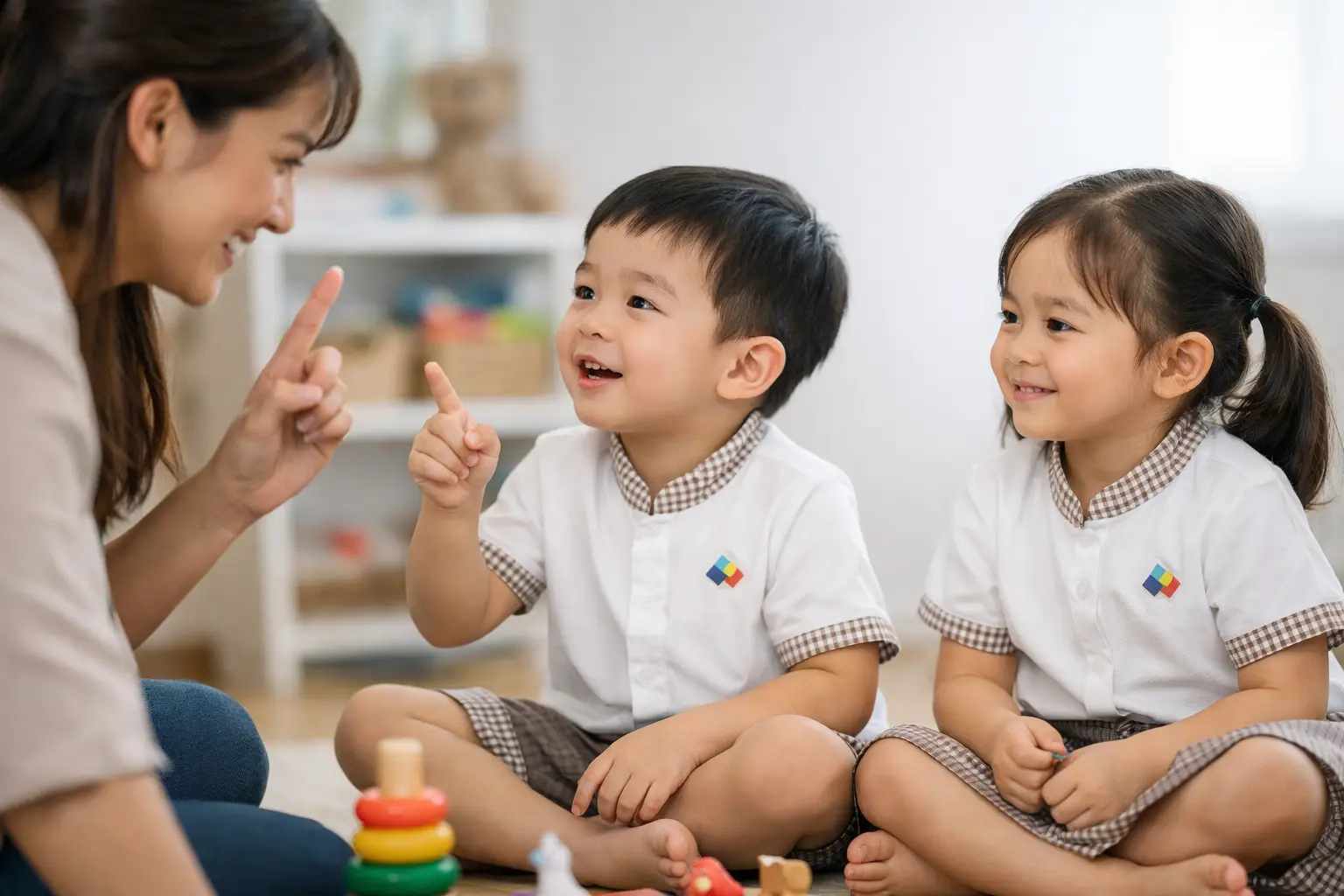
A toddler who points urgently at the highest shelf, shakes their head and says “no” is already communicating with impressive purpose. The next step is not to rush them into perfect sentences. It is to give them many meaningful reasons to listen, gesture, respond and share their ideas. Strong communication skills for toddlers grow through warm, repeated exchanges with the adults and children around them.
For parents, this can be reassuring. Language development is not a race towards the longest vocabulary list. It is a gradual process of building understanding, confidence, attention and the belief that “what I say matters”. These foundations support friendships, emotional regulation, bilingual learning and later literacy.
What communication looks like in the toddler years
Communication begins long before clear speech. A child may use eye contact, facial expressions, pointing, body movements, sounds and single words to make their needs known. They are also learning to understand far more than they can say. When a toddler brings you a shoe, they may be asking to go out. When they repeat “again”, they are remembering an enjoyable experience and inviting you to share it.
Between roughly one and three years old, children often move from gestures and single words towards short phrases. There is wide variation. Some children are careful observers who speak later but understand a great deal; others talk early and enthusiastically. What matters most is steady progress in understanding, expressing needs and engaging with people.
Communication is not only about vocabulary. It includes the ability to take turns, attend to another person, interpret tone of voice, notice feelings and wait briefly for a response. A child who learns to say “my turn”, look at a friend and offer a toy is developing social communication alongside speech.
How to build communication skills for toddlers at home
The most effective language opportunities are usually woven into ordinary moments. A calm, responsive adult does not need to turn every interaction into a lesson. Instead, notice what has caught your child’s attention, join them in that moment and add simple language.
Follow your child’s lead, then add one step
If your toddler is rolling a car and says “car”, you might respond, “Yes, a red car. The car is going fast.” This approach confirms their attempt to communicate while introducing a small amount of new language. It is easier for toddlers to learn words connected to what they can see, touch or do right now.
Try to pause after speaking. Adults naturally fill silences, particularly when they are busy, but toddlers need a few extra seconds to process a question and organise a reply. A patient pause communicates that their contribution is worth waiting for.
Open-ended comments can be more helpful than frequent testing questions. Rather than asking, “What colour is this?” at every opportunity, try, “You chose the yellow cup today.” Questions still have a place, especially familiar choices such as “Would you like apple or banana?”, but conversation should feel shared rather than like a quiz.
Turn routines into conversations
Meals, bath time, getting dressed and travelling are full of useful repetition. Repeated phrases help children understand patterns, anticipate what comes next and eventually join in.
At breakfast, name foods, describe textures and give simple choices. During dressing, talk through body parts and actions: “One sock on. Now the other foot.” At bath time, use playful words such as splash, pour, float and full. The aim is not to use elaborate language. Clear, natural phrases used often are more valuable.
Daily routines also offer chances to connect words with emotions. If your child is upset because playtime has ended, acknowledge it: “You feel cross. You wanted more time with the blocks.” Naming the feeling does not remove the boundary, but it helps children feel understood and gradually gives them language they can use instead of only crying or pushing.
Read interactively, not perfectly
A toddler does not need to sit through every page of a book to benefit from shared reading. They may want to turn pages quickly, point to one familiar picture or ask for the same story each evening. This is all productive.
Talk about the pictures, copy animal sounds, invite your child to finish a repeated phrase and connect the story to their life. “The bear is sleeping. You sleep with your teddy too.” Repetition strengthens memory and makes children confident enough to participate. Board books, rhymes and books with predictable language are especially useful in the early years.
Why songs and music support language
Music gives toddlers an enjoyable framework for hearing patterns, remembering words and practising sounds. A familiar song has repetition, rhythm and predictable pauses, making it easier for a child to anticipate the next word or action. Action songs also connect language to movement, which can help active learners remain engaged.
Clapping a beat, tapping a drum or moving slowly and quickly helps children listen carefully and respond with their bodies. These experiences support attention and turn-taking as well as language. For a toddler who is not yet ready to speak much, joining an action or humming a tune can still be a meaningful form of participation.
At A2E Kids, structured Music Education, including violin and piano enrichment, forms part of a wider whole-child approach. Carefully planned musical experiences can create purposeful opportunities for listening, recalling patterns, expressing ideas and building confidence alongside communication development.
Music should remain joyful. Children do not need to perform on demand, and they will not always join in immediately. Some prefer to watch first, then participate once the song feels familiar. That quiet observation is often active learning.
Supporting bilingual communication with confidence
Many Singapore families use more than one language at home, and bilingual exposure can be a meaningful gift. A child may use words from both languages in one sentence or appear stronger in one language at a particular stage. This is a normal part of learning and does not mean they are confused.
The most helpful approach is consistent, rich interaction. Speak the language in which you can be most warm, natural and expressive with your child. Tell stories from your family, sing songs, describe real experiences and make space for genuine back-and-forth conversation. Quality matters more than forcing equal use of every language each day.
Where possible, let each language have a clear and positive place in family life. One parent may regularly use a home language, while school provides English exposure, or grandparents may share songs and stories in another language. The arrangement can vary. What children need is enough meaningful interaction to connect words with relationships, routines and feelings.
Create opportunities for toddlers to communicate with others
Toddlers learn differently when communicating with peers. They begin to see that another child may want the same toy, have a different idea or need an invitation to join a game. These situations can be challenging, but they are valuable practice for real social language.
Adults can gently provide useful phrases without demanding immediate repetition: “You want a turn. Let’s say, ‘Can I have a turn when you’re finished?’” During imaginative play, add language that helps children cooperate: “The baby is hungry. What shall we cook?” Hands-on activities such as water play, gardening, building and simple science exploration naturally invite children to describe, predict and negotiate.
Avoid speaking for your child too quickly. If they look towards a friend or reach for a toy, give them a moment to gesture, vocalise or attempt a word. Then support the message if needed. The balance is important: children need help to succeed, but they also need regular chances to discover their own voice.
When extra support may be helpful
Every child develops at their own pace, and a single quiet week or a temporary burst of frustration is rarely a reason for alarm. However, it is sensible to speak with a qualified health professional or speech and language therapist if your toddler rarely responds to sounds or their name, has lost skills they previously used, finds it very difficult to understand simple everyday language, or shows little interest in connecting through gestures, sounds or words.
Support is not about labelling a child. It is about understanding their individual profile and giving them the right strategies early. Parents can also share observations with educators, because a child may communicate differently at home and in a group setting. A clear picture across both environments is far more useful than comparing a child with others.
Your child does not need flawless pronunciation or long sentences to be a capable communicator. They need attentive listeners, unhurried conversation and a setting where their questions, gestures, songs and first attempts are welcomed. Each small exchange tells them something powerful: their thoughts can reach another person, and they have something worth saying.
Leave a Reply