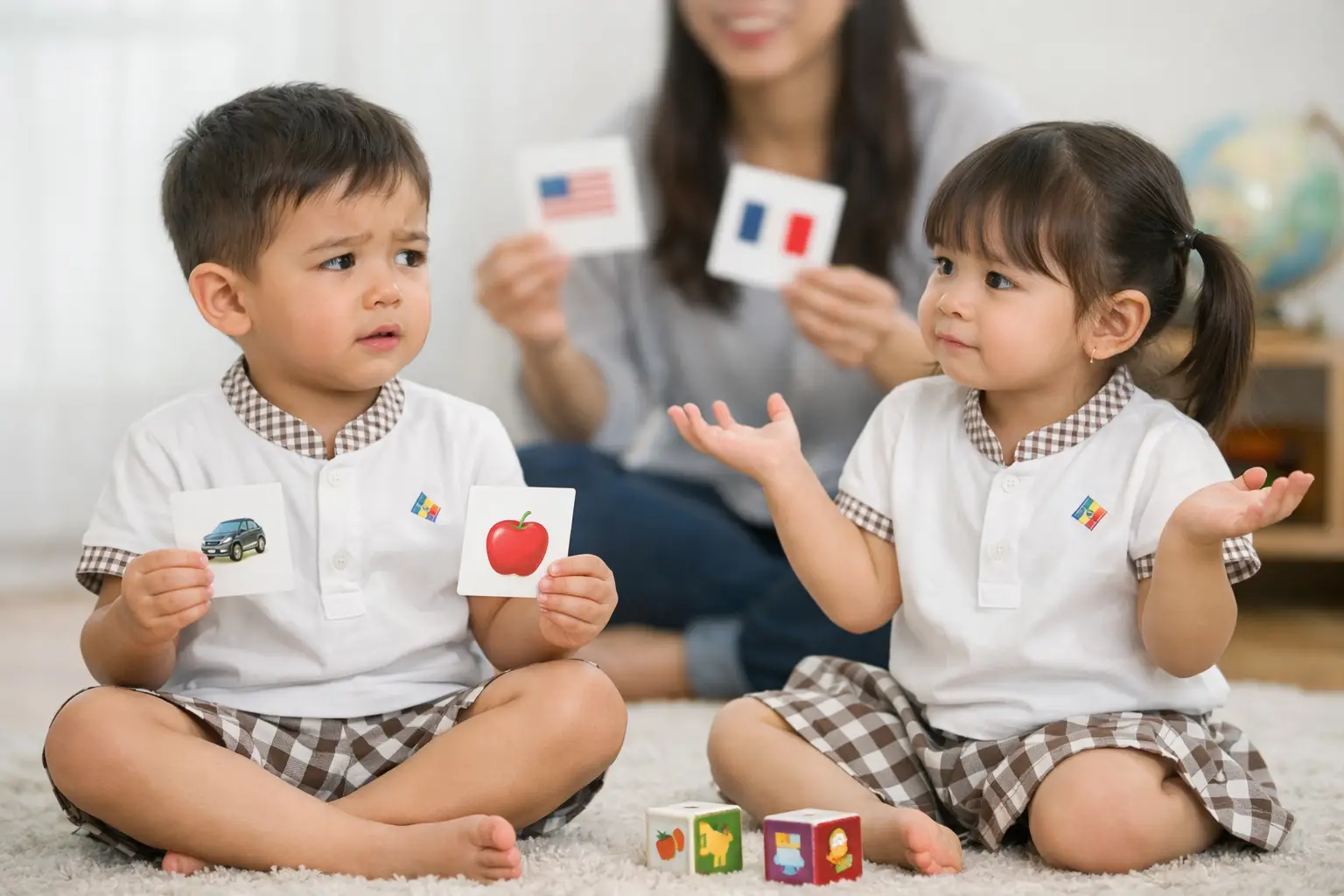
A toddler says one word in English, another in Mandarin, then points instead of finishing the sentence. For many parents, that moment brings a quiet worry: does bilingual learning confuse toddlers, or is this simply part of healthy language development?
The reassuring answer is that bilingual learning does not confuse most toddlers. In fact, young children are remarkably capable of learning two languages at the same time. What can look like confusion is often the brain doing exactly what it should – sorting sounds, meanings, and social cues across two language systems. That process may not always look neat to adults, but it is developmentally normal.
Does bilingual learning confuse toddlers or build stronger language skills?
Toddlers learning two languages may mix words, answer in one language after hearing another, or show faster progress in one language than the other. These patterns are common and usually temporary. They do not mean a child is overwhelmed.
A bilingual toddler is not learning one language badly and another one on top. They are building two systems at once. Because their total language knowledge is spread across both languages, parents sometimes compare only one language at a time and assume the child is behind. A fairer view is to look at overall communication. Can your child understand familiar instructions, express needs, connect with people, and keep adding new words across both languages? If yes, progress is happening.
In many cases, bilingual learning supports communication development rather than weakening it. Children who grow up hearing and using two languages are practising attention, listening, memory, and flexibility from an early age. Those are valuable foundations not only for speech, but for wider learning as well.
What parents often mistake for confusion
The most misunderstood behaviour is language mixing. A toddler might say, “I want shui,” or use a phrase from one language with a noun from another. Adults may hear that and think the child cannot separate the languages. Usually, the opposite is true.
Mixing happens for practical reasons. Young children use the word they know best in the moment. Sometimes one word comes more quickly. Sometimes that word is the one used at home, while another is used in school. This is efficient communication, not evidence of disorder.
Another common concern is uneven development. A child may speak more in English at preschool but understand more Mandarin or Tamil at home. This difference often reflects exposure. Toddlers become stronger in the language they hear more often, use more frequently, or associate with play, comfort, and routine.
There can also be a silent period when a child hears a newer language and takes time before speaking it confidently. During that period, they may watch, listen, imitate actions, and speak less than expected. That can feel worrying, but it is often part of adjustment rather than a sign of confusion.
What bilingual development usually looks like in toddlerhood
Bilingual development is not always identical to monolingual development, and that matters. Some bilingual toddlers may know fewer words in each individual language at first, yet know a healthy total number of words across both. For example, if a child knows “milk” in one language and “water” in another, both count towards language growth.
Pronunciation can also vary. A toddler may apply the sound patterns of one language to another, especially in the early years. This is expected while their speech system is developing.
The pace may appear uneven too. Language is shaped by relationships and context. A child who sings songs in English, hears stories in Mandarin, and speaks to grandparents in a home language is not on a straight line. Their development is rich, layered, and responsive to real life.
For parents seeking structured early learning, this is where thoughtful pedagogy makes a difference. A well-designed bilingual environment does not simply expose children to two languages randomly. It creates meaningful repetition, clear routines, responsive adult interaction, and strong communication cues so children can connect words to actions, feelings, and ideas.
When “it depends” really matters
Although bilingualism itself does not cause confusion, every child is different. Temperament, hearing, exposure, and developmental profile all play a role.
A toddler who hears two languages inconsistently may take longer to use one actively. A child with limited opportunities for back-and-forth conversation may understand more than they can say. If a child has an underlying speech, language, or developmental difficulty, that challenge will still need attention whether they are learning one language or two.
This is why broad reassurance should be paired with careful observation. The real question is not whether two languages are present. It is whether the child is progressing in communication overall.
Parents should pay closer attention if a toddler rarely responds to sound, loses previously acquired words, struggles significantly with understanding in both languages, or shows very limited attempts to communicate by speech, gesture, eye contact, or shared attention. In those cases, an early discussion with a qualified professional is sensible. The concern is not bilingual learning itself, but whether there may be a wider developmental need.
How to support a bilingual toddler without creating pressure
The healthiest approach is usually consistency without rigidity. Children benefit when each language has a clear and meaningful place in daily life. That could mean one language at home and another in school, or one parent mainly using one language while the other uses another. Families do not need to follow a perfect formula, but they do need regular exposure and genuine interaction.
Talk more than you test. Toddlers learn language through connection, not drills. Comment on what they are doing, name feelings, sing, read aloud, and repeat key words in context. If your child replies in another language, you do not need to correct every switch. You can simply model the phrase naturally. If they say, “More fan,” you might answer, “You want more rice? Here is more rice.”
Songs and music can be especially powerful because they support memory, listening, rhythm, and sound discrimination. Repeated musical patterns help toddlers anticipate language and participate before they can produce long sentences. In an early childhood setting, music-rich experiences can strengthen attention and recall while making language joyful rather than demanding.
Routine matters too. Children learn quickly when language is tied to repeated experiences such as greetings, mealtimes, tidying up, outdoor play, and story time. Predictable contexts reduce cognitive load and help toddlers understand what words mean.
Just as important, avoid framing one language as more valuable than the other in front of the child. When children feel that a home language is ignored or inferior, they may resist using it. Language carries belonging, family identity, and emotional security. Protecting that connection supports the whole child.
The role of early education in bilingual confidence
In a high-quality child development programme, bilingual learning should be intentional, nurturing, and developmentally appropriate. Children need warm adult interaction, not passive exposure. They need language linked to movement, play, music, stories, and hands-on discovery.
That integrated approach matters because toddlers do not learn in separate compartments. Communication grows alongside motor development, social confidence, attention span, and emotional security. A child building with blocks, clapping to rhythm, listening to a story, and taking turns in conversation is developing more than vocabulary. They are building the foundations for later literacy, confidence, and school readiness.
For families in Singapore, where bilingual learning is often part of both educational goals and daily life, reassurance should come with quality expectations. Not every bilingual setting is equally supportive. Parents should look for environments where educators speak purposefully, encourage expressive language, observe each child closely, and create rich repetition through meaningful experiences.
A2E Kids believes that purposeful early learning should strengthen communication, memory, focus, and creativity together. When bilingual development is supported by structured interaction, music, movement, and exploratory learning, children are not simply coping with two languages. They are growing into confident communicators.
So, does bilingual learning confuse toddlers?
For most children, no. It may look messy at times, and it may not progress evenly across both languages, but messy is not the same as confused. Toddler language development is full of starts, pauses, substitutions, and bursts of growth. Add a second language, and the path becomes more layered, not less meaningful.
If your child is mixing languages, taking time to warm up, or showing stronger skills in one language than the other, that is often a normal part of bilingual development. What matters most is steady growth in understanding, expression, connection, and confidence over time.
The goal is not perfect speech in two languages by a certain age. The goal is a child who feels secure, curious, and increasingly able to communicate with the people around them. With patient support and a rich learning environment, two languages can become not a source of confusion, but a powerful part of your child’s growth.
Leave a Reply