At some point, most parents face the same practical question: should your child spend the day in childcare, or attend preschool for a shorter, more academic-style programme? When comparing childcare versus preschool Singapore options, the right answer is rarely about prestige. It is about fit – your child’s age, your family schedule, and the kind of developmental environment you want during the earliest and most formative years.
The confusion is understandable. In everyday conversation, parents often use the terms interchangeably. Yet they are not always the same in structure, intent, or daily experience. Choosing well matters because early childhood settings do more than supervise children. They shape communication, confidence, routines, attention span, social habits, and readiness for later learning.
Childcare versus preschool Singapore: what is the difference?
In simple terms, childcare usually refers to a longer-day programme that combines care routines with early learning. Preschool is often used as a broader educational term, but many parents use it to describe shorter programmes focused more directly on school preparation.
In Singapore, the distinction can blur because many quality childcare centres also deliver a strong preschool curriculum. That is why looking only at the label can be misleading. A centre may be called childcare, yet provide a rich bilingual programme, structured learning blocks, creative exploration, music, movement, and communication development throughout the day.
What matters more is the balance between caregiving and pedagogy. Some settings place greater emphasis on supervision and daily care needs. Others intentionally build the day around language exposure, cognitive growth, social-emotional development, and purposeful enrichment. For parents who want both dependable full-day support and meaningful developmental outcomes, this difference is significant.
Why the daily structure matters more than the name
A child does not experience a programme as a category. They experience it as a rhythm. They notice whether the adults are warm and responsive, whether transitions are calm, whether there is time to speak and be heard, whether learning feels active, and whether the environment invites curiosity.
A shorter preschool model may suit families who have flexible caregiving arrangements at home and want a few focused hours of group learning. For some children, especially those who are slightly older and already settled in routine, this can work well.
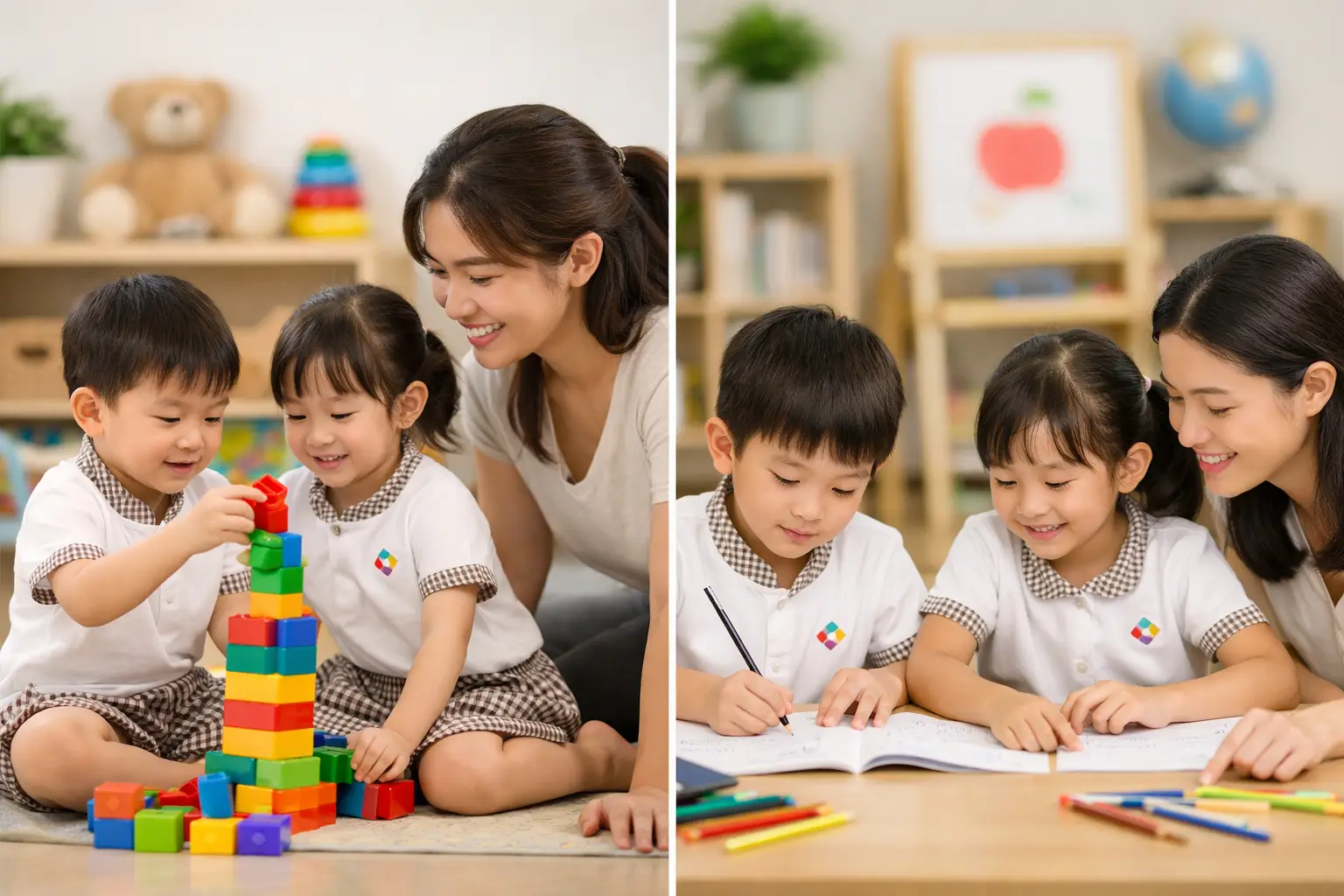
A full-day childcare programme can be the better fit when parents need consistent care while also wanting their child’s day to be rich with developmental opportunities. This is especially valuable if the programme is intentionally designed rather than simply extended. A well-planned full-day environment gives children repeated chances to build language, self-help skills, focus, memory, and social confidence across meals, play, guided learning, rest, and enrichment.
That last point often gets missed. Development does not happen only during table work or formal lessons. It happens when a child learns to express a need clearly, follows a sequence, listens to a story, joins a music activity, experiments with materials, waits for a turn, and solves a small problem with support.
What parents should look for beyond care hours
If you are deciding between childcare and preschool, the first practical question is not simply, “How long is the programme?” It is, “What does my child gain during those hours?”
A strong early years setting should support more than routine supervision. It should help children build across multiple developmental domains – language, cognition, motor development, social-emotional security, creativity, and independence. This is particularly important in the early years, when the brain is highly responsive to repeated, meaningful experiences.
Look closely at how communication is developed. Does the programme create daily opportunities for children to listen, respond, describe, ask questions, and express themselves? For many families, bilingual exposure is also a priority, not just for academic reasons, but because language supports thinking, confidence, and connection.
It is also worth examining how the programme nurtures attention and memory. These are not abstract skills. They affect how a child listens, follows instructions, stays with an activity, and engages in future classroom learning. Purposeful experiences such as music, movement, storytelling, and hands-on discovery can support these foundations in ways that feel natural and joyful to the child.
Childcare versus preschool Singapore for different ages
Age matters in this decision. Infants and very young toddlers usually need a setting where care routines, attachment, sensory experiences, and gentle developmental stimulation are carefully integrated. At this stage, a childcare environment with trained educators and a thoughtful developmental framework is often more practical than a limited-hours preschool model.
For younger children, the quality of interactions is everything. Responsive caregiving, safe routines, and age-appropriate stimulation help build trust, early language, and emotional regulation. Parents should feel confident that care is not separated from development, but part of it.
As children move into the nursery and kindergarten years, families often start thinking more actively about school readiness. This is where some assume preschool is automatically the better option. In reality, a high-quality childcare programme can offer the same – or in some cases, a more complete – foundation when it combines structured learning with enrichment and social development.
A child preparing for primary school benefits from early literacy and numeracy, but also from confidence in speaking, independence in routines, emotional resilience, and the ability to focus in group settings. These are built over time through consistent, well-designed experiences, not only through worksheets or academic drills.
The role of enrichment in a high-quality childcare setting
This is where the best childcare programmes stand apart. If a centre simply fills the day, longer hours do not necessarily mean better outcomes. But if the day is intentionally enriched, childcare can become a powerful developmental environment.
Music is a good example. Many parents see it as an extra, yet structured music education can support memory, listening, rhythm, concentration, creativity, and communication. When children engage in music consistently, they are not only learning notes or songs. They are strengthening attention, auditory processing, and expressive confidence.
Hands-on exploratory learning also matters. STEM-based experiences at an early age do not need to be technical to be valuable. They help children observe, predict, test, describe, and think with curiosity. Combined with active kinaesthetic learning, these experiences support both cognitive growth and practical life skills.
For parents seeking more than basic daycare, this is often the turning point in the decision. The question becomes less about childcare versus preschool as categories, and more about whether the programme offers a purposeful all-in-one environment for whole-child development.
When preschool may be the better choice
There are certainly families for whom a preschool-style arrangement makes sense. If one parent or grandparent is available for the rest of the day, and the child is thriving with a shorter structured session, preschool can be a good fit. Some children also do well with a gradual introduction to group learning before moving into longer days later on.
Preschool can appeal to parents who want a lighter schedule outside class time for home-based care, specialist therapy, or other activities. It can also suit children who are already well supported in routine, language, and social interaction at home.
The trade-off is practical. A shorter programme may offer less consistency in routine and fewer hours for guided social learning, extended projects, or integrated enrichment. For working parents, it may also create logistical strain if the rest of the day has to be patched together through multiple caregivers.
How to choose with confidence
A helpful way to decide is to picture your child’s actual week, not the brochure version. Consider who will care for your child before and after programme hours, how much consistency they need, and what kind of daily environment helps them feel secure and engaged.
Then ask deeper questions. Is the curriculum active and developmentally informed? Are educators attentive and skilled in supporting communication? Does the programme nurture memory, focus, creativity, and self-help skills as part of everyday learning? Are enrichment experiences meaningful, or simply add-ons?
For many families, the strongest option is a childcare setting that delivers the developmental depth of preschool within a full-day structure. That model can be especially reassuring for parents who want care and education to work together rather than compete with each other. At A2E Kids, that belief sits at the heart of a child development approach that combines bilingual learning, music education, exploratory science, movement, and communication growth in one purposeful environment.
The best early years choice is the one that supports your child not only while you are at work, but while they are building the foundations of who they will become. Choose the place where your child is cared for warmly, challenged thoughtfully, and given daily opportunities to grow with confidence.
Leave a Reply