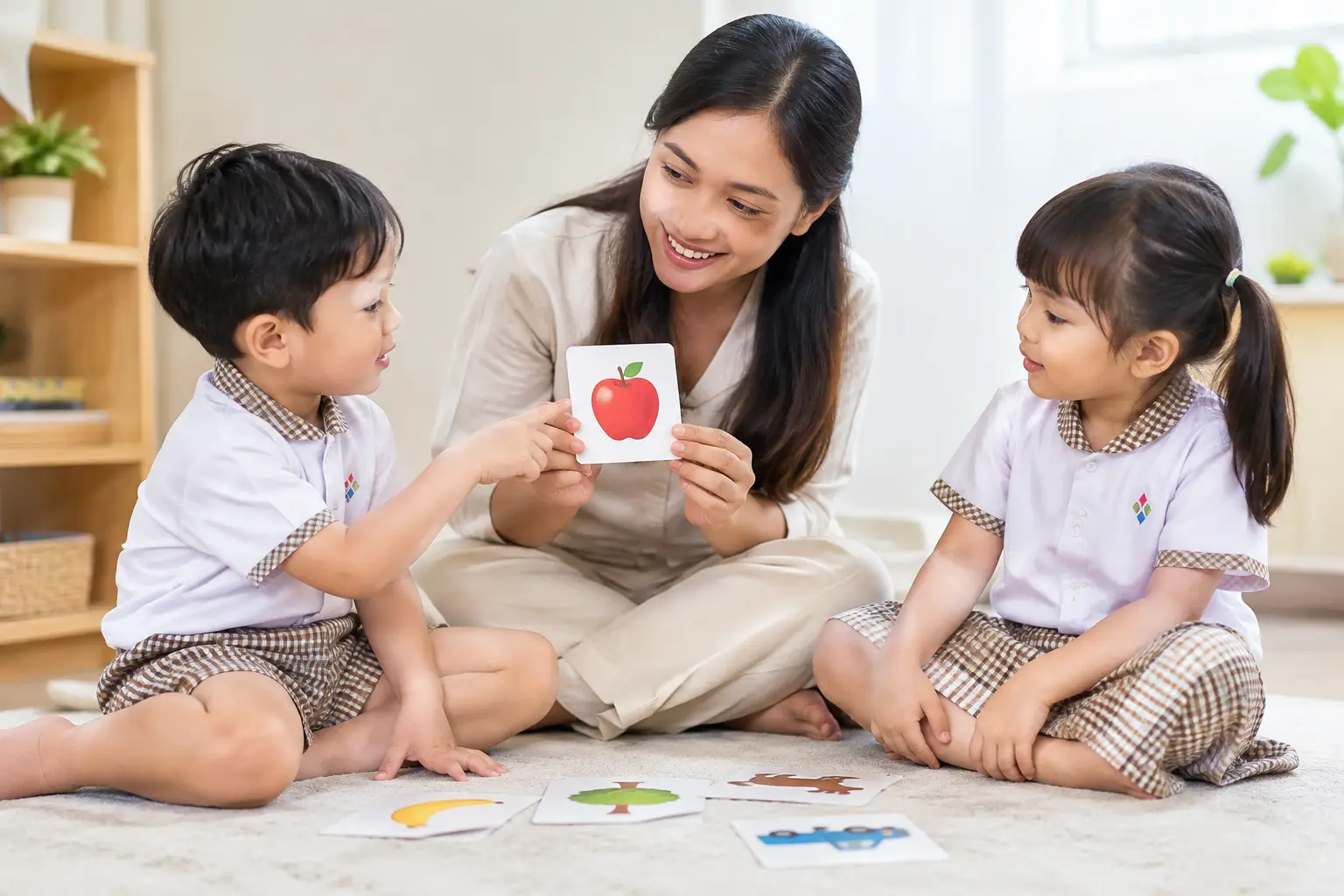
A toddler points at a bus, looks at you expectantly and says, “Big!” That small moment is an invitation. Rather than simply agreeing, you might respond: “Yes, it is a big red bus. It is stopping to pick up passengers.” This gentle expansion is one of the most effective ways to strengthen toddler vocabulary. It gives children richer language without making conversation feel like a lesson.
Vocabulary growth is not about getting a toddler to recite long word lists. It is about helping them connect words with experiences, feelings, actions and people. When children have words to express what they notice and need, they can participate more confidently at home, in school and with others.
Why toddler vocabulary deserves daily attention
Between roughly one and three years old, children are making rapid connections between sounds, meanings and the world around them. They learn best when language is purposeful. A word such as “squishy” makes sense when they are pressing playdough; “careful” becomes meaningful while balancing a cup of water; “frustrated” becomes useful when a tower falls down.
A growing vocabulary supports more than speech. It helps children follow instructions, share ideas, regulate big emotions and build early literacy. Children who can say, “I am disappointed because my turn is over,” are better equipped to seek support than children who only have tears or frustration to communicate the same feeling.
Progress will not look identical for every child. Some toddlers build a large bank of understood words before using many themselves. Others begin speaking in short phrases early on. In bilingual homes, words may be spread across two languages, which is a valuable part of their overall language development, not a reason to limit either language.
How to strengthen toddler vocabulary through conversation
The most valuable language resource is not a flashcard or an app. It is a responsive adult who notices what a child is interested in and talks with them about it.
Follow your child’s attention
If your toddler is captivated by a puddle, speak about the puddle. “The water is shimmering.” “Your boot made a splash.” “The puddle is deep near the drain.” When adults follow a child’s focus, new words are easier to understand and remember because the experience is happening in that very moment.
Try to name objects, but also include describing words and action words. Nouns are a natural starting point – ball, cat, spoon – yet verbs and adjectives give children the building blocks for fuller sentences. Use words such as roll, squeeze, pour, enormous, smooth, sticky and quiet in ordinary situations.
Expand rather than correct
When a toddler says, “Dog run,” avoid turning the moment into a correction. Respond warmly: “Yes, the dog is running very fast!” You have acknowledged their message while modelling the next stage of language.
This approach protects a child’s willingness to communicate. Toddlers need to feel that their ideas matter, even when pronunciation or grammar is still developing. They will hear the correct form repeatedly through natural interaction.
Pause for their response
Adults often fill silence quickly. After asking, “Where do you think the caterpillar is going?”, pause for several seconds. A toddler may need extra time to process the question, choose words and form a reply.
Open-ended prompts can be helpful, but simple choices are equally valuable for younger toddlers: “Would you like the striped cup or the yellow cup?” The key is to wait, listen and respond to what they communicate through words, gestures or facial expressions.
Make daily routines language-rich
Children do not need a separate vocabulary session to learn well. Mealtimes, bath time, getting dressed and travelling can all provide repeated, meaningful exposure to language.
At breakfast, describe food by taste, texture and temperature: crunchy toast, sweet banana, cold milk. While dressing, use positional words such as under, inside, beside and behind. During a walk, notice environmental language: the noisy digger, the narrow path, the traffic light changing from red to green.
Repetition matters, but it should not sound mechanical. Use familiar words in slightly different contexts. A child who hears “full” when filling a cup, packing a bag and completing a puzzle begins to understand the broader meaning of the word.
Everyday routines can also build emotional vocabulary. Name feelings without judgement: “You look disappointed that we are leaving the playground.” “You seem proud of your painting.” A child does not have to repeat the words immediately for them to be useful. Hearing them consistently gives children language they can draw on later.
Read, sing and play with words
Make shared reading interactive
Picture books offer a wonderful opportunity to encounter words that may not arise often in conversation, from “enormous” and “peculiar” to “rescue” and “celebrate”. Yet the aim is not to finish every page. A toddler may want to linger over one illustration, point to a tiny ladybird or ask for the same page again. Follow that interest.
Instead of only reading the printed text, comment on the pictures and invite participation. “The bear looks worried. What do you think happened?” “Can you find something round?” Re-reading favourite books is especially beneficial. Familiar stories allow children to anticipate language, join in with repeated phrases and notice new details each time.
Use music as a memory pathway
Songs, rhymes and rhythmic chants give language a memorable pattern. Repeated sounds support listening skills, while actions attach meaning to words. A song about climbing, tiptoeing or rowing can turn a verb into something children feel in their bodies.
Music also invites children to practise language without pressure. They may sing a word before they are ready to say it in conversation. At A2E Kids, structured music experiences including violin and piano enrichment are part of a whole-child approach that supports attention, memory, creativity and communication. The value is not simply exposure to instruments; it is the purposeful listening, recall, turn-taking and expressive participation that music can encourage.
Let pretend play lead
A toy kitchen, doctor’s kit, building blocks or a few scarves can create rich language opportunities. Pretend play introduces useful vocabulary around roles, sequences and problem-solving: customer, recipe, repair, appointment, bridge, balance and delivery.
Join the play without taking it over. If your child says a block is a cake, accept the idea and extend it: “This chocolate cake needs three candles. Shall we bake it in the oven or serve it at a picnic?” Their imagination sets the direction; your language adds possibilities.
Support bilingual vocabulary with confidence
For many families in Singapore, more than one language is part of daily life. Children benefit from hearing meaningful, high-quality language from people who speak to them warmly and confidently. It is usually more helpful for parents to use the language in which they can express themselves most naturally than to rely on simplified or hesitant speech in another language.
You do not need to translate every sentence. Instead, create natural contexts for each language. One caregiver may consistently use one language, or particular routines, songs and books may happen in a family language. What matters most is regular, responsive interaction.
A bilingual child may know “apple” in English and another food word in Mandarin, Malay, Tamil or a home language. Consider their vocabulary across all the languages they hear. Their knowledge is broader than any single-language word count can show.
Create the conditions for focused listening
Vocabulary develops through interaction, not background noise. Constant television or adult audio can make it harder for toddlers to tune in to speech directed at them. Short, intentional programmes can have a place for some families, especially when an adult watches and talks alongside the child, but they cannot replace real conversation.
Offer small pockets of calm throughout the day. Put devices aside during meals, read together before bedtime and let your child see your face when you speak. Eye contact, gestures, tone and shared attention all help children understand what words mean.
It is also worth resisting the urge to test children too often. Asking “What is this?” repeatedly can turn a joyful interaction into a performance. Comments such as “You found a feather. It feels soft and light,” provide just as much learning with far less pressure.
When to seek additional support
Language development varies, but parents know their child best. Speak with a doctor or qualified speech and language professional if your toddler rarely responds to sounds or their name, has lost words they previously used, seems persistently frustrated by communication, or has very limited attempts to connect through sounds, gestures, eye contact or words.
Seeking guidance is not about labelling a child. It is a proactive step that can clarify what support, if any, would be helpful. Early support works best alongside the everyday warmth, conversation and play that children already enjoy.
Your child does not need perfect pronunciation or lengthy sentences to be a capable communicator. Keep noticing what captures their attention, put thoughtful words around their experiences, and celebrate every new attempt to share a thought. Those ordinary exchanges are where confident language begins.
Leave a Reply