A child who cannot yet read may still remember every word of a familiar song, anticipate its next action and proudly sing the final line. These everyday music memory learning examples show why music has such a meaningful place in early childhood education. Melody, rhythm, repetition and movement give young children memorable cues that can make new ideas feel organised, familiar and enjoyable.
For parents, the goal is not for a child to memorise facts for the sake of it. Purposeful musical experiences can support attention, listening, language and confidence while children are actively engaged. When music is paired with warm adult interaction and hands-on learning, it becomes one helpful pathway for whole-child development.
Why music can support early memory
Young children learn through patterns. A steady beat creates a predictable framework, while a repeated melody helps a child recognise what comes next. When words are placed in a song, the child is not only hearing language but also experiencing its pace, sound and sequence.
This is why many children can recall a song after only a few playful repetitions. The tune acts as an auditory cue, helping them retrieve the words, actions or information attached to it. In educational settings, this approach is often called auditory mnemonics: using sound, rhythm or melody to make learning easier to remember.
Music also invites participation. A child may clap, tap, point, sing, sway or take turns with an instrument. These actions add physical and social cues to the learning experience. Memory is rarely built through sound alone; it is strengthened when children hear, see, do and communicate about what they are learning.
That said, music is not a shortcut that replaces meaningful teaching. A catchy song can help a child remember a sequence, but understanding comes from conversation, real objects, repeated experiences and opportunities to use the idea in context. The most effective approach balances joyful repetition with purposeful exploration.
Music memory learning examples at different ages
The following examples show how musical learning can grow with a child. The activity should always match the child’s developmental stage, interests and readiness.
Remembering daily routines through song
For infants and young toddlers, a short, calm song can signal a familiar part of the day: washing hands, tidying up, greeting friends or preparing for rest. The words do not need to be elaborate. A simple repeated phrase such as “wash, wash, clean hands” gives the child a predictable cue and links language to a real action.
Over time, children begin to anticipate the routine when they hear the melody. This supports their sense of security as well as recall. They learn that certain sounds, words and actions belong together, which can make transitions feel less abrupt in a busy early learning environment.
Learning new vocabulary with rhythm and objects
Music can bring new words to life when children can see and handle what they are singing about. A teacher might introduce fruits, animals, colours or vehicles through a rhythmic chant, then invite children to find the matching objects or pictures. The song provides repetition, while the objects give the vocabulary meaning.
For bilingual learners, this can be especially useful when used thoughtfully. A child may hear a key word in one language, repeat it in a song, then connect it to a familiar item or action. The focus should remain on clear pronunciation, rich conversation and positive exposure rather than expecting children to perform perfectly.
Recalling sequences with action songs
Songs with ordered actions are valuable music memory learning examples because they encourage children to listen closely and recall what happens first, next and last. A familiar action song might ask children to clap, turn, crouch and reach up in a particular sequence. As confidence grows, an adult can pause before the next instruction and allow the children to supply it.
This playful pause matters. It gives children time to retrieve information rather than simply copy others. They practise working memory, body awareness and self-control as they wait, remember and respond. For some children, energetic movement makes learning more accessible; for others, a slower version with clear gestures will be more comfortable.
Building number sense with beats
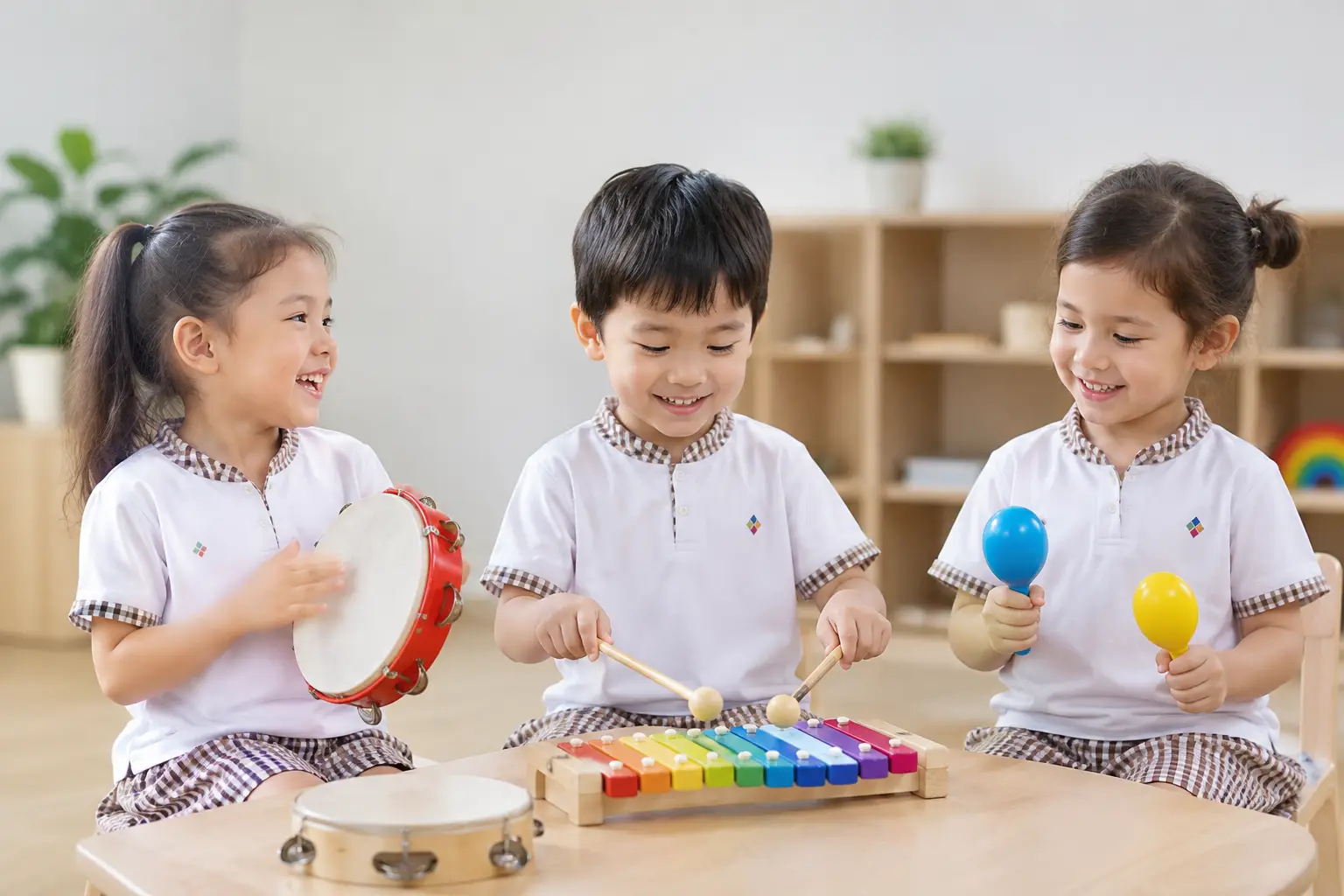
Counting to a beat helps children hear that numbers follow an order. A child can tap a drum four times, count each tap aloud, then stop and listen. Later, they might copy a simple rhythm or decide how many beats to play for a friend.
The learning becomes deeper when numbers are connected to quantity. For example, children can place three counters beside a drum and play three beats, or sing a counting rhyme while moving one object at a time. The beat keeps attention focused, but the physical materials help children understand that each number represents an amount.
Remembering letter sounds and language patterns
Music can support early phonological awareness by drawing attention to rhyme, alliteration and repeated sounds. Children may enjoy hearing several words that begin with the same sound, clapping when they hear a rhyme or completing a repeated line in a song. These experiences help them notice the sound patterns within spoken language.
It is best to keep this light and playful. Not every child will be ready to identify letter sounds at the same age, and singing alphabet songs alone does not guarantee reading readiness. What matters is that children hear language often, enjoy communicating and gradually become aware that words are made of sounds.
Developing listening and recall through instruments
A simple instrument game can make careful listening feel exciting. An adult plays two sounds, perhaps a shake followed by a tap, and invites children to copy the pattern. Once that feels secure, the pattern can become three sounds or include a pause.
This activity supports auditory discrimination, turn-taking and concentration. Children must hold the sequence in mind long enough to reproduce it, while also watching for social cues and managing their movement. Some will enjoy leading the pattern for others to copy, which adds communication and leadership practice.
From repetition to real understanding
Parents sometimes worry that repetition is too repetitive, especially when a child requests the same song many times. Yet repetition is one way young children make sense of the world. Each return to a song may reveal a new word, a clearer action or a stronger sense of confidence.
The key is to extend the experience when the child is ready. After singing about shapes, look for shapes in the room. After a tidy-up song, ask where one particular toy belongs. After a rhythm pattern, encourage the child to invent one. These small follow-up moments help move learning from recall to understanding and independent use.
Adults can also vary one element at a time. Sing faster and then slower, use a quiet voice and then a loud one, or change the final action. Variation keeps children attentive and helps them recognise the underlying pattern rather than relying only on a fixed routine.
What purposeful music education looks like
A purposeful programme does more than play background music or teach children a performance piece. It gives children regular chances to listen, sing, move, create and respond. It also links music to wider developmental goals, including communication, emotional expression, physical coordination and social interaction.
At A2E Kids, structured music education, including free violin and piano enrichment, is designed as part of a broader developmental experience. Children can encounter music as listeners and creators, not only as performers. This matters because early confidence often grows when a child feels safe to try a sound, repeat a rhythm and share an idea with others.
Instrument learning should remain age-appropriate. Very young children benefit from exploring sound, keeping a pulse and learning how to handle instruments with care. As they mature, they can develop greater control, pattern awareness and sustained attention. Progress will look different for every child, and a nurturing environment makes room for those differences.
Simple ways to continue at home
Home musical moments do not need special equipment or long lessons. Sing the same short song during a regular routine, such as putting on shoes or clearing the table. Leave a pause for your child to finish a familiar word. Clap their name in a rhythm and invite them to clap yours back.
Keep the atmosphere encouraging rather than corrective. If a child changes the words, loses the beat or prefers to listen before joining in, they are still participating. The aim is to build a positive relationship with sound, language and learning, not to create a perfect performance.
When music is used with care, it gives children something powerful: a joyful way to hold onto new ideas and make them their own. A familiar melody can become a small bridge between curiosity, concentration and the confidence to try again tomorrow.
Leave a Reply