A childcare speech programme review should look beyond whether children sing songs, repeat vocabulary or take part in show-and-tell. These can be valuable experiences, but meaningful communication development is built into the rhythm of a child’s whole day: how educators listen, how they extend a child’s ideas, how peers learn to take turns, and how confidently a child feels able to speak.
For families choosing a premium early childhood programme, speech and language support deserves close attention. It influences relationships, emotional expression, early literacy and a child’s readiness to participate in learning. The right setting does not rush children to perform. It gives them repeated, joyful reasons to communicate.
What a childcare speech programme should support
Parents often use the word “speech” to describe many different parts of communication. In practice, speech refers to how sounds are produced, while language covers understanding words, building sentences and sharing meaning. Communication also includes listening, gesture, eye contact, social interaction and the confidence to contribute.
A strong childcare programme supports these areas through age-appropriate, everyday experiences. Infants need warm face-to-face exchanges, responsive naming and time to coo, point and imitate. Toddlers benefit from simple choices, predictable routines and adults who add words to what they are already trying to say. Preschoolers need richer conversations: explaining their thinking, retelling events, asking questions and negotiating with friends.
The goal is not to make every child speak in the same way or at the same pace. Children develop differently, particularly when they are growing up with more than one language. The goal is to create a secure environment where each child is understood, encouraged and gently challenged.
A childcare speech programme review: what to look for
When reviewing a centre’s approach, start with what happens outside a scheduled language lesson. A well-designed programme makes communication visible throughout play, meals, music, outdoor activities and transitions. Educators should be speaking with children, not simply directing them.
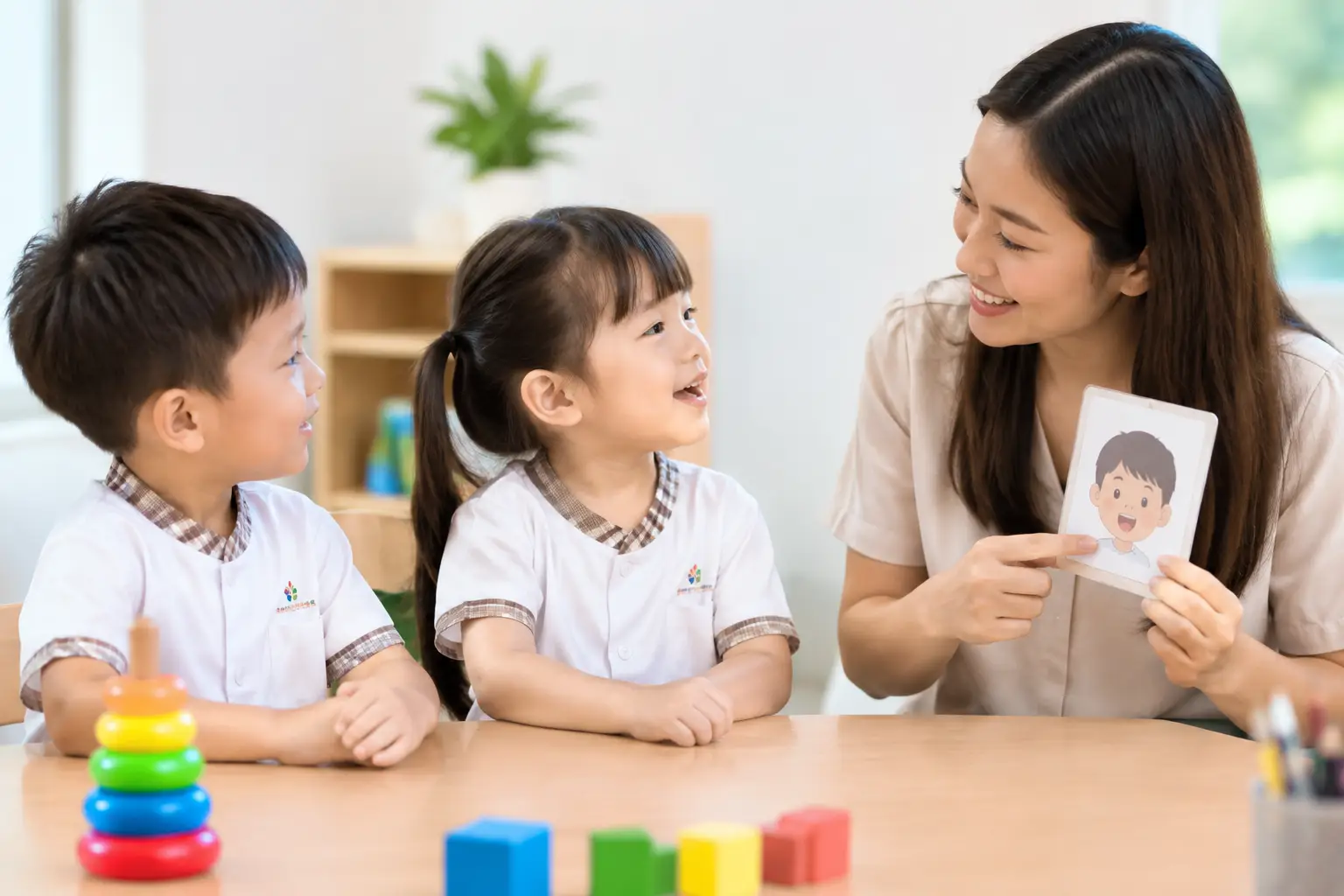
Notice whether adults pause after asking a question. A child may need a few extra seconds to process language and form a response. Watch for educators who acknowledge a child’s attempt, then naturally extend it. If a toddler says, “Dog run,” an adult might respond, “Yes, the brown dog is running very fast.” This models fuller language without turning conversation into a correction exercise.
Quality also shows in the learning environment. Books should be accessible and read with expression, props should invite imaginative play, and displays should give children something familiar to talk about. Small-group activities can be particularly helpful, as they allow quieter children more room to participate than a large class discussion.
A good review should also consider how progress is observed. Families deserve more than a general assurance that their child is “doing well”. Educators should be able to share meaningful observations about comprehension, vocabulary, interaction, confidence and emerging speech sounds, while recognising that development is not a race.
The role of bilingual learning
For many Singapore families, bilingual development is a central consideration. Exposure to two languages does not cause speech or language delay. Children may distribute their vocabulary across both languages, use words from each language in one sentence or show stronger confidence in one language at a particular stage. These are often normal features of multilingual development.
What matters is consistent, high-quality exposure delivered with warmth and purpose. Children benefit when educators use songs, stories, routines and real conversation in each language, rather than relying on worksheets or isolated word memorisation. The languages should feel useful and connected to relationships.
Parents should ask how the programme supports children who are more comfortable in one language, and how educators communicate observations without making unfair comparisons. A thoughtful centre celebrates bilingual identity while helping children understand and express themselves clearly in both learning contexts.
Music can strengthen communication foundations
Music is not a replacement for specialist speech and language therapy, nor should it be presented as one. Yet purposeful music education can support several foundations that matter for communication. Rhythm encourages listening and turn-taking. Songs build vocabulary and memory. Repeated melodic patterns can help children anticipate language, while group music-making invites shared attention and social connection.
This is especially meaningful when children are actively involved: listening for changes in sound, following simple instructions, remembering patterns and expressing ideas through movement. Such experiences can strengthen focus and auditory awareness in ways that complement language-rich conversation.
At A2E Kids, a structured Music Education Programme with violin and piano enrichment sits alongside bilingual learning, exploratory science and active kinaesthetic experiences. For parents, the value of this integrated approach is that communication is not treated as a stand-alone target. It is practised through listening, movement, creativity, relationships and daily discovery.
Questions that reveal programme quality
A centre brochure may promise confidence and communication skills. A visit gives parents the chance to understand how those promises are delivered. Ask how educators encourage a child who communicates mainly through gesture, how they support a child who rarely speaks in groups, and how they extend the language of a child who is already highly verbal.
It is also useful to ask how often children participate in small-group discussion, storytelling, dramatic play and shared reading. Find out whether educators record observations and how they partner with families. Clear, respectful communication between home and school helps adults use consistent language and understand a child’s strengths.
Finally, ask what happens when concerns arise. A responsible programme will not diagnose a child or make alarming claims. It should explain how educators observe patterns, speak sensitively with parents and recommend an appropriate external professional assessment when needed. This is a sign of care and professional judgement, not a weakness in the programme.
What a programme cannot promise
Be cautious of any childcare speech programme that promises rapid results, flawless pronunciation or a fixed vocabulary milestone for every child. Communication development is influenced by temperament, hearing, health, family language patterns, learning opportunities and developmental profile. A nurturing programme can make a real difference, but it cannot guarantee identical outcomes.
There is also a trade-off between highly structured instruction and the spontaneous talk children need. Flashcards and rehearsed presentations may produce visible short-term performance, but children also need unhurried play, messy experiments, pretend scenarios and genuine conversation. These are the moments when they learn to explain, disagree kindly, solve problems and find their own voice.
For children with persistent difficulty understanding language, limited social communication, unclear speech that causes frustration, loss of previously used skills or concerns about hearing, early professional advice is worthwhile. Childcare educators can be valuable partners in noticing patterns, but they should work alongside families and qualified specialists where appropriate.
Choosing a setting where children are heard
The most reassuring childcare speech programme is one where communication is woven into care itself. Children are greeted by name, given time to respond, invited to make choices and encouraged to share their ideas. Their attempts are met with interest rather than pressure.
Look for a programme that balances intentional teaching with play, bilingual exposure with emotional security, and developmental ambition with respect for individual pace. When children feel safe enough to ask, imagine, negotiate and tell their stories, they are building far more than speech skills. They are learning that their thoughts matter – a powerful foundation for confident learning and meaningful connection.
Leave a Reply