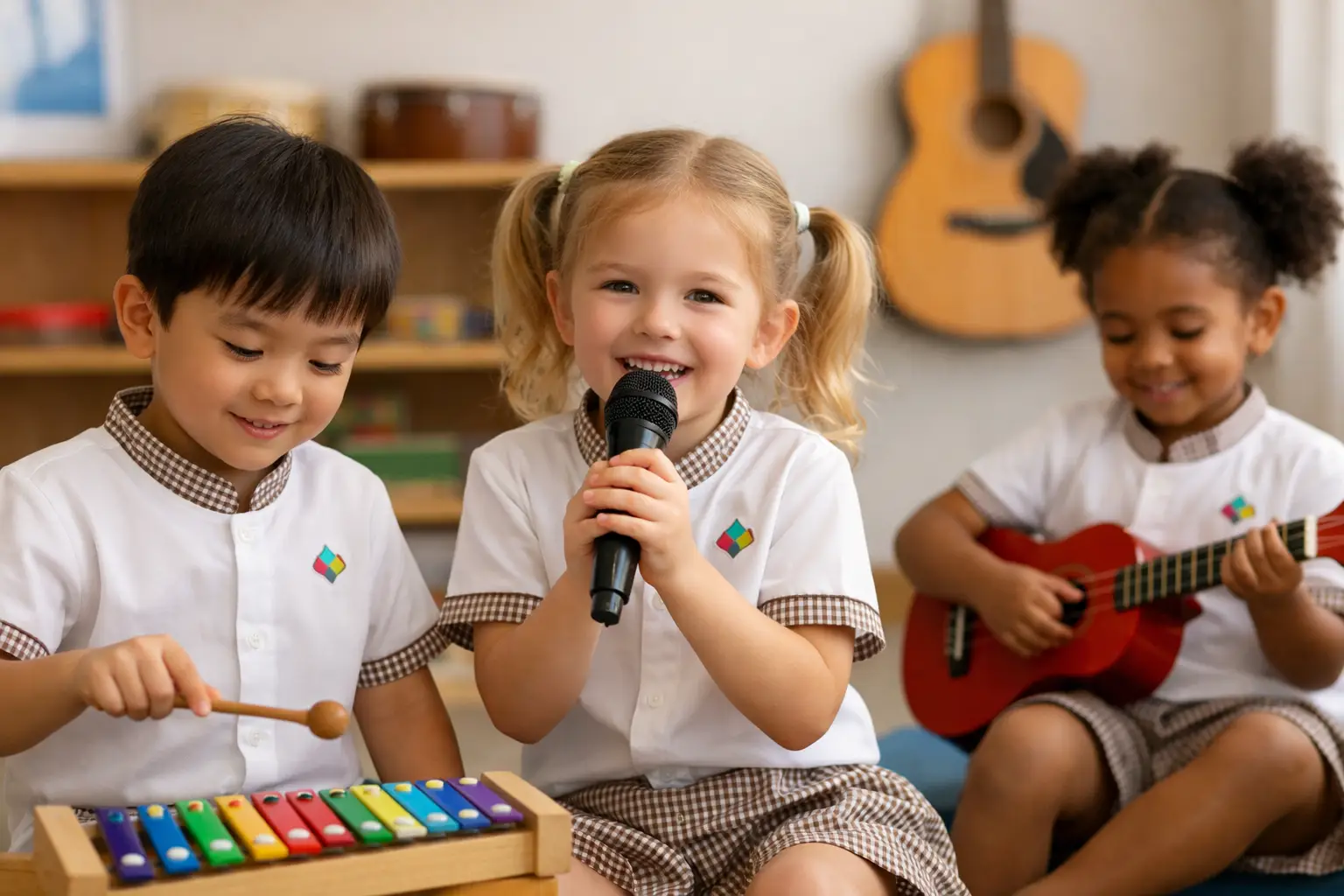
A child tapping a steady beat, remembering the next line of a song or waiting for their turn to play an instrument is doing far more than making music. In a preschool with music curriculum, these moments can build habits that support learning across the day: listening carefully, following patterns, expressing ideas and participating confidently with others. For parents seeking more than custodial care, music can be a purposeful part of a child’s early developmental foundation.
Music is not a shortcut to academic success, nor should every child be expected to perform. Its value lies in regular, age-appropriate experiences that make learning active, joyful and meaningful. When delivered with clear educational intent, it can support a young child’s cognitive, language, physical and social-emotional growth alongside play, bilingual learning and everyday routines.
What a Preschool With Music Curriculum Should Include
A music curriculum is different from an occasional sing-along or a performance prepared for a year-end concert. Those experiences can be enjoyable, but a structured programme has clear learning aims, progression and consistency. Children should encounter music regularly through singing, movement, listening, rhythm activities and opportunities to explore instruments.
For infants and toddlers, this may mean responding to familiar voices, clapping simple rhythms, moving to tempo and exploring sound safely. As children grow, they can learn to distinguish fast and slow, loud and soft, high and low. They may begin to reproduce rhythm patterns, sing with greater control, recognise musical cues and take part in group activities that require attention and cooperation.
The strongest programmes connect music to the wider curriculum rather than treating it as an isolated enrichment class. A song may reinforce new vocabulary in English or Mandarin. A rhythmic pattern can support early number awareness. Movement activities can develop balance, coordination and body awareness. Storytelling through music can invite children to describe feelings and use language with imagination.
Why Music Supports Whole-Child Development
Young children learn through repetition, sensory experience and relationships. Music brings these elements together naturally. A familiar melody gives children a dependable structure, while changing words, rhythms or actions add a manageable challenge. This balance is especially helpful during the preschool years, when attention is still developing and learning needs to feel engaging rather than pressured.
Attention, memory and pattern recognition
A child who listens for a cue before shaking a tambourine practises self-control. A child who recalls the sequence of a song exercises working memory. A child who notices that a rhythm repeats begins to understand patterns. These are small actions, yet they are closely connected to the learning behaviours children will use in school and daily life.
Auditory mnemonics can make this particularly practical. By pairing information with melody, rhythm and repetition, educators can help children remember routines, vocabulary, sounds and concepts in a way that feels natural. The aim is not rote learning for its own sake. It is to give children memorable pathways for understanding and retrieving what they have learnt.
Communication, confidence and creativity
Music also creates low-pressure opportunities for communication. A child who is quiet in conversation may join a repeated chorus, copy an action or answer a musical call-and-response. Over time, these small contributions can strengthen willingness to speak, listen and participate in a group.
In a bilingual environment, songs and rhythmic language games can expose children to pronunciation, intonation and new vocabulary in both languages. The benefits depend on thoughtful teaching. Children need educators who explain meaning, encourage conversation and revisit words in different contexts, rather than simply asking them to memorise lyrics.
Creative development matters too. When children choose a sound for a character in a story, invent movements for a song or experiment with an instrument, they learn that their ideas have value. There is room for structure and freedom: children can learn a shared rhythm, then be invited to create their own variation.
Social-emotional and physical growth
Group music-making asks children to share space, observe others and contribute to a common activity. They experience the satisfaction of creating something together, while also learning that they may need to pause, wait or adjust to the group. These are valuable early lessons in empathy and cooperation.
Action songs, dance and instrument play also encourage physical development. Marching to a beat, crossing the midline during movement games, using fingers to press keys or holding a bow all call on coordination in different ways. The activities should always be matched to a child’s age, safety needs and readiness.
From Exposure to Meaningful Music Learning
There is a trade-off between offering many activities and allowing enough time to develop skills. A timetable packed with one-off experiences may look impressive, but children benefit most when they revisit concepts and can see their own progress. Consistent exposure helps a child move from copying a rhythm to recognising it, and from handling an instrument to using it with greater care and purpose.
Instrument instruction can be a meaningful part of this progression when it is introduced playfully and with realistic expectations. Piano activities can support finger control, listening and the relationship between sound and pitch. Violin experiences can develop posture, coordination and patience. For preschoolers, the priority should be curiosity, musical enjoyment and foundational habits, not perfection or examination-level achievement.
At A2E Kids, free violin and piano enrichment forms part of a structured Music Education Programme that uses auditory mnemonics to support memory, focus, attention span, creativity and communication. This approach recognises that music learning is most valuable when it contributes to the child’s broader development, rather than becoming another achievement parents must measure.
Educator quality is central. Teachers need to know how to adapt an activity for a toddler who is still learning to sit with a group, a child who is sensitive to noise or a confident preschooler ready for a more complex role. A nurturing educator notices effort, offers encouragement and gives children different ways to take part. Listening, watching, moving and playing are all valid entry points into music.
Choosing a Preschool With Music Curriculum
When visiting a preschool, it helps to look beyond whether instruments are displayed in the classroom. Ask how music is planned, how often children participate and what developmental goals the educators have in mind. A high-quality programme should be enjoyable, but it should also be intentional.
Consider these questions when comparing options:
- Is music part of the regular weekly learning experience, rather than limited to special events?
- Do activities include singing, listening, movement, rhythm and instrument exploration?
- How does the programme support communication, memory, attention and social interaction?
- Are instruments introduced safely and in ways that suit each age group?
- Can educators explain how music connects with language, physical development and classroom learning?
Parents should also consider their child’s temperament. A highly active child may respond well to movement and percussion, while a child who prefers to observe may first engage through listening or watching peers. Neither response is a problem. The right environment gives every child time and encouragement to participate at their own pace, while gently extending their confidence.
It is worth asking how the centre communicates progress. Preschool development is rarely best captured by a single score or a recital alone. Meaningful feedback may describe how a child is sustaining attention for longer, remembering a sequence, volunteering an idea, using new words or becoming more comfortable in a group. These observations give parents a fuller picture of growth.
A Foundation Children Can Hear and Feel
Music belongs in early childhood because it gives children a way to learn with their whole selves. They listen, move, remember, communicate, create and connect. When these experiences are guided by skilled educators within a caring, structured preschool environment, music can help children build capabilities that reach well beyond the classroom.
For families, the most helpful question is not whether a child will become a musician. It is whether the programme uses music thoughtfully to help that child become more attentive, expressive, confident and ready to learn. A well-chosen experience can give them a positive relationship with learning that continues long after the final note of the day.
Leave a Reply