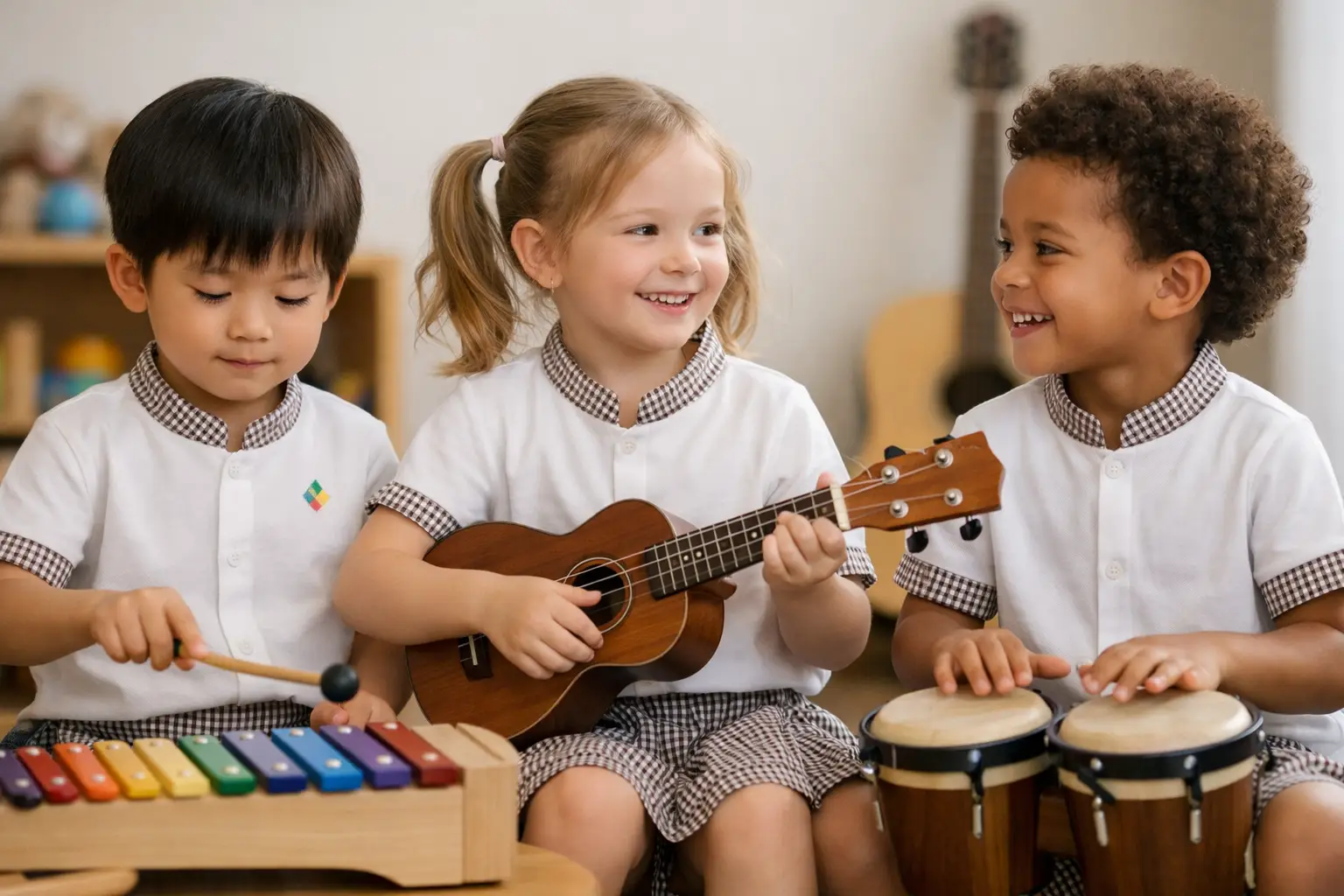
A toddler taps a steady beat, pauses, then anticipates the next sound before it arrives. What looks like a small musical moment is also meaningful brain work. Cognitive development through music gives young children repeated opportunities to listen closely, remember patterns, control their actions and express ideas – all through an experience that feels joyful and natural.
For parents, the value of music is not limited to a future performance or a pleasant after-school activity. When it is taught purposefully and consistently in the early years, music can support the foundations children use for communication, learning, relationships and everyday independence. Your Child’s Well-being and Development is our Top Priority, so the goal is never to create pressure. It is to create an encouraging environment where growth can happen one note, movement and conversation at a time.
Why cognitive development through music matters
Early childhood is a period of rapid neural development. Young children learn by noticing, repeating, moving, trying and receiving warm guidance. Music naturally brings these processes together. A familiar song asks a child to hold words and melody in mind. A rhythm game asks them to wait, respond and adjust. Playing a simple instrument asks their eyes, ears, hands and attention to work as a team.
These experiences can nurture several connected cognitive skills. Memory is used when a child recalls a lyric, sequence or musical cue. Attention is practised when they listen for a change in tempo or wait for their turn. Pattern recognition develops as they hear repeated beats and phrases. Planning and self-control grow when they begin, stop, play softly or follow a short series of instructions.
The benefit is strongest when music is active rather than passive. Background music may create a pleasant atmosphere, but it does not ask much of a child. Singing, clapping, moving, naming sounds and playing an instrument invite participation. That active involvement is where children practise thinking skills in a memorable setting.
Music supports more than one area of learning
Cognitive growth does not develop in isolation. A child’s ability to focus is linked to emotional security. Their willingness to communicate is shaped by confidence. Their capacity to follow instructions is strengthened when their body is ready to participate. Music is especially valuable because it can support these domains together.
Memory and auditory processing
Children first make sense of much of the world through sound. They learn to recognise voices, notice changes in tone and connect words with meaning. Musical activities sharpen this listening habit by giving sounds a clear structure. A repeated melody, rhythm or phrase becomes easier to recognise and recall over time.
Auditory mnemonics are one purposeful approach. They use rhythm, melody and repetition to help children remember information. For example, a short musical cue may help a child remember the steps for tidying up, washing hands or preparing for a transition. The music provides a dependable prompt, while the repeated routine gives the cue meaning.
This is not a shortcut that replaces understanding. A child still needs patient explanation, modelling and practice. Yet a well-chosen song or rhythm can make information more accessible, especially for young learners who respond strongly to sound and movement.
Focus, attention span and self-regulation
Many parents hope to help their child sustain attention without making learning feel overly formal. Music offers a gentle route. Following a beat, copying a rhythm or listening for a signal requires children to be present. They learn that there is a time to play, a time to pause and a time to listen.
A group music session also introduces shared attention. Children watch an educator, notice their peers and contribute to a common activity. This can be particularly helpful for learning classroom routines, but expectations should remain age-appropriate. Infants may engage for only a few moments, while preschoolers can gradually manage longer musical sequences and more detailed instructions.
Language and communication
Songs expose children to new vocabulary, rhyme, sentence rhythm and expressive speech. Repeating a lyric can encourage a hesitant child to join in because the words are supported by a familiar melody. Action songs add another layer: children hear a word, connect it with a movement and experience its meaning with their whole body.
For bilingual learners, music can make both languages feel welcoming and usable. The focus should be on clear pronunciation, meaningful context and regular repetition, rather than asking children to memorise words without understanding them. Singing together also builds the confidence to speak in front of others, take turns and share ideas.
Creativity and flexible thinking
Music education is not only about getting every note right. When children experiment with sound, choose how to move or create a rhythm of their own, they practise making decisions. They learn that there can be more than one way to respond creatively within a safe structure.
This balance matters. Too little guidance can leave young children unsure what to do, while too much correction can make them afraid to try. Thoughtful educators provide a clear starting point, then make room for individual expression. A child may copy a pattern first and later invent a variation. That is a meaningful step from imitation towards independent thinking.
Why instruments add depth to early music learning
Singing and movement are powerful, but instruments bring an additional sensory and motor dimension. When children play the piano or violin, even at a beginner level, they learn to coordinate listening with controlled movement. They notice that the way they touch, press or draw the bow affects the sound they create.
Piano activities can help children explore pitch, sequence and left-right coordination. Violin learning invites careful posture, listening and gradual control of fine motor movements. Neither instrument should be introduced as a test of talent. In the early years, the purpose is exploration, enjoyment and steady skill-building.
Instrumental learning also teaches children to persist with small challenges. A sound may not work on the first try. With encouragement, they adjust their hand position, slow down and try again. This experience of effort, feedback and progress supports a growth-minded attitude that is valuable far beyond music.
At A2E Kids, free Violin and Piano Enrichment forms part of a structured Music Education Programme designed to support whole-child development. Children are given opportunities to engage with music as learners, listeners, movers and confident communicators, rather than simply watching from the side-lines.
What purposeful music education looks like
A meaningful early childhood music programme is more than a collection of songs. It has a clear developmental intention while remaining warm, playful and responsive to each child. Educators observe how children engage, then adapt the pace and level of challenge. A child who is ready may lead a rhythm pattern; another may begin by holding an instrument, listening and joining with a simple action.
A well-rounded approach connects music with daily learning. Counting beats can support early numeracy. Musical stories can strengthen language. Movement to tempo can develop body awareness and kinaesthetic learning. Group performances, even informal ones, can nurture confidence and social connection.
Consistency is equally important. A single music class can be enjoyable, but repeated experiences allow children to recognise patterns, build familiarity and develop confidence. Short, regular sessions often suit young children better than occasional sessions that demand long periods of concentration.
How parents can extend musical learning at home
Home does not need to become a formal lesson space. The most useful musical moments are often woven into ordinary routines. Sing the same short song while getting dressed, clap a simple rhythm for your child to copy, or invite them to make a quiet-loud sound comparison using safe household objects.
Keep the experience shared. Rather than asking, “Can you do it correctly?”, try, “I noticed you waited for the beat,” or, “What sound do you think comes next?” These responses help children feel seen while directing their attention towards listening, memory and effort.
It also helps to follow your child’s cues. Some children love repeating one favourite song for weeks; repetition is often how they learn. Others prefer movement, instruments or imaginative musical play. There is no need to rush towards formal instruction if a child is not ready. Enjoyment and emotional safety create the conditions for sustained learning.
The most valuable musical experience is one where a child feels capable, connected and curious. When music is part of a purposeful early learning environment, each song can become a small invitation to listen more closely, think more deeply and grow with confidence.
Leave a Reply