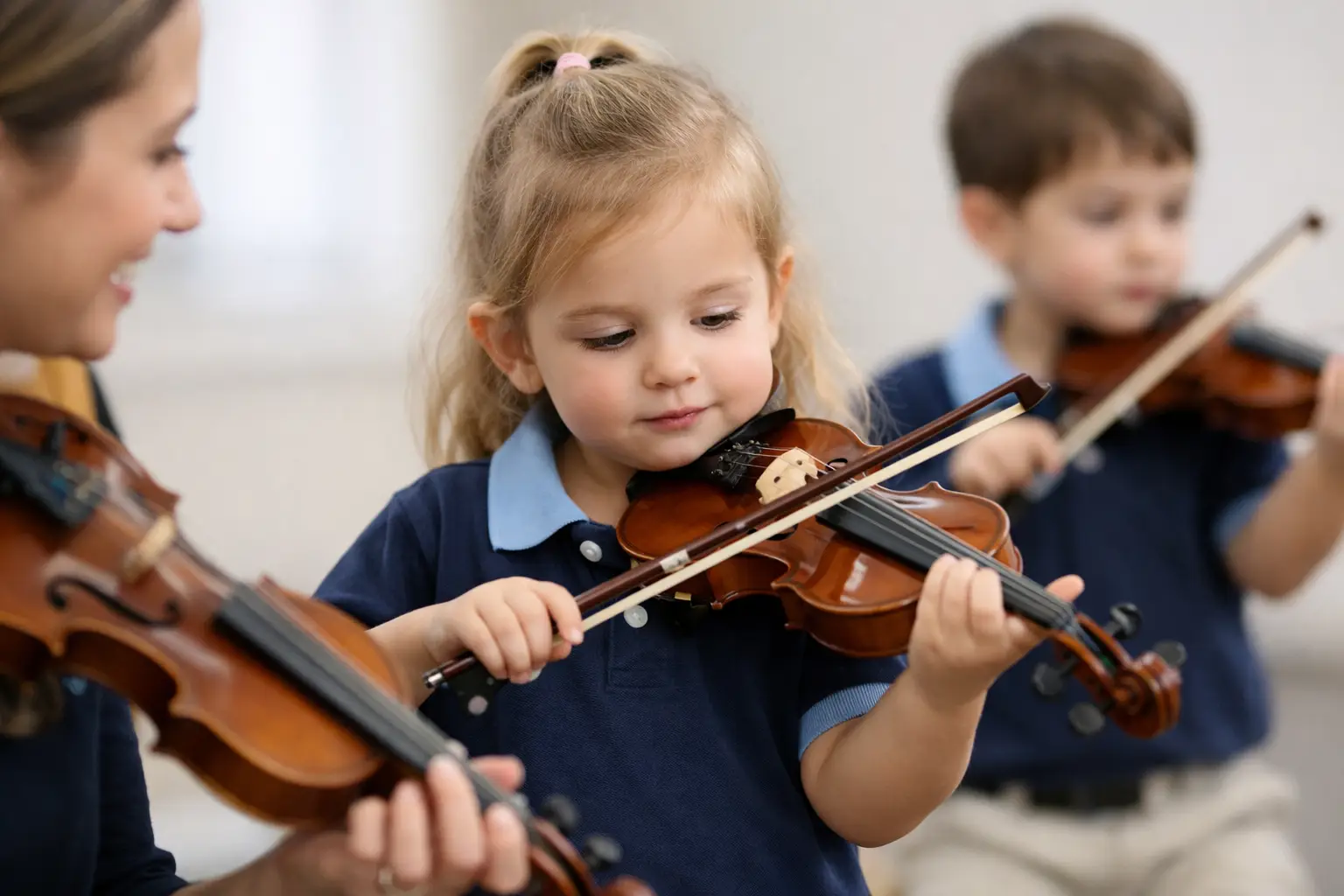
A three-year-old rarely sits still for long, and that is exactly why early music teaching has to be handled with care. Violin lessons for preschoolers are not about producing polished performances or pushing formal technique too soon. At this age, the value lies in what the learning process builds – listening, coordination, memory, concentration, confidence and joyful participation.
For many parents, the question is not whether music is beneficial. It is whether the violin is too complex for a young child. The honest answer is that it depends on how the lessons are taught. When violin learning is developmentally appropriate, warm and playful, it can become a meaningful part of whole-child growth. When it is too rigid or too performance-led, it can quickly feel frustrating for both child and parent.
Why violin lessons for preschoolers can be so valuable
The violin asks a child to do something quite remarkable. They must listen carefully, notice pitch, coordinate small and large movements, respond to rhythm and stay mentally engaged. For a preschooler, these are not just musical tasks. They are building blocks for broader development.
A thoughtful violin programme can support attention span because children are learning to pause, watch, copy and repeat. It can strengthen auditory discrimination because they begin to hear differences in sound, tone and pattern. It can also encourage body awareness, as children learn how to hold an instrument, move the bow and respond to physical cues. These are early foundations that support learning well beyond music.
There is also an emotional benefit. Young children often glow when they can participate in something that feels special and grown-up, especially when expectations are realistic and success is measured in small steps. Holding the instrument correctly, remembering a rhythm or following a musical instruction can all become moments of genuine achievement.
That said, the violin is not valuable simply because it is challenging. Its value comes from being taught in a way that respects the developmental stage of the child.
What preschool violin lessons should actually look like
Parents sometimes imagine violin instruction as a child standing still, bow poised, repeating scales. For preschoolers, that picture is usually the wrong one. Effective early lessons are active, varied and sensory-rich.
A suitable session might include movement, singing, clapping patterns, listening games and short turns with the instrument. There should be a strong element of imitation, because young children learn best by watching and doing rather than through lengthy verbal explanation. Teachers may use stories, simple imagery and repeated routines to help children remember posture, rhythm and musical ideas.
This matters because preschool children are still developing impulse control, working memory and physical coordination. They need lessons that fit the way they naturally learn. A child who wiggles, pauses, watches others or loses focus briefly is not failing. They are behaving like a preschooler.
The best programmes understand that musical growth at this age is gradual. Rather than expecting long periods of concentration, they build learning through short, consistent experiences. Over time, these repeated encounters can strengthen focus and confidence in a very natural way.
The role of play in early violin learning
Play is not a distraction from learning. For young children, it is often the route into learning. A playful violin lesson can still be purposeful and carefully planned. When a teacher turns rhythm into a clapping game or posture into a pretend balancing activity, the child is not doing less serious work. They are accessing the lesson in a way their brain and body can manage.
This approach also helps reduce pressure. Preschoolers respond best when they feel safe, curious and encouraged. If every lesson becomes a correction-heavy exercise, interest can disappear quickly. A playful structure keeps children open to repetition, and repetition is where real progress begins.
Signs your child may be ready
There is no perfect age at which every child should begin. Some children are ready earlier, while others benefit from waiting. Readiness is less about age alone and more about temperament, interest and the quality of the teaching environment.
A preschooler may be ready if they enjoy music, respond to rhythm, like copying actions and can engage with a short guided activity. They do not need to sit still for half an hour or follow complex instructions. They simply need enough curiosity and comfort to participate with support.
It is also worth considering whether your child enjoys group experiences or one-to-one attention. Some children thrive when they learn alongside others. Others feel more secure with gentler individual guidance. Neither is better in every case.
Parents should also allow room for uneven starts. A child may love the violin one week and resist it the next. That fluctuation is normal in early childhood. Progress is rarely linear at this age.
What parents should avoid expecting too soon
One of the biggest mistakes in early music education is measuring success by outward performance alone. A preschooler who is not yet playing recognisable tunes may still be making excellent developmental progress.
At this stage, success often looks quieter. It may be improved listening, stronger turn-taking, better imitation, more patience with routine or greater confidence in trying something unfamiliar. These gains matter. They are part of the reason early enrichment can have such lasting value.
It is also helpful not to compare children too closely. One child may quickly remember rhythms, while another takes longer but shows strong sensitivity to sound. One may love the instrument immediately, while another needs time to warm up. Early learning should never become a race.
The importance of gentle consistency
Young children benefit from rhythm and routine. A short, regular musical experience is usually more effective than occasional long sessions. This is true in class and at home. Even a few minutes of listening, singing or practising a familiar movement can reinforce learning.
The key word is gentle. Preschoolers do not need drilling. They need consistency without pressure. If the learning atmosphere remains calm and encouraging, children are far more likely to stay engaged over time.
How music supports whole-child development
For families choosing an early childhood programme, the bigger question is often how music fits into overall development. This is where violin instruction becomes especially meaningful when it sits within a broader educational approach rather than as an isolated extra.
Music can strengthen listening and memory because children are asked to retain patterns, recognise cues and respond in sequence. It can support communication because songs, rhythm work and musical interaction all rely on expression and response. It can support physical development through posture, balance and coordinated movement. It can also nurture creativity, which is not a luxury in early education but an essential part of flexible thinking and confident self-expression.
When these experiences are paired with language development, movement-based learning and a nurturing daily routine, children benefit in multiple domains at once. That is why well-designed early music instruction can feel so different from a simple after-school activity. It becomes part of a child’s developmental environment.
At A2E Kids, this integrated view is central to the learning experience. Music enrichment is not treated as a decorative add-on. It sits alongside communication development, active kinaesthetic learning and broader whole-child support, allowing each area to reinforce the others.
Choosing the right programme for preschool violin lessons
Not every programme offering violin will be right for a young child. Parents should look closely at the teaching philosophy, not just the instrument on offer. A strong early years programme understands child development as well as music.
Ask whether lessons are adapted for preschoolers. Ask how teachers manage attention spans, whether movement and play are included, and how progress is measured. A good answer will focus on growth, confidence and engagement rather than only recitals or technical milestones.
It is also sensible to notice the emotional tone of the environment. Young children learn best where they feel secure. A warm, responsive teacher can make an enormous difference, especially with an instrument as physically and mentally demanding as the violin.
For some children, the violin will become a lasting passion. For others, it may simply be one valuable chapter in their early development. Both outcomes can be worthwhile. The point is not to force a future musician. It is to give a child rich, meaningful experiences that build the mind, the body and the confidence to learn.
When violin lessons for preschoolers are offered with care, expertise and realistic expectations, they can do far more than teach music. They can help a young child listen more closely, focus more steadily and step into learning with joy.
Leave a Reply