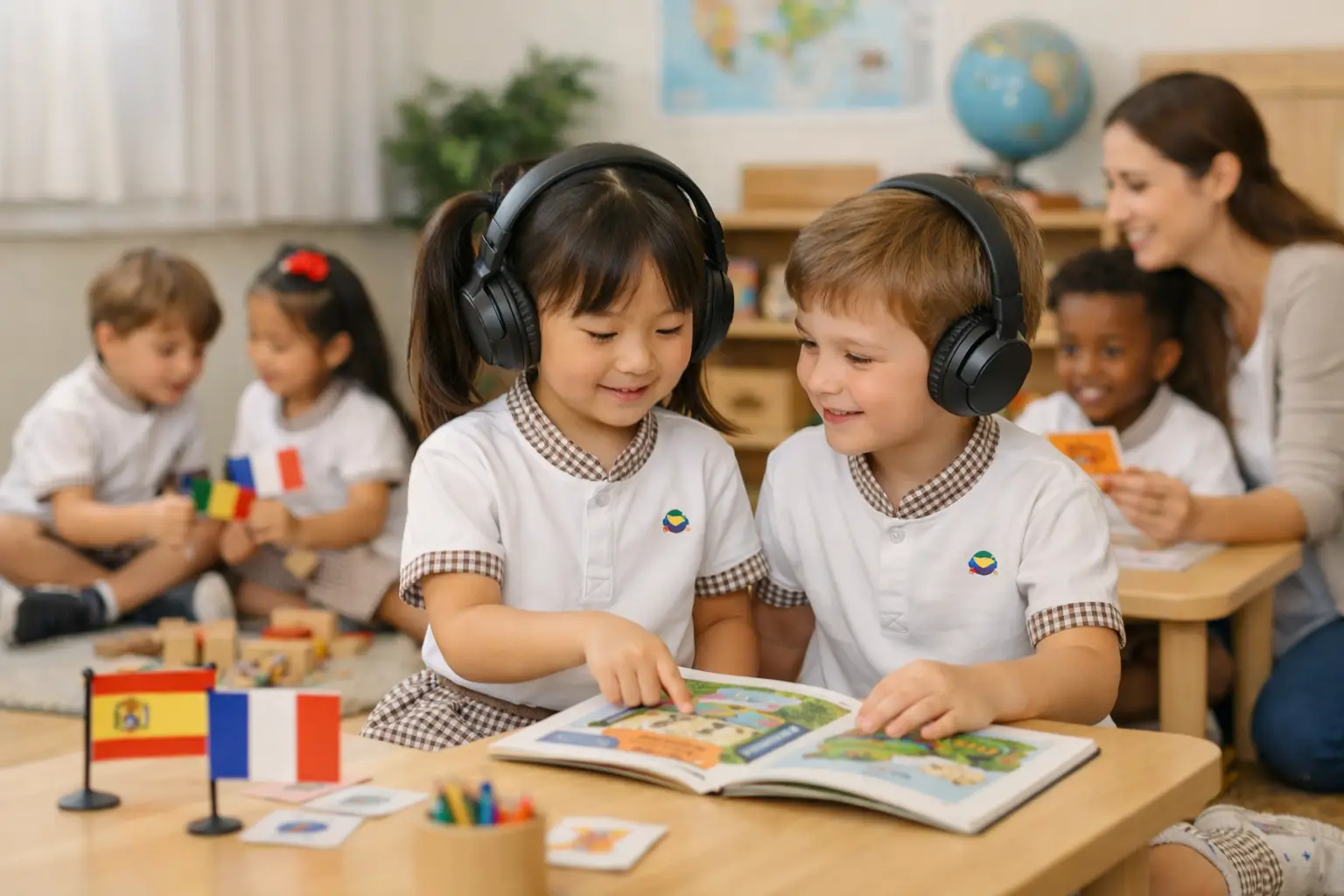
A child’s first response at nursery may be a smile, a gesture, a favourite song or a newly spoken word in English or Mandarin. These small moments reveal why parents looking for the best bilingual nursery features should look beyond how many hours each language is taught. The quality of a bilingual environment lies in how naturally children hear, use and enjoy both languages throughout meaningful parts of their day.
For young children, language development is closely connected to security, relationships, movement, music and play. A well-designed bilingual nursery supports communication while also nurturing attention, confidence, creativity and a genuine readiness to learn. Here are the features that make the greatest difference.
1. Purposeful exposure to both languages every day
A strong bilingual programme gives children frequent, consistent exposure to both languages, rather than treating the second language as a short, isolated lesson. They should hear meaningful vocabulary during routines such as greeting friends, washing hands, mealtimes, outdoor play and tidying up. This helps children understand that language is useful for expressing needs, sharing ideas and building relationships.
Consistency matters, particularly for infants and toddlers who are still learning to distinguish sounds and patterns. Educators may use clear language routines, songs, stories and repeated phrases to help children connect words with actions and experiences. Repetition is not a limitation at this age. When it is warm and purposeful, it gives children the confidence to participate.
The balance between languages may differ across programmes. Some families prioritise English fluency, while others hope to strengthen Mandarin in a predominantly English-speaking home. The right setting should be able to explain how it supports both languages and how its approach meets children at different starting points.
2. Educators who make language feel safe and engaging
Children learn language most readily when they feel seen, understood and encouraged. Skilled bilingual educators do more than translate instructions. They respond to a child’s interests, extend simple phrases into richer conversations and give each child time to communicate in their own way.
For example, if a toddler points to a butterfly, an educator may name it in both languages, describe its colours and invite the child to notice where it is going. This turns a fleeting observation into a moment of vocabulary, thinking and connection. For preschoolers, educators can ask open questions, encourage turn-taking and support them in retelling stories or explaining their choices.
Warmth is especially valuable for children who are quieter in one language. A child should never feel pressured to perform or be corrected harshly for mixing languages. Code-switching can be a normal stage of bilingual development. With patient modelling and positive interaction, children gradually learn when and how to use the words they know.
3. Stories, songs and conversation at the heart of the day
Among the best bilingual nursery features, a language-rich daily rhythm is one of the clearest indicators of quality. Children need more than flashcards or vocabulary drills. They benefit from expressive storytelling, rhymes, role play, picture discussions and songs that make language memorable.
Music is particularly valuable because rhythm, melody and repetition support listening and recall. Singing together also invites participation from children before they are ready to speak in full sentences. When music education is thoughtfully integrated with communication activities, children can practise pronunciation, listening, sequencing and expressive confidence in a joyful setting.
At A2E Kids, the structured Music Education Programme, including complimentary violin and piano enrichment, gives children another meaningful way to develop focus, memory and attentive listening. These skills complement bilingual learning because a child who listens closely to rhythm and sound is also practising important foundations for speech and communication.
4. Learning through hands-on exploration, not worksheets alone
Young children do not learn best by sitting still for long periods. A bilingual nursery should create opportunities for them to touch, build, investigate, move and ask questions. During an exploratory science activity, for instance, children might sort leaves, watch ice melt or test which objects float. Educators can introduce descriptive language in both languages as children observe and experiment.
This approach gives words a real context. Concepts such as heavy and light, rough and smooth, fast and slow become easier to understand when children can experience them with their bodies and senses. It also develops curiosity, problem-solving and the confidence to communicate a prediction or discovery.
Active kinaesthetic learning is equally valuable. Dance, obstacle courses, dramatic play and practical life activities all offer natural language moments. A child may learn action words while moving, positional words while navigating a course, or social phrases while pretending to run a shop. The learning is purposeful because the words help the child do something meaningful.
5. Clear support for communication, not just vocabulary
Knowing many words is only one part of bilingual development. Children also need to listen, take turns, understand instructions, express feelings and communicate with peers. The strongest programmes deliberately support these wider communication skills.
Look for educators who encourage children to make choices, describe what they have created and negotiate during play. Group discussions, show-and-tell activities and collaborative projects can help preschoolers speak with increasing clarity. For younger children, responsive conversations, gestures and visual cues provide the building blocks for later speech.
Speech and language milestones vary. Some bilingual children may use fewer words in each individual language at first, even though their combined vocabulary is growing well. A quality nursery observes development holistically and shares practical observations with parents. Where a child needs extra support, early, sensitive communication between educators and family is far more helpful than comparison or alarm.
6. A whole-child programme with space for rest and play
Bilingual learning thrives when children are well-rested, emotionally secure and physically active. A packed timetable can appear impressive, but very young children also need unhurried play, predictable routines and time to process new experiences. Premium early childhood education is not about making every minute academic. It is about making each part of the day developmentally meaningful.
This is why the best programmes connect language to social-emotional, cognitive, physical and self-help growth. When children learn to wait for a turn, pack away materials, comfort a friend or try again after a challenge, they are developing life skills alongside language. These experiences build independence and resilience, both of which support future learning.
Parents should also consider how the nursery manages transitions. A child entering an unfamiliar setting may initially rely more on their home language, become quieter, or need extra reassurance at drop-off. A nurturing team will work with the family to make this adjustment gradual and positive, without losing sight of the child’s individual temperament.
7. Meaningful partnership with parents
Language development continues at home, so parent partnership is a valuable feature rather than an optional extra. The nursery should share what children are exploring, the songs or vocabulary they are enjoying, and simple ways families can reinforce learning without turning home time into another lesson.
Families do not need to be fluent in both languages to support bilingual growth. Reading picture books, singing familiar songs, talking about daily routines and responding enthusiastically to a child’s attempts to communicate all make a difference. The most important factor is regular, warm interaction.
When visiting a nursery, ask how educators track language and communication progress, how they support children from different home-language backgrounds, and how they share observations with parents. You may also wish to notice whether children are speaking freely, listening attentively and appearing comfortable with their educators. These everyday signs can tell you more than a display of learning materials.
Choosing bilingual nursery features with confidence
The best choice is not necessarily the programme with the most activities or the most ambitious claims. It is the one where bilingual communication is woven into caring relationships, engaging experiences and a well-considered approach to whole-child development. Your child deserves a place where they can be curious, heard and encouraged to grow in both languages, one meaningful conversation at a time.
Leave a Reply