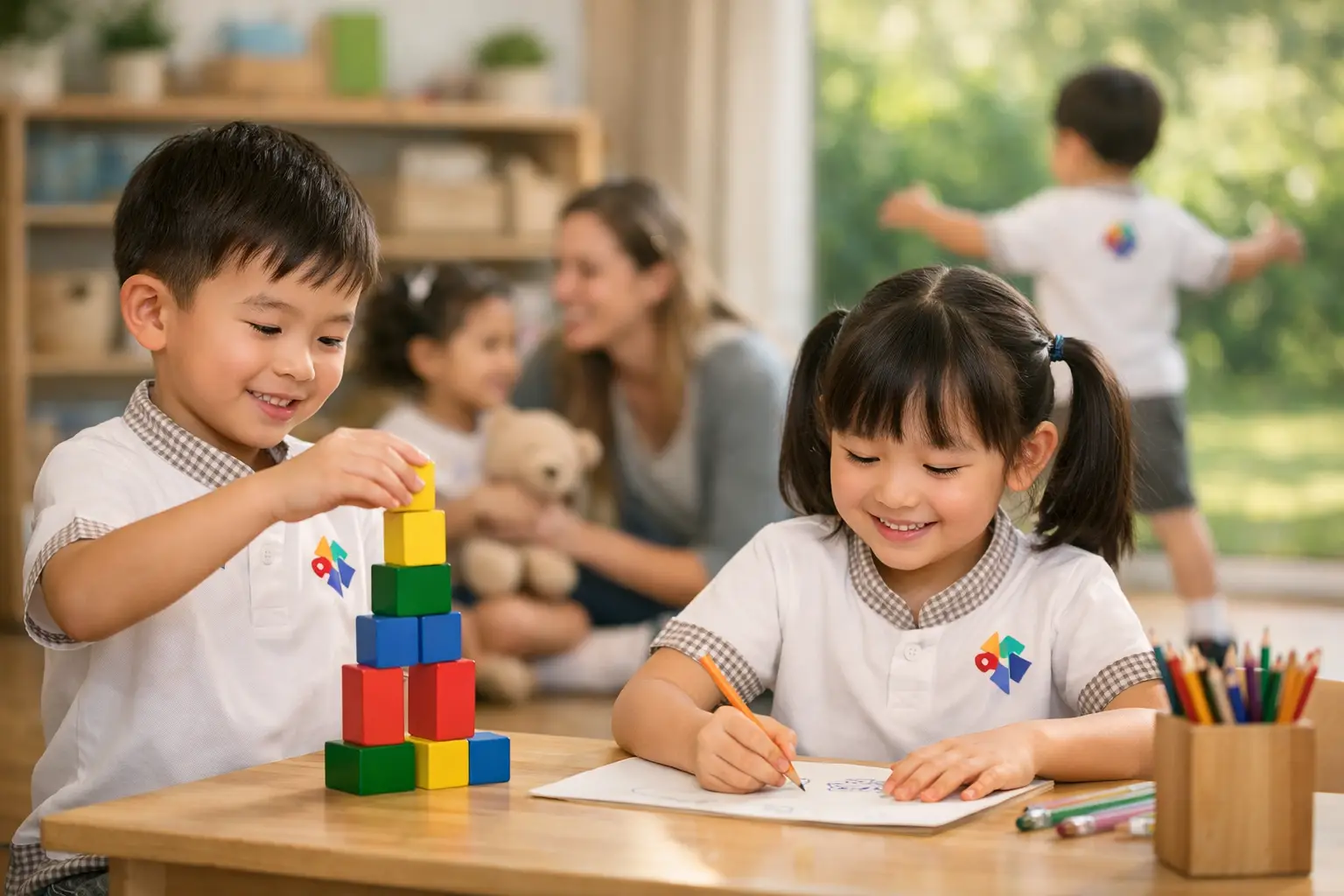
A child who spends the morning singing in two languages, the afternoon building with hands-on materials, and the day learning how to express ideas clearly is not just being kept busy. They are building foundations. A holistic child development programme gives those early hours real purpose by supporting the whole child – mind, body, language, emotions, creativity and confidence – in one connected learning experience.
For many parents, that difference matters. Childcare is not simply about supervision. It is about choosing an environment where care and education work together, where daily routines are designed to strengthen attention span, communication, memory, social development and independence. In the early years, these areas do not grow in isolation. They influence one another constantly.
What a holistic child development programme really means
A holistic child development programme looks beyond narrow academic milestones. Rather than focusing only on letters, numbers or worksheets, it considers how children learn best at a young age. That means combining cognitive growth with language development, physical movement, social-emotional security, self-help skills and creative expression.
In practice, a well-designed programme should feel structured but not rigid. Children need routine because it builds security and supports behaviour. At the same time, they need meaningful exploration, conversation, movement and play because those experiences shape brain development. The strongest settings understand that purposeful learning can happen during music, storytelling, active play, mealtimes and guided group interaction, not only during formal lesson blocks.
This whole-child approach is especially valuable in infancy and early childhood because development is rapid and deeply interconnected. A child learning to listen carefully during a music activity may also be strengthening memory and self-regulation. A child describing what they have built may be developing vocabulary, confidence and social awareness all at once.
Why whole-child development matters in the early years
The early years are not a waiting room before “real” learning begins. They are the period when children develop many of the habits and capacities that later shape school readiness and long-term confidence. Focus, turn-taking, expressive language, resilience, curiosity and independence all begin taking form very early.
This is why a broader developmental model often serves children better than a narrow academic one. A child who can recite information but struggles to communicate needs, manage emotions or stay engaged will still face challenges in a classroom. By contrast, a child with strong communication skills, healthy routines, emotional security and genuine curiosity is often better prepared to learn across every subject.
There is also a practical advantage for families. When care, education and enrichment are integrated into one setting, children benefit from consistency. Skills introduced during one part of the day can be reinforced naturally across other activities. That continuity matters far more than many parents first realise.
The key areas in a holistic child development programme
Language and communication
Strong communication sits at the heart of early learning. Children need opportunities to listen, understand, speak, ask questions and express feelings clearly. In a bilingual environment, this can be even more powerful, provided the language exposure is intentional and age-appropriate.
Good programmes do not treat language as memorisation alone. They create repeated chances for conversation, singing, storytelling, guided speech and meaningful interaction. Children learn language best when it is woven through the day and connected to real experiences.
Speech and vocal development can also make a meaningful difference. Clearer expression often improves confidence, participation and social interaction. For quieter children, this support can gently strengthen their willingness to speak up. For highly verbal children, it can refine clarity and listening skills.
Cognitive growth and attention
Parents often ask how to help children improve concentration. The answer is rarely to expect them to sit still for long periods. Attention develops gradually through engaging, well-paced experiences that invite children to listen, observe, remember and respond.
Activities that use rhythm, repetition, auditory cues and hands-on exploration can strengthen memory and focus in ways that feel natural to children. Auditory mnemonics, for example, can support recall because young learners often remember through sound, pattern and repetition before they retain abstract instruction.
This is one area where quality matters. A programme should challenge children without overwhelming them. Too little structure may lead to aimless activity. Too much pressure can reduce joy and confidence. The best balance depends on age, temperament and stage of development.
Creativity and music
Music is sometimes treated as a pleasant extra. In reality, it can play a serious developmental role. Learning through rhythm, melody and instrumental exposure can support listening, memory, timing, coordination and self-expression.
For young children, violin and piano experiences are not about performance standards. They are about attentive listening, fine motor awareness, discipline, enjoyment and creative confidence. Music can also help children settle, participate in groups and develop persistence through practice.
Creativity matters beyond the arts as well. Children who are encouraged to imagine, experiment and express ideas often become more flexible thinkers. They learn that there can be more than one solution, more than one way to communicate, and more than one path to understanding.
Physical and kinaesthetic learning
Children do not learn only at tables. Movement supports development in ways parents can see and ways they cannot. Active kinaesthetic learning helps children connect ideas with action, which is especially useful in the early years when bodies and brains are learning together.
Gross motor experiences build coordination, balance and body awareness. Fine motor activities support later writing, self-care and task control. Physical movement can also improve engagement for children who struggle to absorb information through listening alone.
This is one reason a full-day programme should not feel sedentary. Young children need a rhythm of active, calm, social and focused experiences across the day.
Social-emotional development and independence
A confident learner is not simply a bright learner. Confidence grows when children feel secure, understood and capable. A strong programme helps children manage transitions, take turns, cooperate, communicate needs and recover from frustration.
Self-help skills are part of this picture too. Feeding, tidying, dressing, toileting readiness and simple personal responsibility all contribute to independence. These are not small achievements. They shape confidence and reduce stress for children as they move into more structured school settings.
What to look for when choosing a programme
Not every setting that uses the word holistic delivers a genuinely integrated approach. Some offer scattered enrichment without a clear developmental framework. Others are warm and caring but lack educational intention.
Parents should look for a programme where the different elements work together. Music, language, movement, communication and daily routines should not sit in separate boxes. They should reinforce one another through thoughtful planning and skilled teaching.
It is also worth asking how outcomes are observed. Progress in the early years is not only about academic checklists. Educators should be able to speak clearly about how a child is developing in focus, communication, confidence, social participation and independence, as well as early literacy and numeracy foundations.
The daily environment matters too. Children need warmth and encouragement, but they also need purposeful teaching. Families often feel they must choose between a nurturing atmosphere and strong developmental practice. In truth, the most effective early years settings combine both.
At A2E Kids, this integrated model is central to the learning experience. A bilingual full-day programme enriched with music instruction, speech and vocal development, active kinaesthetic learning and auditory memory support reflects what many parents are seeking – care that is nurturing, and learning that is intentionally designed for whole-child growth.
The long-term value of a holistic child development programme
The benefits of a holistic child development programme are not always measured by how much a child can recite at age three or four. Often, they appear in the child who listens well, adapts more easily, speaks with confidence, enjoys learning and approaches new situations with greater security.
That does not mean every child develops at the same pace or responds to the same methods in the same way. Some children thrive immediately in group discussion. Others need gentler encouragement. Some are energised by music. Others respond more strongly to movement or hands-on exploration. A thoughtful programme recognises these differences while still providing structure and high expectations.
For parents, that is often the real goal – not pushing a child ahead unnaturally, but giving them a rich, balanced start that strengthens the skills they will rely on for years to come. When early education respects the full picture of development, children are not only prepared for school. They are better supported to grow into capable, curious and confident young learners.
The right early years setting should help your child feel safe enough to explore, supported enough to communicate, and challenged enough to keep growing.
Leave a Reply