When you visit two childcare settings and both look warm, safe and cheerful, the difference can be easy to miss. Yet in the daycare vs early learning conversation, the real question is not simply who will look after your child. It is who will intentionally support how your child thinks, communicates, explores, remembers and grows.
For many families, that distinction becomes clearer once a child starts showing their own pace and personality. Some children need more support with speech. Some are curious and active but struggle to focus. Some are sociable but need help building confidence in new situations. A strong early years environment does more than supervise these moments. It uses them as opportunities for development.
Daycare vs early learning: the core difference
Traditional daycare is often built first around care needs. That usually means safe supervision, meals, rest, hygiene, play and a routine that helps parents manage the working day. Good care matters deeply. Young children need consistency, emotional security and responsive adults before any meaningful learning can happen.
Early learning includes those same foundations, but it adds a clear developmental purpose. Activities are planned with outcomes in mind, whether that means stronger language, better listening, improved motor coordination, early numeracy, social confidence or greater independence. The day is not only filled. It is designed.
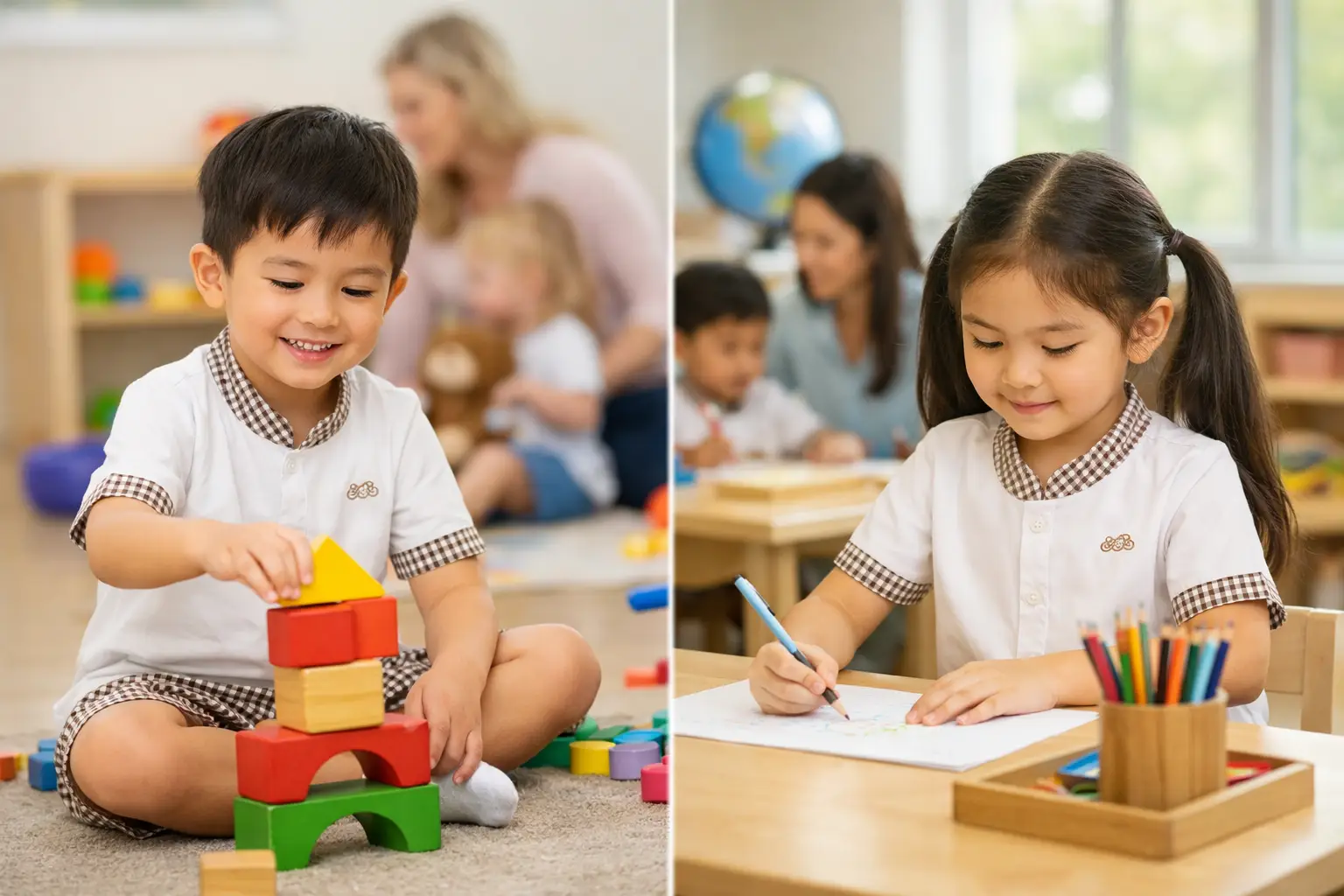
This does not mean every moment becomes formal instruction. In fact, the best early learning environments know that young children learn through movement, repetition, play, music, conversation and hands-on experiences. The difference is intentionality. A painting activity in a daycare setting may simply keep children occupied for twenty minutes. In an early learning programme, that same activity may be used to build vocabulary, pencil control, colour recognition, turn-taking and self-expression.
Why the distinction matters in the early years
The first years of life are not a waiting room before school. They are a period of rapid brain development, especially in language, attention, memory, sensory processing and emotional regulation. Children are constantly making connections through what they hear, see, touch and repeat.
That is why environment matters so much. If a child spends long days in care, those hours shape habits of thinking and learning. A setting with strong pedagogy can support curiosity, concentration and communication in ways that influence later confidence at school and beyond.
There is also a practical point for parents. Many families are not choosing between care and education as separate needs. They need both, in one place, with people they trust. The most valuable programmes recognise this. They understand that a child’s well-being and development should never be treated as separate priorities.
What high-quality early learning looks like
A genuine early learning programme is not defined by worksheets or children sitting still for long periods. It is defined by how thoughtfully each part of the day supports development.
Language-rich interaction is one of the clearest signs. Educators are not only giving instructions. They are modelling vocabulary, asking open questions, encouraging children to express ideas and helping them build confidence in speaking. In a bilingual setting, this can be especially powerful, as children learn to understand meaning, rhythm and expression across more than one language.
Purposeful routines matter too. Mealtimes can develop self-help skills and conversation. Music can strengthen listening, memory and pattern recognition. Movement-based learning can improve coordination while helping active children engage more fully. Storytelling can nurture attention span, imagination and comprehension all at once.
The strongest settings also look beyond one domain of growth. A child is not only learning letters or numbers. They are developing socially, emotionally, physically and creatively. When these areas are supported together, children often show more balanced progress.
Daycare vs early learning for different family needs
Not every family is looking for exactly the same thing, and that is where nuance matters. If you need short-term care, occasional flexibility or a simple, safe routine for part of the day, a traditional daycare arrangement may be entirely appropriate. There is nothing lesser about choosing what fits your family honestly.
But if your child is spending full days in a setting, or if you want those early years to build strong foundations, early learning often offers more long-term value. This is especially true for parents who want support with school readiness, communication, bilingual exposure, focus, creativity or confidence.
It also depends on your child. A highly energetic child may benefit from active kinaesthetic learning rather than a passive routine. A quiet child may flourish in an environment that gently develops speech and self-expression. A musically responsive child may engage more deeply when rhythm and sound are part of everyday learning. The best choice is rarely about labels alone. It is about fit.
Questions worth asking when comparing programmes
When parents compare options, brochures can sound similar. Nearly every provider says they are caring, experienced and child-focused. What helps is asking how that care translates into development.
Ask what children are learning during a typical day, not just what they are doing. Ask how educators support language development and communication skills. Ask whether activities are adapted for different ages and stages. Ask how the programme builds attention span, memory, independence and social confidence. These questions reveal whether learning is intentional or incidental.
It is also worth observing the children. Are they engaged, curious and secure? Do adults speak with warmth and purpose? Is the environment calm yet stimulating? A well-run early learning setting often feels different in subtle ways. There is structure without harshness, energy without chaos and nurturing without low expectations.
Looking beyond care to developmental outcomes
Parents increasingly want more than a place that keeps children busy until pick-up time. They want an environment that helps their child become articulate, resilient, creative and ready for the next stage. That does not mean chasing academic pressure too early. It means recognising that development happens every day, whether it is guided well or left to chance.
This is where enrichment can make a meaningful difference, provided it is integrated thoughtfully. Music, for example, is not only an extra. It can support listening skills, memory, rhythm, confidence and emotional expression. Speech and vocal activities can strengthen pronunciation, clarity and expressive language. Hands-on exploratory learning can deepen understanding because children remember what they actively experience.
At A2E Kids, this whole-child approach sits at the heart of the programme. Care, bilingual learning, music enrichment, communication development and active exploration are brought together so children are not only nurtured, but purposefully supported across multiple domains of growth.
What parents often misunderstand about early learning
One common concern is that early learning may be too structured or too demanding for very young children. Poorly designed programmes can create that problem, but high-quality early learning should feel age-appropriate, engaging and joyful. The aim is not to rush childhood. It is to make childhood richly developmental.
Another misunderstanding is that children will simply pick things up naturally wherever they are. Children do learn naturally, but that does not mean all environments offer the same quality of input. Warmth alone is not enough. Young minds benefit from adults who understand how to scaffold language, focus, creativity and self-help skills in everyday moments.
Parents sometimes assume school readiness means reading early or doing sums. In reality, readiness is broader. It includes being able to listen, follow routines, communicate needs, regulate emotions, work with others and approach learning with curiosity. These capacities often matter more in the beginning than premature academics.
Choosing with confidence
If you are weighing daycare vs early learning, it helps to move beyond marketing terms and look at the child experience underneath. Does the setting simply provide supervision, or does it intentionally build foundations that matter for life and learning? Does it nurture your child’s well-being while also expanding their abilities?
The right answer should feel reassuring and purposeful at the same time. Your child deserves warmth, safety and affection. They also deserve a learning environment that sees their potential clearly and supports it with care, expertise and consistency.
When those pieces come together, early childhood becomes more than a practical arrangement for the day. It becomes a powerful beginning – one that helps children find their voice, strengthen their focus and step forward with confidence.
Leave a Reply