A child’s earliest learning is rarely announced by a worksheet or a test score. It appears when they find the words to explain a feeling, persist with a tricky puzzle, keep a beat with others, or confidently try something new. The future of nursery education must protect these meaningful moments while giving children the foundations to thrive in school and in life.
For parents, this changes the question from “Who will look after my child?” to “What experiences will help my child grow?” Nurturing care remains essential, especially for infants and toddlers. Yet high-quality early childhood education increasingly recognises that care and purposeful development belong together. Children need security, warmth and consistent routines, alongside rich opportunities to communicate, explore, move, create and contribute.
The future of nursery education is whole-child learning
The most promising nursery environments will move beyond narrow definitions of school readiness. Recognising letters, numbers and colours matters, but readiness also includes listening, taking turns, managing frustration, expressing needs, and approaching unfamiliar tasks with curiosity.
Young children develop across connected domains. Language supports friendships and emotional regulation. Physical movement supports coordination, confidence and concentration. Music can strengthen listening, pattern recognition and memory. Meaningful play allows children to test ideas without fear of getting an answer wrong. When these areas are planned together, learning feels natural rather than pressured.
This is particularly relevant in the early years, when development is rapid but never identical from one child to another. One child may speak confidently but need support joining group activities. Another may be observant and careful, yet take longer to use language in a new setting. A thoughtful nursery programme notices the whole child and responds with patience, rather than treating every child as though they should progress at the same pace.
Purposeful play will matter more, not less
There is a misconception that a future-focused nursery must look increasingly academic, digital or fast-paced. In reality, the children most prepared for change may be those who have had time to play deeply.
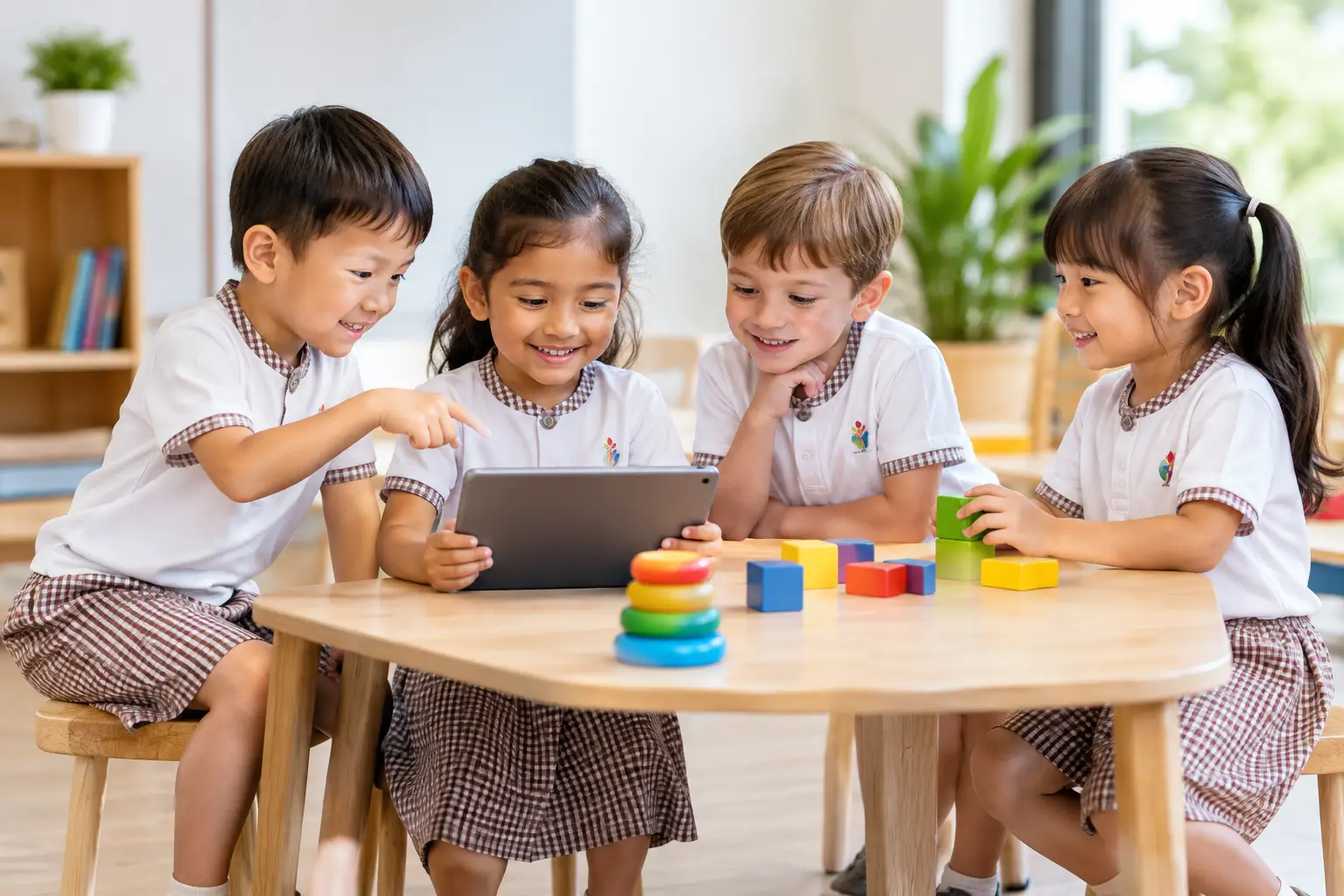
Purposeful play is not unstructured time with a few toys placed in a room. It is carefully designed learning in which educators observe children’s interests, introduce language and challenge, and know when to step back. A water investigation can become a lesson in prediction, volume, cooperation and new vocabulary. Building a tall structure can involve problem-solving, spatial awareness and resilience when it falls down.
Hands-on exploratory learning is especially valuable because young children learn through their senses and their bodies. They need to touch, sort, pour, climb, sing, carry, balance and experiment. Active kinaesthetic experiences help children connect ideas to action, while also developing practical self-help skills and awareness of others.
The trade-off is that purposeful play can look less immediately measurable than a completed workbook. Parents may not always see a page brought home at the end of the day. What they should see over time is more meaningful: a child who asks questions, explains what they have discovered, perseveres and takes increasing pride in what they can do independently.
Language and communication will become central
In a multilingual society such as Singapore, bilingual development is more than an academic advantage. It is a way for children to connect with family, culture and a wider community. The future of nursery education should make room for both languages to be heard, used and enjoyed in everyday interactions.
Strong communication is not simply about speaking early or using sophisticated words. It includes understanding instructions, listening to another person’s point of view, using words instead of tears or pushing, and having the confidence to share an idea. These abilities support classroom participation long before formal schooling begins.
The most effective language-rich environments do not rely on repetition alone. Educators use stories, songs, conversations, dramatic play and real experiences to give words meaning. They pause for a child’s response, extend what the child says, and create a culture where trying to communicate is valued. For quieter children, this may mean gentle encouragement in a small group. For highly verbal children, it may mean learning to listen with equal care.
Music will be recognised as a developmental tool
Music is often treated as a pleasant extra in early childhood programmes. Its role can be far more purposeful. Learning rhythm, melody and instrumental skills invites children to listen closely, remember sequences, coordinate movement and practise with concentration.
Regular exposure matters. A one-off performance may inspire excitement, but structured music education gives children time to develop familiarity, discipline and confidence. Through singing, rhythm games and age-appropriate instrumental learning, children can experience the satisfaction of gradual improvement. They also learn that individual effort contributes to a shared sound.
For young children, music should never become another source of performance pressure. The goal is not to produce accomplished musicians at nursery age. It is to use auditory learning in ways that support attention span, memory, creativity and joyful self-expression. A well-designed programme will be playful enough for childhood while still being intentional about developmental outcomes.
This is one reason A2E Kids places free violin and piano enrichment within a wider child development programme, rather than presenting music as an isolated activity. When music, communication, movement and exploratory science are connected, children can experience learning as something rich and coherent.
Technology needs a clear purpose
Technology will continue to shape children’s lives, but more screens do not automatically create more capable learners. For nursery-aged children, the quality of interaction around a tool matters far more than the tool itself.
A digital microscope used with an educator to examine a leaf may deepen observation and conversation. A video call with a family member overseas can support relationships and language. By contrast, passive screen time can displace the very experiences young children need most: face-to-face talk, physical movement, imaginative play and responsive adult attention.
Future-ready nurseries will therefore use technology selectively. They will introduce children to inquiry, creativity and responsible habits, while protecting ample time for sensory learning and human connection. Parents should feel comfortable asking how technology is used, why it is used, and what learning it adds that cannot be achieved more simply through play or conversation.
Educators and families will work as true partners
No nursery programme can replace the security children gain from their families. Equally, parents should not have to carry the full weight of supporting development alone. The strongest early childhood experience is a partnership in which educators share meaningful observations and families offer insight into their child’s interests, routines, languages and temperament.
This does not require parents to turn every evening into a lesson. Small moments are powerful: inviting a child to help prepare fruit, talking about the journey home, singing a familiar song, or allowing extra time for them to put on their own shoes. These everyday interactions reinforce independence, language and belonging.
Parents should also expect honest, respectful communication. Development is not a straight line, and a trusted educator will celebrate progress while raising concerns early and thoughtfully. Whether a child needs more support with separation, speech, peer interaction or attention, timely collaboration can make a significant difference.
Choosing a nursery for the years ahead
A future-focused nursery is not defined by fashionable facilities or an ambitious timetable alone. When visiting a centre, notice how adults speak with children. Look for calm routines, genuine warmth, accessible materials and children who are actively engaged rather than merely occupied.
Ask how the programme supports bilingual communication, creativity, physical development, self-help skills and social-emotional well-being. Find out how educators observe progress, adapt activities and communicate with families. Most importantly, consider whether the environment sees your child as an individual with strengths to build on, not simply a learner to accelerate.
Your child does not need to have every future skill before starting primary school. They need a secure place to become curious, capable and confident in who they are. Choose an early learning community where their questions are welcomed, their well-being is protected, and each small step forward is given the care it deserves.
Leave a Reply