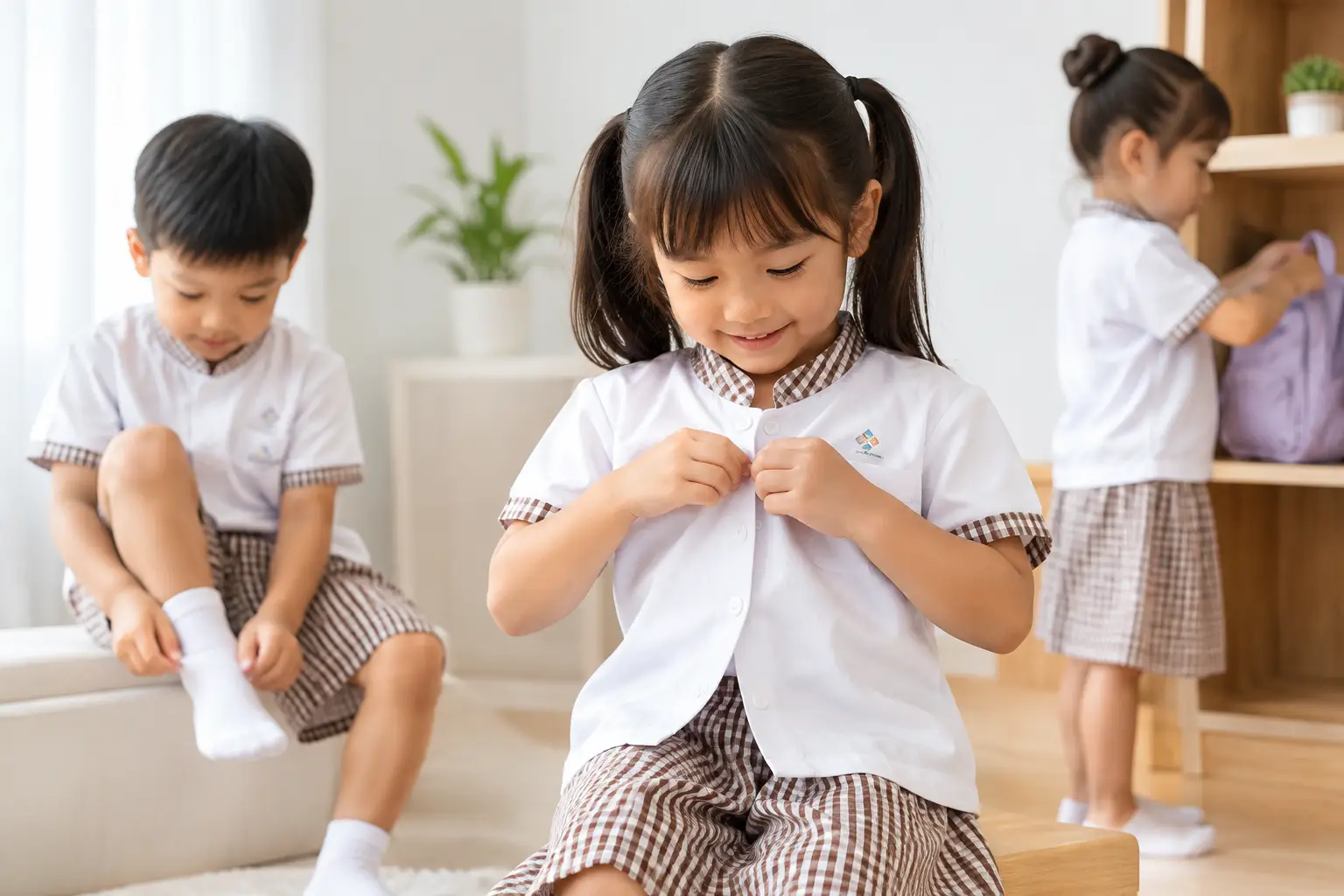
A child who insists on putting on their own sandals, even when they are on the wrong feet, is doing far more than delaying the morning routine. They are practising judgement, coordination, perseverance and confidence. Learning how to develop self-help skills gives children meaningful opportunities to say, “I can try”, long before they can do every task perfectly.
For young children, self-help skills are the practical abilities that support daily independence: feeding themselves, washing hands, dressing, toileting, tidying up and communicating their needs. These abilities develop gradually through repeated, supported practice. The goal is not to rush childhood or expect independence too soon. It is to create a secure foundation where children feel capable, respected and willing to learn.
Why self-help skills matter beyond daily routines
When children take part in caring for themselves, they begin to understand that their actions have an effect. Pulling up a zip, placing a cup in the sink or choosing a book before rest time may appear small, but each successful attempt strengthens a child’s sense of agency.
Self-help learning also supports several developmental areas at once. Dressing develops fine motor control and body awareness. Mealtimes build hand-eye coordination, language and social understanding. Tidying encourages memory, categorisation and responsibility. A child who can communicate “I need help” or “I need the toilet” is also building the confidence to participate in group settings and form positive relationships.
Independence does not mean leaving a child to manage alone. In the early years, independence grows through dependable adult guidance. Children need time, clear routines and encouragement that recognises effort, not only results.
How to develop self-help skills at the right pace
The most effective approach is to begin with what your child can already do, then offer one manageable next step. A toddler who can lift a spoon may be ready to practise scooping. A preschooler who can put on a T-shirt may be ready to learn how to turn it the right way round.
Age can offer a helpful guide, but every child develops differently. Temperament, physical coordination, language development and previous experience all influence readiness. Some children confidently attempt everything; others prefer to observe first. Both responses are normal. Progress is more meaningful when it is steady and positive than when it is hurried.
Make routines predictable
Children learn best when the same activities happen in a familiar order. A consistent morning routine, for example, might involve using the toilet, washing hands, getting dressed, having breakfast and packing away dishes. Predictability helps children remember what comes next and reduces the number of instructions they need to process.
Use simple, specific language. Instead of saying, “Get ready now”, try, “First, put one arm into your shirt. Then find the other sleeve.” For young children, one instruction at a time is often enough. As confidence grows, you can gradually reduce prompts and allow them to lead more of the routine.
Visual cues can be useful, particularly for children who are still developing language or who find transitions challenging. A small sequence of pictures showing handwashing steps, for instance, turns an adult instruction into something the child can follow independently.
Prepare the environment for success
A child cannot practise independence if everyday items are out of reach or too difficult to use. Thoughtful organisation makes a considerable difference. A sturdy step stool at the sink, low hooks for bags, easy-grip cutlery and clothes with simple fastenings give children a genuine chance to participate.
This does not require turning the whole home upside down. Choose one or two routines that matter most to your family and make them accessible. A small basket for socks and underwear, for example, lets a child choose and put away their clothing. A clearly labelled toy shelf makes tidying less abstract.
Offer limited choices rather than open-ended decisions. “Would you like the blue cup or the green cup?” gives a child control without creating unnecessary overwhelm. Choice-making develops communication and decision-making, while keeping the routine moving.
Build skills through everyday moments
Self-help development is not a separate lesson. It happens during the ordinary moments families already share.
At mealtimes, invite your child to sit comfortably, use a spoon or fork, drink from an open cup when developmentally ready, and help clear their place. Spills are part of learning. Respond calmly: “The water has spilled. Let’s get a cloth and wipe it together.” This teaches responsibility without shame.
During dressing, allow extra time for your child to try. Begin with easier tasks such as pushing arms through sleeves, pulling off socks or fastening Velcro shoes. More complex skills, including buttons, zips and shoelaces, can come later. If you take over immediately because you are in a hurry, the message can unintentionally become, “You cannot do this.” When time is short, explain honestly: “I will help today because we need to leave, and we can practise after dinner.”
Personal hygiene offers another valuable opportunity. Teach handwashing with the same sequence each time: wet hands, use soap, rub, rinse and dry. Singing a short familiar song can help children understand how long to wash. For toilet learning, maintain a calm and matter-of-fact approach. Accidents are information, not failure. Children benefit from reassurance, clean-up routines and language that protects their dignity.
Tidying is often more successful when it is concrete. Rather than asking a young child to “clean up everything”, say, “Let’s put the blocks in this basket.” Make it a shared task at first. As children become more capable, give them a small responsibility they can own, such as returning books to a shelf or putting dirty clothes in the laundry basket.
Use encouragement that develops resilience
Praise is most helpful when it describes effort and strategy. “You kept trying until the zip moved” tells a child what they did well. “You remembered to wash your hands before lunch” reinforces the routine and helps them notice their own progress.
Avoid stepping in too quickly when a child is frustrated. A brief pause gives them space to think and attempt a solution. If help is needed, offer the smallest amount possible. You might hold a jacket steady while your child pushes in their arm, rather than putting the entire jacket on for them.
There is a balance to strike. Repeated struggle can become discouraging, especially when a task is beyond a child’s current physical ability. Break it into smaller parts, demonstrate slowly, then try again together. The aim is confident participation, not perfect performance.
Support communication alongside independence
Self-help skills and communication are closely connected. Children need words, gestures or signs to express hunger, discomfort, a need for the toilet, or a request for assistance. Giving children useful phrases empowers them to advocate for themselves respectfully.
Practise language during routines: “Help, please”, “More water”, “All done”, “I can do it”, and “Can you show me?” These phrases are practical, but they also build social confidence. For bilingual families, using familiar words in both home languages can support understanding and help children connect actions with meaning.
Music and rhythm can make routines easier to remember. A handwashing rhyme, tidy-up song or simple clapping pattern can support attention, memory and participation. At A2E Kids, purposeful enrichment and active learning are woven into children’s development because skills become more lasting when children experience them with enjoyment, movement and meaningful repetition.
When a child resists doing things independently
Resistance does not always mean a child is being difficult. They may be tired, hungry, seeking connection, worried about getting something wrong or simply enjoying the comfort of being helped. On demanding days, it is perfectly appropriate to provide more support.
Try to distinguish between a child who cannot yet complete a task and one who needs encouragement to begin. Offering a playful start can help: “Shall we see if your foot can find its sock?” You can also connect before asking for cooperation. A few minutes of focused attention can make a child more willing to attempt the next routine.
If you notice persistent difficulty with feeding, dressing, coordination, communication or toileting, speak with your child’s early childhood educator or a relevant health professional. Early guidance can provide reassurance and practical strategies tailored to your child’s needs.
A child’s growing independence will rarely look neat or efficient. There will be backwards shoes, toothpaste on the sink and toys that somehow miss the basket. Yet every patient opportunity to try tells your child something powerful: you are trusted, you are learning, and you are becoming capable.
Leave a Reply