A toddler who cannot yet explain a story may happily finish the last word of a familiar song. A baby may turn towards a parent’s singing voice before responding to everyday speech. These small moments show how music supports language development: it gives children a memorable, playful structure for hearing sounds, anticipating words and joining in without pressure.
For infants and preschoolers, language grows through many everyday interactions – talking, listening, reading, movement and play. Music is not a shortcut that replaces these experiences. It is a powerful companion to them, because it makes the building blocks of communication easier to notice, repeat and enjoy. When music is thoughtfully woven into early learning, it can strengthen both a child’s desire and readiness to communicate.
Why music and language belong together
Music and language share several foundations. Both rely on listening closely, recognising patterns, remembering sequences and using the voice to express meaning. Before a child can read or hold a sustained conversation, they are already absorbing the rise and fall of speech, familiar sounds and the rhythm of the language spoken around them.
Songs make these features more obvious. A steady beat helps children hear where phrases begin and end. Repeated lyrics bring the same sounds and vocabulary back again. Changes in pitch and volume invite children to listen for emotional meaning: a gentle lullaby feels different from an energetic action song.
This matters because young children learn language gradually. They need many warm, meaningful encounters with words before those words become part of their own speech. Music creates these encounters in a format that is predictable enough to feel safe and varied enough to hold attention.
Rhythm supports speech timing and sound awareness
Speech has rhythm. We naturally stress some syllables, pause between ideas and change our pace depending on what we want to say. Clapping to a beat, tapping a drum or marching during a rhyme helps children experience timing physically as well as hear it.
Action songs are particularly useful for this reason. When a child claps, stomps or points at the right moment, they connect a sound with a movement and a meaning. This kinaesthetic involvement can be especially helpful for children who learn best by doing rather than sitting still and listening.
Rhymes also draw attention to sound patterns. Hearing that “cat” and “hat” sound alike, or noticing the first sound in “sun” and “sand”, develops early phonological awareness. These are the listening skills that later support pronunciation, spelling and reading. The aim is not to test children on sounds, but to let them enjoy hearing how language works.
Repetition builds vocabulary without feeling repetitive
Parents know that children often ask for the same song again and again. That repetition has developmental value. Each return gives a child another chance to hear a new word, connect it with an action or image, and eventually try saying it independently.
A well-chosen song can introduce everyday vocabulary such as body parts, animals, colours, actions and feelings. It can also model useful sentence patterns. For example, a song that repeats “I can…” gives children a simple framework for expressing their own abilities: “I can jump”, “I can draw” or “I can help”.
The strongest learning happens when adults extend the song beyond its lyrics. After singing about animals, a teacher or parent might ask which animal the child liked, describe its movement or invite the child to create a new verse. This turns passive recall into conversation.
Singing invites children to use their own voice
Some children are cautious talkers. They may understand much more than they say, particularly in new settings or when they are learning more than one language. Singing can offer a gentler route into vocal expression because children can join a group, echo a short phrase or hum along before they are ready to speak alone.
Music also supports turn-taking. In call-and-response songs, an adult sings a phrase and pauses for the child to answer. In musical play, children wait for their turn with an instrument, listen to another person’s idea and contribute their own sound. These are early social communication skills, not simply musical ones.
How music supports bilingual language development
For children growing up with more than one language, songs can make each language feel familiar, enjoyable and purposeful. Repeated phrases provide useful exposure to pronunciation, vocabulary and natural speech rhythm. When the song is paired with gestures, pictures or real objects, children have several clues to help them understand meaning.
Bilingual learning works best when children are not asked to perform before they are ready. It is normal for a child to listen quietly, answer in one language or mix words from both languages while building confidence. Music creates a low-pressure setting in which they can absorb language first and participate over time.
Consistency is more valuable than complexity. A small selection of songs used regularly in each language can be more helpful than constantly introducing unfamiliar material. Adults should also speak naturally around the music: name what is happening, respond to the child’s attempts and use songs as a bridge into genuine interaction.
Music activities that build communication at home
You do not need formal musical training to use music purposefully. The quality of the interaction matters far more than singing perfectly. Choose short songs with clear words, a manageable pace and opportunities for your child to participate.
Try singing a familiar song and deliberately pausing before the final word of a line. Give your child time to fill the gap with a word, sound, gesture or smile. You can also sing daily routines, such as tidying toys or washing hands, using the same simple tune each day. Familiar musical cues help children anticipate what comes next while hearing relevant vocabulary in context.
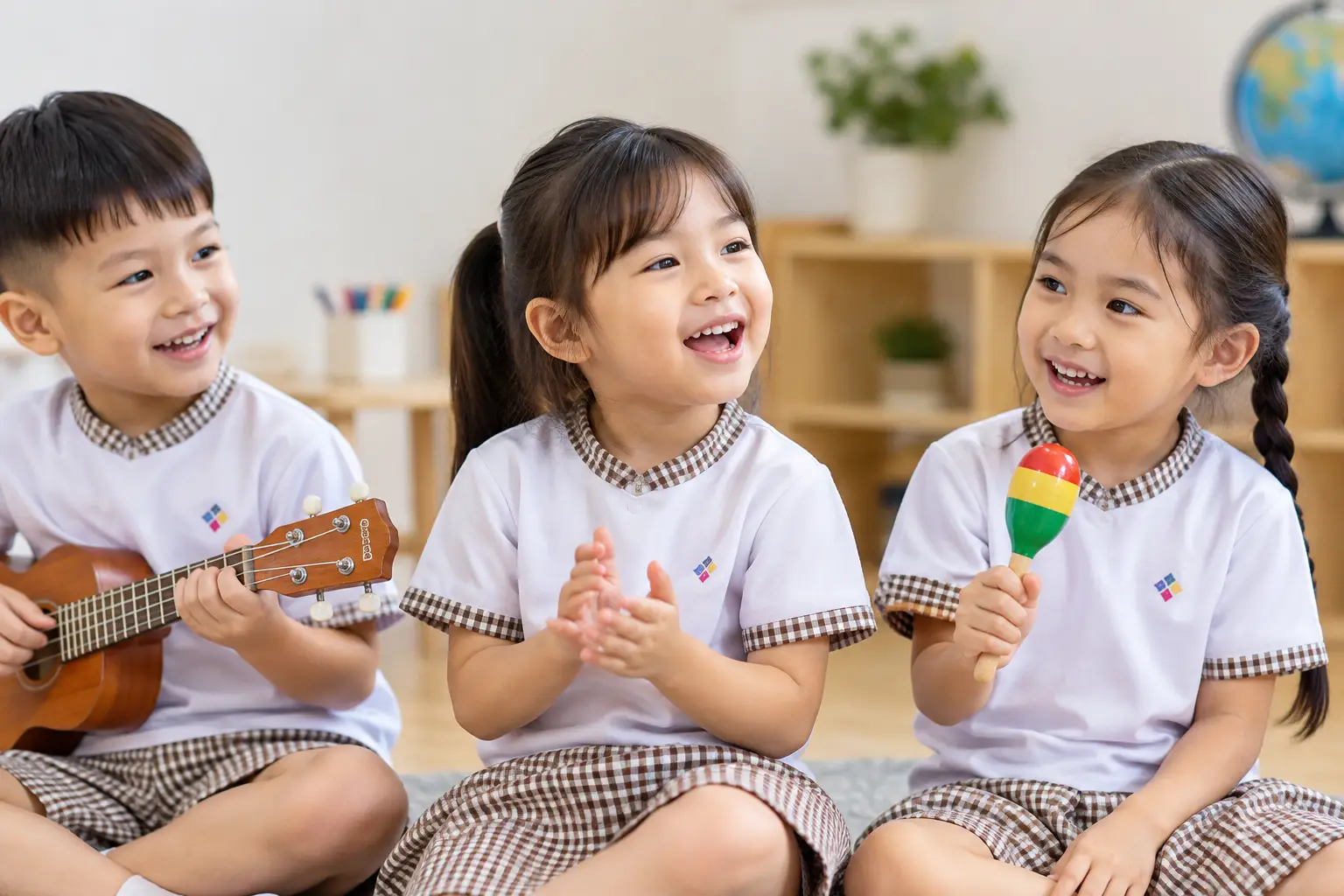
Instrument play can be equally valuable when it includes conversation. Rather than handing over a shaker and moving on, describe the sound: “That is loud”, “You are shaking quickly”, “Shall we stop?” Then listen to your child’s response. A pot and wooden spoon can become a prompt for words such as fast, slow, quiet, turn and again.
Reading and singing work well together too. After sharing a picture book, make up a simple song about a character or retell one event with claps and actions. There is no need for a polished performance. The purpose is to give your child another way to revisit language they have just heard.
What purposeful music education looks like in early childhood
Music has the greatest developmental impact when it is intentional, regular and connected to wider learning. A thoughtful programme does more than play background songs. It gives children opportunities to listen, sing, move, remember patterns, explore instruments and communicate with others.
Auditory Mnemonics are one helpful approach. By connecting information to melody, rhythm and repeated sound patterns, children may find it easier to recall words, sequences and ideas. Used appropriately, this supports memory and attention while keeping learning engaging. It should always sit alongside rich conversation, story-sharing and hands-on exploration, rather than becoming a drill.
At A2E Kids, music education includes free violin and piano enrichment within a wider developmental programme. Instrumental learning can nurture careful listening, concentration and perseverance, while group music experiences encourage cooperation and confidence. These benefits grow most meaningfully when children are allowed to explore at their own developmental pace.
It also helps to maintain realistic expectations. Music can support communication, but it is not a substitute for specialist assessment if a parent has concerns about a child’s hearing, speech, understanding or social communication. Early discussion with a qualified professional can provide clarity and the right support.
Choosing music experiences that serve your child
Look for experiences where children are active participants rather than simply an audience. The best sessions leave room for movement, choices, repetition and conversation. They recognise that a confident singer, a quiet observer and an enthusiastic drummer can all be learning.
Consider your child’s temperament and current needs. A highly energetic child may benefit from rhythmic movement followed by a calm listening activity. A child who is still developing confidence may enjoy predictable songs and small-group participation. For bilingual children, familiar tunes in both languages can provide reassurance while expanding their listening world.
Most of all, let music remain joyful. When a child feels seen, heard and encouraged, a simple song can become much more than a tune. It can be a shared language for curiosity, connection and the confidence to communicate.
Leave a Reply