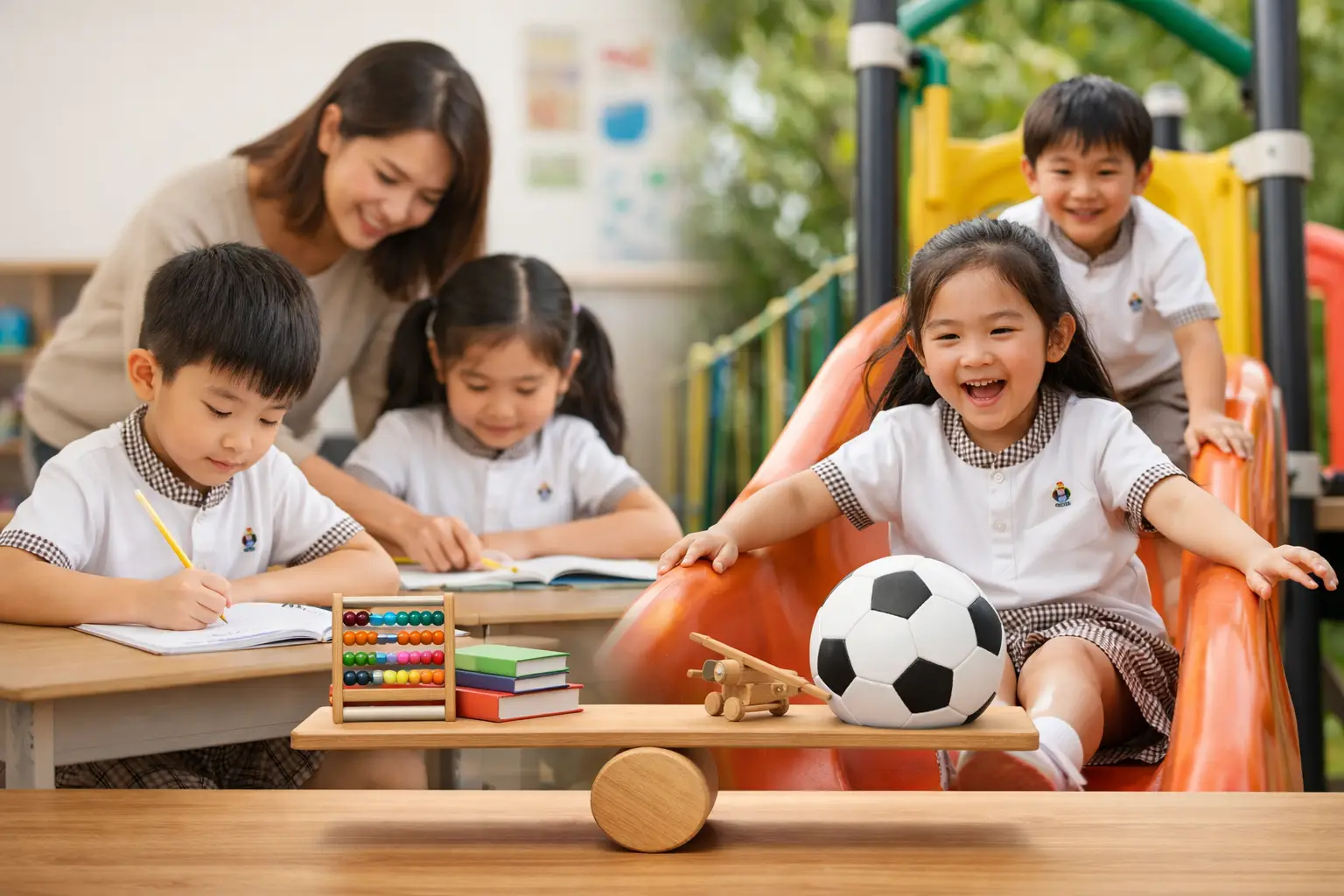
A toddler carefully places buttons into matching containers, then abandons the activity to turn the containers into a pretend train. Both moments matter. The conversation around structured learning vs free play can make parents feel they must choose between academic progress and a joyful childhood. In reality, young children develop most meaningfully when purposeful guidance and self-directed exploration work together.
For families seeking more than supervision from early childhood care, the question is not which approach is best in isolation. It is whether a child’s day offers the right balance of security, challenge, movement, creativity and freedom for their stage of development.
What structured learning gives young children
Structured learning is a planned experience with a clear developmental purpose. An educator may guide children through a bilingual story, introduce rhythm patterns, practise turn-taking in a small group, or invite them to investigate why an object floats. The activity has an intention, appropriate materials and adult support.
For infants and preschoolers, structure should not mean long lessons, worksheets or pressure to perform. It means predictable routines and carefully designed moments that help children build skills step by step. A familiar sequence of arrival, meals, group experiences, outdoor play and rest can be deeply reassuring. When children know what comes next, they can direct more energy towards participating, communicating and learning.
Purposeful teaching is particularly valuable for abilities that often benefit from repetition and modelling. Language development, early numeracy, listening skills, self-help routines and fine motor control grow when adults notice what a child can do and offer the next achievable challenge. A child may learn new vocabulary during a guided picture-book session, then use those words later when describing their own play.
Structured music experiences offer another example. Keeping a simple beat, listening for changes in pitch and remembering a short sequence can support attention, auditory memory and coordination. When introduced playfully, violin or piano enrichment is not about producing miniature performers. It is an opportunity for children to practise focus, confidence and expressive communication through sound and movement.
The value of intentional adult guidance
Children do not need adults to control every discovery, but they do need adults who can extend it. A skilled educator observes closely, asks a well-timed question and adapts the challenge. If a child is building a tall tower, the adult might ask, “What could make the base stronger?” This preserves the child’s ownership while encouraging early problem-solving.
Intentional teaching also helps ensure that every child has access to experiences they may not choose independently. Some children naturally gravitate towards books, while others prefer climbing, construction or dramatic play. A thoughtfully planned programme makes room for all of these interests while gently broadening each child’s confidence across communication, physical development, creativity and early scientific thinking.
Why free play is serious learning
Free play is child-led. Children choose what to explore, how long to stay with it and often who to involve. They may negotiate roles in a pretend café, test which blocks make the best bridge, create a game with scarves, or spend ten quiet minutes examining a leaf.
Because the child has genuine control, free play exercises skills that cannot simply be instructed. Decision-making, perseverance, imagination, social negotiation and emotional regulation emerge naturally. When a play plan fails, children have a reason to try again. When a friend wants the same toy, they practise expressing a need, waiting, offering an alternative or seeking help.
Free play can look unstructured to an adult, yet it is often full of thinking. A child arranging animal figures by size is exploring comparison. Two children deciding whether a blanket is a cave or a superhero cape are using language, symbolism and collaboration. A child repeatedly pouring water between containers is developing concentration, hand control and an early understanding of volume.
The freedom to follow an interest also supports motivation. Children learn that their ideas are worth pursuing. This sense of agency is a strong foundation for later learning, because a child who is curious and willing to experiment is more likely to engage with a new challenge rather than fear getting it wrong.
Free does not mean unsupported
High-quality free play is not an educator stepping away from the room. It depends on a safe, inviting environment with open-ended materials, sufficient time and adults who are attentive without taking over. The educator may document a child’s interests, introduce a new resource, model respectful language or step in when support is needed.
The difference is that the adult follows the child’s lead. Rather than directing every outcome, they create the conditions for rich exploration. This is especially important for very young children, whose play is their primary way of making sense of people, objects and everyday experiences.
Structured learning vs free play: the false choice
The most effective early years programmes do not place structured learning and free play at opposite ends of the day. They allow each to strengthen the other.
A planned sensory activity may introduce words such as smooth, rough, heavy and light. Later, during free exploration, children use those words as they compare natural materials. A guided movement session may build balance and body awareness. On the playground, children then test those abilities as they climb, jump and invent obstacle courses.
This rhythm matters. Too much adult direction can leave children reliant on instructions and reduce opportunities for creativity. Too little guidance can mean missed opportunities to build foundational skills, particularly when a child needs more language support, encouragement to join peers or a carefully scaffolded challenge.
The right balance depends on age, temperament and developmental needs. Infants need responsive caregiving, sensory exploration and simple routines more than formal group activities. Toddlers benefit from short, engaging guided moments followed by plenty of active, independent play. Preschoolers can participate in longer projects and collaborative learning, while still needing generous time to imagine, move and make choices.
What a balanced day can look like
A balanced programme does not need to feel rigid. It should feel purposeful, warm and responsive. Children may begin with independent arrival play, move into a brief bilingual group experience, then investigate materials in learning areas. Meals become opportunities for conversation and self-help. Outdoor time supports physical confidence, risk assessment and friendship. Music, science and creative experiences add new ways to think and express ideas.
At A2E Kids, this whole-child approach brings together structured developmental experiences with opportunities for children to explore, communicate and create. Enrichment such as music education, kinaesthetic learning and hands-on STEM exploration can give children meaningful starting points, while play allows them to revisit ideas in their own way.
Parents can look beyond whether a setting describes itself as play-based or academic. The more useful questions are: Are educators responsive to children’s interests? Is there a clear developmental purpose behind planned activities? Do children have time to make choices and sustain their play? Are movement, language, relationships and creativity treated as essential parts of learning?
How parents can support both at home
Home does not need to become a classroom. Small, consistent moments are enough. Invite your child to help sort socks, sing a familiar song with actions, talk about what they notice on a walk, or help prepare fruit for a snack. These are structured opportunities because you are intentionally building language, memory, coordination and independence.
Then protect unhurried time for your child to play without a prescribed result. Offer simple materials such as blocks, paper, boxes, scarves or safe kitchen utensils. Resist the urge to correct every idea or show the “right” way to use an object. Your child may surprise you with the complexity of their thinking when given space.
If your child seems reluctant to join a guided activity, begin with their interest and keep the demand small. A child who loves vehicles may be more willing to count wheels than counters. If they become absorbed in play, allow that concentration to continue when possible. Deep engagement is valuable learning, even when it does not look like a formal lesson.
A child’s early years do not need to be a race towards the next milestone. They need caring adults, rich experiences and the confidence to say, “I can try.” When structure gives children useful tools and free play gives them room to use those tools imaginatively, learning becomes both purposeful and joyful.
Leave a Reply