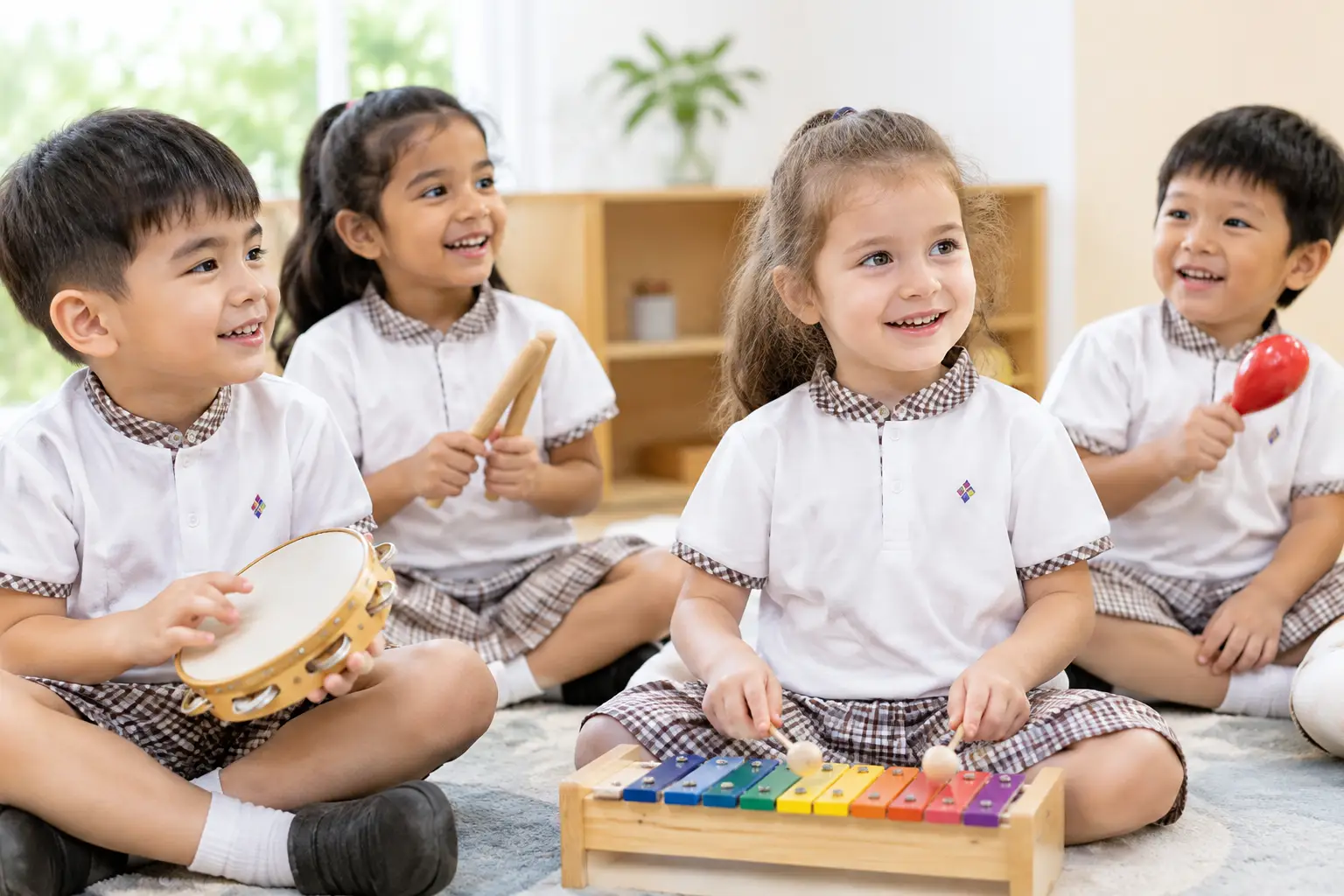
A child tapping a steady beat, waiting for their turn to play a note, then remembering a familiar melody is doing far more than making music. A thoughtful early years music programme gives young children repeated, joyful practice in listening, concentrating, communicating and expressing themselves. For parents choosing an early learning setting, this matters because these foundations support the way children participate in everyday classroom life and relationships.
Music is not a shortcut to making every child a performer, nor should it be treated as one. Its value lies in the rich developmental experience it creates: sound, movement, language, memory, emotion and social connection all come together in an activity children naturally enjoy.
What an early years music programme should develop
The strongest programmes start with development, not simply a timetable of songs. Children need music experiences that meet them at their stage of growth while gently extending what they can do. A baby may respond by turning towards a sound or copying a simple rhythm. A preschooler may follow a pattern, sing with clearer words, or take responsibility for playing one part in a group activity.
Listening, focus and attention
Before a child can reproduce a rhythm or learn the beginnings of an instrument, they must listen carefully. Music invites this in a concrete way. A child listens for when the drum stops, notices whether sounds are high or low, and waits for a musical cue before moving. These small moments build the habit of directing attention towards a task.
The goal is not for young children to sit still for long periods. Early learners need movement, play and variation. Short, purposeful activities are often more effective than extended instruction. A programme should balance singing, instrument exploration, rhythm games and movement so that children remain actively involved while practising sustained attention in age-appropriate ways.
Memory through meaningful repetition
Children enjoy hearing favourite songs again and again. This repetition is not wasted time. When a child recalls the next line, anticipates a change in tempo or remembers a sequence of actions, they are strengthening working memory and recall.
At A2E Kids, Auditory Mnemonics form part of the Music Education Programme. By linking sound patterns with words, actions and familiar routines, children can practise remembering information in a way that feels engaging rather than pressured. Music can make patterns easier to notice, whether a child is learning a new vocabulary word, a sequence or a simple concept.
Memory activities should remain playful and achievable. If a pattern is too complex, children may become frustrated; if it is always identical, the learning may lose its challenge. Skilled educators adjust the level gradually, allowing children to experience success before introducing the next step.
Communication and language
Songs offer a natural setting for children to hear and use language. Rhythm helps them notice syllables, while rhyme draws attention to sounds within words. Repeated lyrics can give a quieter child a low-pressure way to join in, particularly when they are not yet ready to speak at length in a group.
In a bilingual early childhood environment, music can also support children as they encounter more than one language. Simple songs, chants and call-and-response activities give meaning through gesture, facial expression and repetition. This does not replace rich conversation, storytelling or reading aloud. Rather, it complements them by giving children another memorable route into listening and speaking.
Music also develops communication beyond words. Children learn to watch a teacher’s signal, respond to a partner, show when they are ready, and recognise how tone and volume can communicate a feeling. These are valuable early social skills.
Creativity and emotional expression
There is a difference between teaching children to copy a song and giving them room to make musical choices. Both have a place. Copying helps children gain confidence and learn structure; creating a soundscape for a story or choosing how to move to a piece of music encourages imagination.
An inclusive programme makes room for different responses. One child may sing boldly, another may prefer tapping a rhythm, and a third may listen closely before participating. Educators can recognise each form of engagement while offering gentle encouragement. Over time, children often become more willing to share an idea, take a turn or perform a short part alongside their peers.
Why instruments need purposeful teaching
Seeing small children hold a violin or find notes on a piano can be delightful, but the benefit is not in the photograph. Instrument learning can support coordination, listening and perseverance when it is introduced with realistic expectations.
For young children, the first lessons may focus on handling an instrument safely, noticing differences in sound, following a start-and-stop cue and understanding that practice happens in small steps. These experiences build self-control and confidence. They also teach children that improvement often comes through patient repetition, not instant perfection.
Free violin and piano enrichment can be particularly meaningful when it is integrated into the child’s wider learning rather than offered as an isolated add-on. Children should have opportunities to connect musical learning with movement, stories, language and group participation. This makes the experience accessible even to children who are still developing fine motor control or who need more time to feel comfortable in a group.
Parents should be cautious of programmes that promise a specific academic outcome from music alone. Every child develops differently, and music is one valuable part of a broad early childhood education. Its greatest contribution is often the combination of habits it nurtures: attentive listening, willingness to practise, emotional expression, coordination and confidence.
What purposeful music learning looks like in a preschool day
A quality programme does not need to feel like a formal conservatoire lesson. In fact, very young children learn best when musical experiences are woven naturally through a well-planned day.
A morning greeting song can help children settle into the classroom and learn one another’s names. A rhythm can signal a transition from play to tidy-up time. During a story, children may create sounds for rain, footsteps or animals. In movement sessions, they can respond to fast and slow music, building body awareness as well as listening skills.
These moments work because music has a clear purpose. It supports routines, reinforces language and helps children make sense of shared experiences. When combined with active kinaesthetic learning and hands-on exploration, it also recognises that young children learn with their whole bodies, not only by listening to an adult speak.
How parents can assess an early years music programme
When visiting a preschool, look beyond the list of instruments or the number of performances held each year. Ask how the programme is adapted for different ages and temperaments. Find out whether educators explain the developmental intention behind activities, and how they observe each child’s participation and progress.
It is also useful to notice the atmosphere. Are children encouraged without being pushed? Do they have chances to move, explore and repeat? Is there a balance between group learning and individual support? A child who is hesitant at first should be given time to build trust, while a child who is eager should be offered fresh challenges.
The educator’s role is especially important. A warm, observant teacher knows when to simplify a rhythm, when to invite a child forward and when to let them watch from nearby. This responsive approach protects well-being while helping children grow in independence.
Music as part of whole-child growth
Music is most powerful when it sits within a programme that values every area of development. A child’s growing attention supports exploratory science. Their language skills help them share observations. Their physical coordination supports self-help tasks and active play. Their confidence helps them participate in a bilingual classroom and form friendships.
For families seeking more than basic childcare, music education can be a meaningful sign of a centre’s broader commitment to purposeful learning. The question is not simply whether a child will learn songs or begin an instrument. It is whether the experience helps them become a more attentive listener, a more confident communicator and a curious learner who is comfortable trying something new.
The best musical moments in the early years are often wonderfully ordinary: a child remembering the next beat, singing a new word with pride, or smiling as they realise their sound belongs in the group. Given patient guidance and regular opportunities, those moments can help shape a confident beginning for learning.
Leave a Reply