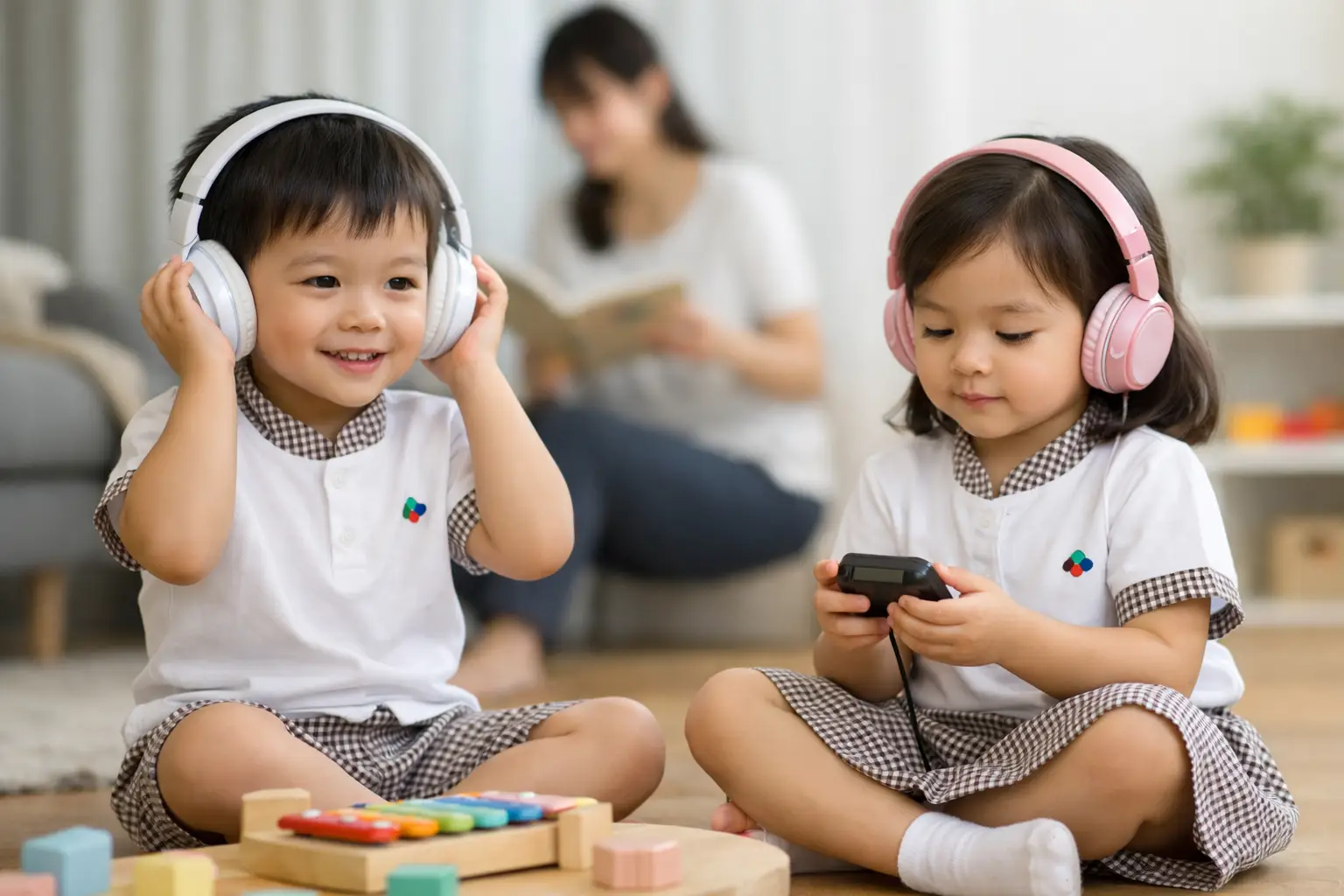
A toddler who taps along to a song, repeats the last word of a familiar rhyme, or turns quickly when they hear their name is doing more than enjoying a sound. They are practising attention, memory, language and connection. Auditory learning for toddlers uses these everyday listening moments purposefully, helping young children make sense of patterns, words and instructions in ways that feel natural and joyful.
For parents, the goal is not to make a toddler sit still for a long lesson or memorise facts on command. It is to create a responsive environment where listening is active, meaningful and paired with movement, play and warm conversation. This supports whole-child development while respecting the short attention spans and changing needs of the early years.
What auditory learning means in the toddler years
Auditory learning is learning through sound. For toddlers, that can include spoken language, music, rhythm, rhymes, environmental sounds and the changing tone of a trusted adult’s voice. It is not simply about hearing well. It involves noticing a sound, giving it meaning, remembering it and responding.
When an adult says, “First we wash hands, then we eat,” a toddler begins to connect words with sequence. When they hear the same clean-up song each day, they learn to anticipate what comes next. When they clap a simple rhythm and try to copy it, they are listening closely, coordinating their body and holding a pattern in mind.
These experiences can support communication skills, working memory, concentration and confidence. They also help children participate more independently in daily routines. However, auditory learning is most effective when it is one part of a balanced approach. Toddlers learn with their whole bodies: through seeing, touching, moving, experimenting and relating to others.
Why music and rhythm are especially powerful
Music gives sound an organised structure. A melody, repeated lyric or steady beat makes information easier for young children to notice and revisit. That is why many toddlers can recall words in a favourite song before they can use the same words confidently in ordinary conversation.
Rhythm also gives children a clear framework for attention. A predictable beat can help them pause, listen and join in. Clapping games, action songs and call-and-response activities invite participation without placing pressure on a child to speak perfectly. A child may begin by watching, then tapping, then vocalising a small part of the song. Each stage is meaningful.
Repetition matters, but it should not become mechanical. A familiar song can be sung faster or slower, softly or loudly, with new actions or a child’s name added in. These small changes encourage flexible listening. They also make the experience playful rather than performative.
Music should never be treated as a shortcut to guaranteed academic outcomes. Every child develops at a different pace, and enjoyment is a valuable outcome in its own right. Yet purposeful musical experiences can create rich opportunities to practise recall, focus, listening discrimination and expressive communication.
Auditory mnemonics: making patterns memorable
Auditory mnemonics use sound patterns to make information easier to remember. For toddlers, this may be as simple as a short tune for packing away toys, a rhyme for washing hands or a repeated phrase that signals the next part of the day.
The best mnemonics are brief, consistent and connected to a real action. “Shoes on, bag on, ready to go” may help a child remember a morning routine because the words are rhythmic and repeated at the moment they need them. The aim is not to test a child. It is to offer a friendly prompt that supports growing independence.
Everyday ways to support listening at home
Meaningful auditory learning does not require a room full of equipment. It grows from small, repeated interactions where adults speak clearly, listen back and allow time for a child to respond.
During meals, describe what is happening in simple language: “Your banana is soft. Can you hear the crunch?” At bath time, notice sounds together, such as water splashing, a bottle squeezing or a duck squeaking. On a walk, pause for birds, traffic, footsteps or rain. Ask open but manageable questions: “What did you hear?” or “Was that sound loud or quiet?”
Stories are equally valuable, especially when they are shared rather than rushed. Use expression, repeat a favourite line and let your child fill in a word if they want to. If they lose interest after two pages, that is not failure. Close the book, talk about one picture, or return to it later. Toddlers build attention in short stretches.
Simple sound-and-movement games work well because they combine listening with action. You might clap a pattern for your child to copy, play music and freeze when it stops, or make animal sounds for them to identify. Keep the challenge within reach. Two claps may be plenty for a younger toddler; an older child may enjoy copying a longer pattern.
Conversation is the foundation
Songs and rhymes are useful, but responsive conversation remains at the heart of language development. Toddlers need adults who notice their attempts to communicate and build on them.
If your child says, “Car go,” you might respond, “Yes, the red car is going fast.” This confirms their message while offering slightly richer language. If they point and make a sound, name what they are noticing before asking a question. Children learn that sounds and words have power when their efforts receive a warm, relevant response.
Bilingual families can support auditory development in both languages. The most helpful approach is usually the one that allows caregivers to speak naturally, consistently and with confidence. Songs, stories and daily routines can be enjoyed in more than one language, giving children repeated exposure to each language’s sounds, vocabulary and rhythm. Progress may look different from child to child, particularly when they are learning multiple languages, so comparison is rarely useful.
When less sound is more helpful
A stimulating sound environment is not the same as constant noise. Background television, videos or adult conversations can compete with the sounds a toddler needs to notice. When singing a song, sharing a book or giving an instruction, reducing competing noise can make listening easier.
Some children are also more sensitive to sound than others. A noisy birthday party, hand dryer or busy classroom may feel overwhelming rather than exciting. Watch for signs such as covering ears, becoming distressed, withdrawing or finding it difficult to follow simple directions in loud settings. Offer quieter breaks and avoid assuming that a child is being difficult.
Likewise, if a toddler does not consistently respond to their name, seems not to notice everyday sounds, has frequent ear infections, or shows ongoing difficulty understanding speech, speak with a healthcare professional. Hearing and communication concerns are best explored early, with calm support rather than worry or blame.
A purposeful early-learning environment
In a quality early childhood setting, auditory experiences are woven through the day rather than treated as an occasional activity. Children benefit when music, stories, bilingual communication, routines and hands-on exploration work together. A song can prepare children for a transition; a science activity can introduce new descriptive words; a group rhythm game can build turn-taking and social awareness.
At A2E Kids, this whole-child perspective is reflected in a structured Music Education Programme that includes violin and piano enrichment, alongside bilingual development, STEM exploratory science and active kinaesthetic learning. The intention is not simply to expose children to instruments. It is to offer purposeful experiences that encourage memory, focus, creativity, communication and self-expression within a nurturing daily routine.
The strongest learning moments are often quiet and ordinary: your toddler repeating a phrase from a story, humming while they put toys away, or listening carefully before joining a group song. Give those moments time. A child who feels heard is more willing to listen, respond and grow.
Leave a Reply