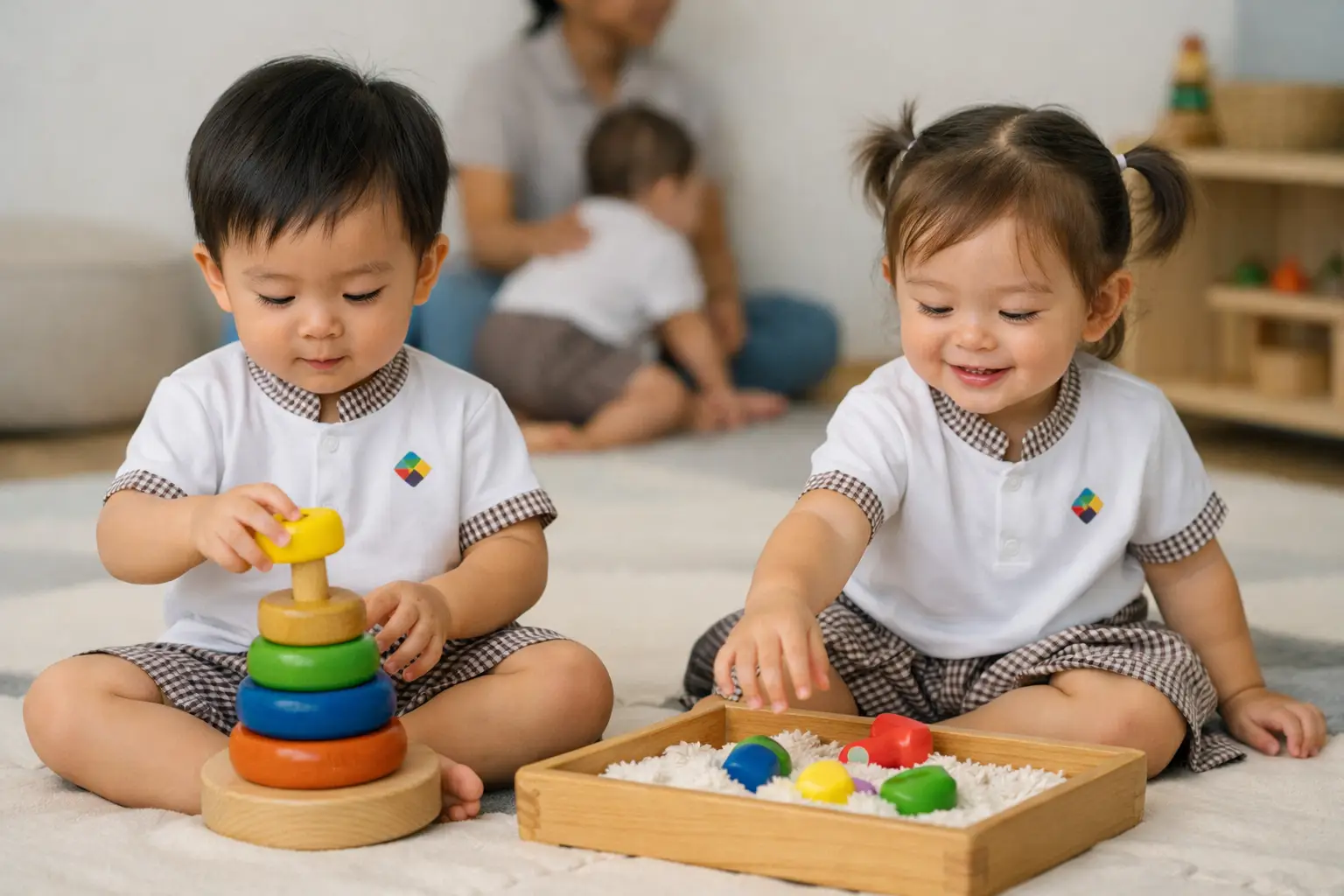
The most meaningful infant play often happens in the ordinary moments – on a play mat after a nap, during a nappy change, or while your baby is watching your face as you sing. The best infant development activities are not the flashiest ones. They are the experiences that help your baby build movement, communication, attention, memory and trust through warm, repeated interaction.
For many parents, the challenge is not whether to support development, but how to do it well without turning every part of the day into a lesson. That balance matters. Infants learn best when activities are simple, responsive and matched to their stage of growth. A well-chosen activity should feel purposeful, but never pressured.
What makes the best infant development activities?
A strong activity supports more than one area of development at once. A baby reaching for a scarf is not only practising fine motor control. They are also learning visual tracking, attention, body awareness and cause and effect. When you speak gently as they move, language development joins the experience too.
This is why whole-child development matters so much in infancy. Physical skills, communication, emotional security, sensory processing and early thinking do not develop in isolation. They build together. The most effective activities encourage this natural integration rather than focusing too narrowly on one milestone.
It also helps to remember that infants develop at different rates. Some babies love movement and seek stimulation. Others need a calmer pace and more time to process. The goal is not to rush progress. It is to create repeated opportunities for healthy growth.
1. Tummy time with purpose
Tummy time remains one of the best infant development activities because it strengthens the neck, shoulders, trunk and arms that babies need for later rolling, crawling and sitting. Yet many infants resist it at first, which is completely normal.
The key is to keep it short, frequent and engaging. Lie down face-to-face, place a high-contrast card nearby, or sing softly so your baby has a reason to lift their head. Even one or two minutes at a time is useful when repeated throughout the day.
If your baby becomes upset quickly, chest-to-chest tummy time can be a gentler starting point. What matters most is consistency, not duration.
2. Face-to-face talking and expression play
Your face is one of your baby’s first and most powerful learning tools. When you talk, pause, smile and vary your expression, your infant studies movement, sound, rhythm and emotional cues all at once.
This kind of interaction supports early communication long before speech begins. Babies learn turn-taking when you coo, then wait for their response. They begin to connect tone with meaning. They also develop stronger social engagement, which lays foundations for confidence and attention.
Simple works beautifully here. Describe what you are doing, repeat familiar phrases, and let your baby watch your mouth. In bilingual households, hearing both languages naturally in daily routines can be especially beneficial when delivered with warmth and repetition.
3. Singing, rhythm and gentle music play
Music offers far more than entertainment in infancy. Repeated melodies, rhythmic patterns and predictable sounds can support memory, listening skills, emotional regulation and early language awareness. Many babies respond to song before they respond to spoken instruction.
You do not need to perform perfectly. A calm lullaby, a rhythmic action song, or gentle clapping games can all be valuable. Repetition is especially powerful because infants learn through familiar patterns. They begin to anticipate what comes next, which strengthens attention and auditory memory.
This is one reason structured music exposure can be such a meaningful part of early development. At A2E Kids, music is viewed not as an extra, but as a purposeful developmental tool that supports focus, communication and creativity from the earliest years.
4. Reaching, grasping and texture exploration
Around the first months of life, babies begin moving from reflexive action towards more intentional reaching and grasping. Offer safe objects with different textures, weights and shapes so your baby can explore with hands and mouth.
A soft cloth, a textured teether, a smooth rattle and a crinkly fabric square each provide different sensory information. These experiences help build fine motor control, hand strength and sensory awareness. They also teach babies that their actions produce feedback.
There is a trade-off to keep in mind. Too many toys at once can overwhelm attention. A smaller, carefully chosen selection often leads to deeper engagement.
5. Floor play that encourages movement
Babies need time on the floor to learn how their bodies move through space. This is where they experiment with kicking, rolling, pivoting and eventually crawling. Devices that keep babies contained for long periods may be convenient in short stretches, but they should not replace open-ended floor movement.
Place one interesting object slightly out of reach to encourage stretching and turning. Change your baby’s position so they experience the world from different angles. Join them at floor level and celebrate effort, not just success.
Movement play supports more than physical milestones. It also develops persistence, problem-solving and spatial awareness.
6. Reading aloud from the very beginning
Reading to an infant may seem premature, but it is one of the most valuable habits you can begin early. Babies benefit from hearing the rhythm of language, the patterns of repeated words and the emotional warmth of shared attention.
Board books with clear pictures, faces and strong contrast are ideal at first. Let your baby touch the pages, stare at one image for a long time, or lose interest after a minute. The objective is not finishing the book. It is building language exposure and positive associations with books.
When you read regularly, you also create a predictable moment of connection. That emotional security supports learning more broadly.
7. Mirror play for self-awareness and focus
A baby-safe mirror can hold an infant’s attention remarkably well. Babies are drawn to faces, movement and contrast, which makes mirror play a natural way to support visual attention and social development.
During tummy time or lap play, position the mirror so your baby can observe movement. Talk about what they see: eyes, nose, smile, hands. Although very young infants do not yet understand reflection in the way older children do, they still gain valuable practice in tracking, observing and engaging.
This is also a lovely opportunity for bonding. When you join in, your baby begins linking visual curiosity with shared joy.
8. Sensory play with restraint
Sensory experiences are useful, but more stimulation is not always better. Infants benefit most from calm, manageable sensory input rather than constant noise, lights or activity.
Good infant sensory play might include listening to soft bells, feeling warm water during bath time, watching a scarf float slowly, or touching fabrics with different textures. These experiences help babies process information through sight, sound, touch and movement.
If your baby turns away, arches their back, cries or becomes frantic, that is useful feedback. It usually means the activity needs to be simplified. Responsive parenting matters more than finishing any planned task.
9. Everyday routines as learning moments
Some of the best developmental experiences are already built into your day. Feeding, bathing, dressing and settling are rich opportunities for communication, sequencing and emotional security.
During dressing, name body parts and describe actions. During feeding, pause for eye contact and conversation. During bath time, pour water slowly, introduce simple words such as wet and splash, and let your baby anticipate familiar routines.
These repeated moments are powerful because infants learn through pattern. Predictable routines help babies feel safe, and a secure baby is more ready to engage, observe and learn.
10. Supported social play
Even before babies can play directly with peers, they benefit from observing others, hearing varied voices and experiencing warm social interaction. Gentle group experiences can support attention, communication and emotional development.
This does not mean infants need busy schedules. In fact, too much activity can lead to overtiredness. But calm, high-quality social exposure – whether with caregivers, siblings or a thoughtfully structured infant programme – can broaden a baby’s experience in meaningful ways.
For families choosing infant care, this is an important distinction. A strong developmental setting does more than supervise. It creates purposeful opportunities for communication, movement, music, exploration and secure attachment throughout the day.
How to choose the right activities for your baby
The best infant development activities are the ones your baby is ready for and willing to engage in. Watch their cues closely. A baby who is alert, calm and curious is ready to learn. A baby who is hungry, overstimulated or tired needs regulation first.
It also helps to think in terms of rhythm rather than performance. A few minutes of high-quality interaction, repeated daily, is usually more effective than occasional elaborate activities. Progress in infancy is often quiet and gradual. Head control improves. Eye contact lasts longer. Babbling becomes more varied. These are meaningful signs that development is taking root.
If you ever feel uncertain, trust two principles. Keep play relational, and keep it purposeful. Infants do not need a packed timetable. They need responsive adults, rich language, safe movement, sensory balance and experiences that nurture the whole child.
The smallest moments, repeated with care, often do the most important work.
Leave a Reply