At first glance, many early years settings can look similar. The brochures mention care, routines and happy classrooms. Yet for parents who want more than supervision, childcare with educational programme means something far more purposeful – a setting where every part of the day supports growth in language, thinking, confidence and well-being.
That distinction matters most in the earliest years, when children are not simply being kept safe and occupied. They are building attention span, absorbing sound patterns, forming communication habits, strengthening memory and learning how to relate to the world around them. A strong programme does not rush childhood. It gives children the right experiences, at the right pace, with the right guidance.
What childcare with educational programme really means
A true childcare with educational programme is not just daycare plus a few activities added in. It is a structured developmental environment where care and learning are thoughtfully integrated. Meals, movement, play, music, stories, transitions and rest all sit within a wider framework designed to support the whole child.
For infants and young children, this should include much more than alphabet drills or worksheet-based tasks. High-quality early learning is built through interaction, repetition, sensory exploration, language exposure and responsive teaching. Children learn through relationships before they learn through formal instruction. That is why the best settings combine warmth with pedagogy.
Parents sometimes ask whether a more educational approach might feel too academic too soon. The answer depends on how the programme is designed. If learning is developmentally appropriate, active and engaging, it does not pressure the child. Instead, it nurtures curiosity, self-expression and the foundations needed for later school success.
Why the early years need more than basic care
The first years of life are a period of remarkable brain development. Children are learning how to listen, notice patterns, regulate emotions, move with coordination and use language with purpose. These are not separate skills. They support one another.
For example, a child who develops stronger listening through music and conversation may also show better focus during storytelling. A child who is encouraged to express ideas in both action and speech may build confidence alongside communication skills. A child who explores materials hands-on may strengthen both problem-solving and persistence.
This is why a well-designed programme should not be narrow. Academic readiness matters, but so do creativity, self-help skills, social awareness and physical confidence. Families looking for premium early childhood education are often not asking for more activities. They are asking for better ones – experiences chosen because they support meaningful development.
What to look for in an educational childcare programme
A clear developmental framework
A strong programme should be able to explain what children are learning and why. Not in vague terms, but in practical ones. Parents should be able to see how daily experiences support communication, cognition, motor development, social-emotional growth and independence.
If a setting cannot explain its approach beyond general statements about fun and care, that is worth noticing. Enjoyment matters, but purposeful learning requires intention.
Bilingual exposure that builds communication
In a multilingual environment, bilingual learning can be especially valuable when it is delivered naturally and consistently. Young children benefit from regular exposure to rich vocabulary, songs, stories and guided conversation in more than one language. This strengthens listening, expression and confidence over time.
The key is quality rather than token exposure. A few repeated phrases are not the same as a language-rich environment where children hear, understand and use meaningful language every day.
Enrichment that supports the brain, not just the timetable
Some enrichment activities are included because they sound impressive. Others are included because they genuinely contribute to child development. Parents should know the difference.
Music is a good example. When taught with structure and purpose, music education can support memory, auditory discrimination, rhythm, concentration and expressive confidence. It can also improve children’s readiness to listen, follow patterns and participate with others. In the right hands, this is not an extra. It is part of cognitive and communication development.
The same applies to hands-on science and movement-based learning. STEM experiences help children ask questions, make predictions and observe outcomes. Kinaesthetic learning supports coordination, body awareness and engagement, especially for young children who learn best by doing rather than sitting still.
Childcare with educational programme and whole-child development
The most effective childcare with educational programme supports children across multiple domains at once. This is one of the clearest signs of quality. In real life, development is interconnected.
A music session can strengthen listening and memory. A guided group activity can build social skills and turn-taking. A self-help routine can support independence and confidence. A story discussion can expand vocabulary while teaching emotional understanding.
When a programme is designed around whole-child growth, parents tend to see benefits that go beyond the classroom. Children may communicate more clearly at home, show greater curiosity, settle into routines more confidently or demonstrate stronger focus during everyday tasks. These are meaningful outcomes because they reflect genuine developmental progress, not just performance.
The role of music, movement and exploratory learning
For many parents, educational quality is still judged mainly by literacy and numeracy. Those areas matter, but early childhood development is broader than that. Children need rich sensory and expressive experiences to build strong foundations.
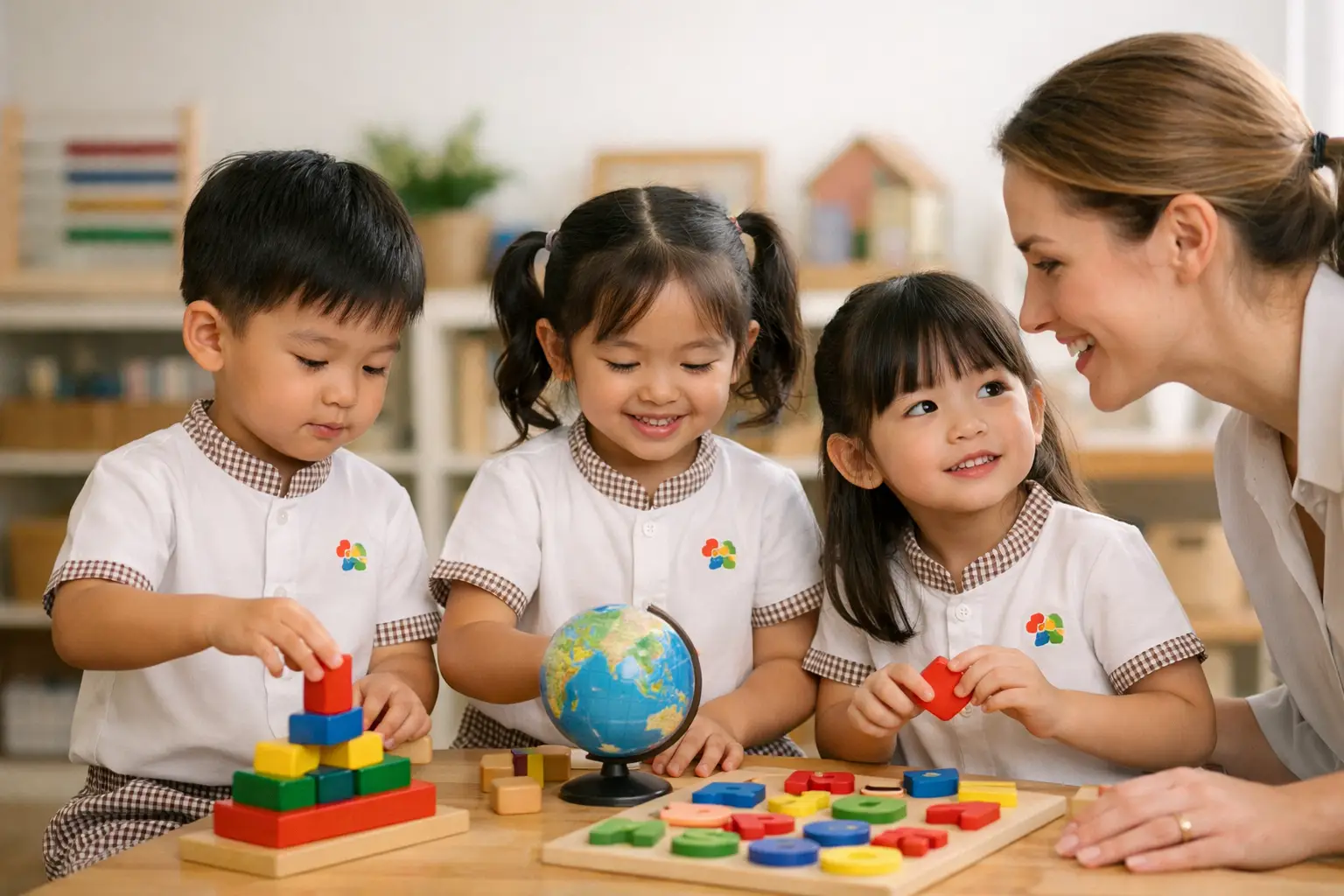
Music education, in particular, deserves closer attention. Through rhythm, repetition, melody and auditory patterning, children develop listening discipline and memory pathways that support later learning. Instrument exposure can also encourage perseverance, coordination and self-belief. In a thoughtfully structured programme, free violin and piano enrichment is not simply a premium feature. It is a meaningful developmental tool.
Exploratory science has a similar value. Young children are natural investigators. They compare, test, notice and question. Good STEM experiences do not require children to memorise facts. They invite children to think, observe and make sense of the world.
Movement-based learning is equally important. Some children process best when their bodies are active. Physical engagement can improve attention, reduce frustration and help learning feel accessible. When movement is used well, it supports both academic readiness and emotional regulation.
Questions parents should ask before enrolling
When visiting a preschool or child development setting, look beyond the classroom displays. Ask how the programme supports communication development. Ask how educators build attention span and confidence. Ask what makes the curriculum more than a standard care routine.
It is also helpful to ask how enrichment is integrated into the day. If music, bilingual learning or STEM are treated as occasional extras, their impact may be limited. If they are embedded within a consistent developmental approach, children are more likely to benefit meaningfully.
Another useful question is how the setting balances nurture with structure. Young children need both. A warm environment helps them feel secure enough to learn, while predictable routines and intentional teaching help them progress.
In Singapore, where parents often have high expectations for school readiness, it can be tempting to choose the most overtly academic option. Yet early success is not only about getting ahead on paper. It is about building the inner tools for learning – focus, language, resilience, curiosity and confidence.
A more purposeful standard for early childhood
Choosing childcare is one of the earliest educational decisions a family makes. It shapes not only a child’s daily routine, but also how that child begins to see learning, relationships and their own abilities.
That is why families increasingly seek programmes that combine loving care with educational substance. They want an environment where children are seen as capable, where development is intentional and where enrichment has a clear purpose. For parents who value bilingual growth, communication skills, creativity and stronger cognitive foundations, that standard is worth expecting.
At A2E Kids, this belief sits at the heart of the programme – caring for children closely while empowering young minds through bilingual learning, music education, exploratory discovery and whole-child development.
The best early years setting will not try to make childhood faster. It will make it richer, more thoughtful and more developmentally meaningful, one day at a time.
Leave a Reply