A child who spends the morning building a bridge from blocks, negotiating roles with friends and explaining why it keeps falling is learning far more than construction. For parents weighing up a play based or structured preschool, the real question is not whether learning should feel enjoyable. It is whether each day gives a child enough purposeful guidance, freedom to explore and caring support to grow with confidence.
This choice can feel especially significant when you want more than reliable childcare. You may be looking for a setting that nurtures communication, concentration, creativity, independence and readiness for the next stage of education. Understanding how play and structure work together can help you choose a preschool experience that supports your child as a whole person.
What does play-based preschool mean?
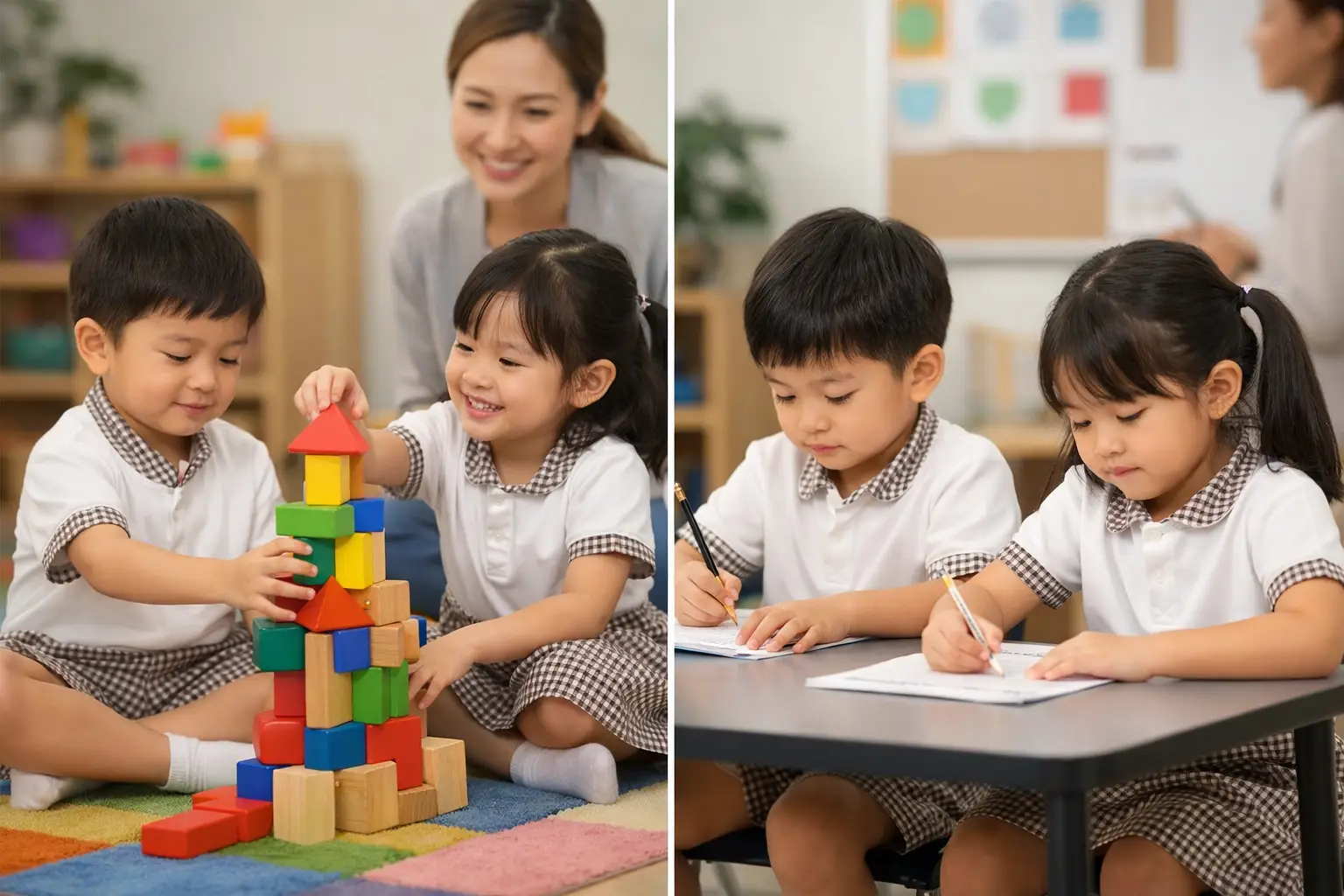
A play-based preschool uses meaningful play as a primary way for children to learn. Rather than receiving information only through direct instruction, children investigate materials, act out ideas, solve small problems and make choices. A pretend market stall can develop language and early numeracy. Water play can introduce prediction, comparison and scientific curiosity. A group game can teach turn-taking, self-regulation and empathy.
High-quality play is not simply unplanned activity or a room full of toys. Skilled educators observe children closely, prepare inviting environments and extend learning with thoughtful questions. When a child says, “My tower is too wobbly,” an educator might ask what could make its base stronger. The child remains the active thinker, while the adult gently deepens the experience.
Play is particularly valuable in the early years because young children learn through movement, repetition, sensory discovery and relationships. It allows them to follow curiosity, practise ideas without fear of getting an answer wrong and build the persistence needed when something does not work immediately.
What does structured preschool mean?
A structured preschool has a clear daily rhythm, intentional learning goals and educator-led experiences. Children may gather for bilingual language activities, music, storytelling, movement, early literacy, numeracy or hands-on science. Routines for arrival, meals, transitions and tidy-up time are consistent, helping children understand what comes next and feel secure.
Structure should not mean long periods of sitting still, worksheets or pressure to perform beyond a child’s developmental stage. At its best, it gives children a dependable framework in which they can participate, listen, communicate and build skills progressively. A well-planned activity on rhythm, for example, can develop auditory attention, memory and coordination while still feeling joyful and active.
For many children, predictability is reassuring. Knowing that outdoor exploration follows morning group time, or that they can share their ideas during a familiar routine, can reduce uncertainty and make it easier to engage. Structure also helps educators ensure that key developmental areas are not left to chance.
Play based or structured preschool: it is rarely either-or
The strongest early childhood programmes do not place play and structure at opposite ends of a scale. They use each purposefully. Children benefit from protected time to initiate play, alongside planned experiences that introduce new vocabulary, concepts, techniques and social expectations.
Consider a garden project. A structured introduction might invite children to examine seeds, learn relevant words in English and Chinese, and discuss what plants need to grow. The play-based element begins when children explore soil, decide where to place their seeds, observe changes, draw what they see and talk with peers about their discoveries. The learning is richer because guidance and exploration support one another.
A balanced programme also recognises that children develop at different rates. One child may need a gentle invitation to join a group activity, while another may need help slowing down, listening and completing a task. Responsive educators adjust the level of support without losing sight of shared goals.
Why intentional structure supports whole-child growth
The preschool years are a period of rapid brain, language and social development. Purposeful routines and carefully designed experiences can strengthen foundations that children will use well beyond preschool.
Communication and bilingual confidence
Children need many natural reasons to listen, speak, ask questions and express feelings. Songs, stories, role-play, show-and-tell and small-group conversations all create opportunities to use language with meaning. In a bilingual setting, consistent exposure across daily experiences helps children connect words to actions, objects and relationships rather than memorising vocabulary in isolation.
Structure gives educators opportunities to model clear speech, introduce richer language and encourage quieter children to contribute. Play gives children a reason to use those words independently. Both matter when building confident communicators.
Focus, memory and self-regulation
Attention is not developed by expecting a young child to remain still for too long. It grows through engaging experiences that gradually invite children to listen, remember, take turns and return to a task. Music can be especially powerful here. Repeating rhythms, recalling lyrics and responding to musical cues encourage auditory memory, focus and coordination in ways children can enjoy.
A thoughtful programme may combine free musical exploration with guided violin or piano enrichment. Children experience the pleasure of sound and movement while learning to notice patterns, follow instructions and practise with care. These are valuable early habits, not merely performance skills.
Independence and life skills
Children gain confidence when they are trusted with age-appropriate responsibilities. Serving their own food, packing away materials, washing hands carefully, putting on shoes and caring for shared spaces build self-help skills and a sense of contribution.
These moments are often most effective when routines are clear but not rushed. An educator can demonstrate a task, allow a child to try, offer help where needed and celebrate effort. The aim is not perfection. It is the gradual belief that “I can do this”.
Signs of a healthy balance in a preschool programme
When visiting a preschool, look beyond whether the room appears busy or quiet. Notice how educators relate to children and whether activities have a clear developmental purpose. A balanced environment usually has a predictable daily rhythm, while still allowing time for children to make choices, move their bodies and pursue ideas.
Ask how teachers plan from observations of each child. Find out how language, early mathematics, science, physical development, creativity and social-emotional learning are woven into the week. It is also useful to ask what happens when a child is reluctant to participate, frustrated during play or ready for a greater challenge. The answers reveal whether the programme sees development as individual and ongoing.
You may also wish to consider the quality of enrichment. Meaningful enrichment is not an extra activity added for appearance. It should connect to children’s developmental needs and be delivered consistently by educators who understand how young children learn. Music, movement, STEM exploration and kinaesthetic learning can be especially valuable when they are part of the programme rather than isolated events.
Choosing for your child, not for a label
Some children initially thrive with a clear routine because it helps them feel settled. Others need ample time for imaginative play and physical exploration before they are ready to join a group activity. Most need both, and their needs can change as they mature.
Rather than choosing solely between labels, consider the quality of the adult guidance, the warmth of the environment and the breadth of learning offered. Does the programme protect childhood wonder while providing the intentional experiences that develop focus, communication and confidence? Does it see play as serious learning, and structure as a source of security rather than pressure?
At A2E Kids, this balance is reflected in a developmental approach that brings together bilingual learning, exploratory science, active kinaesthetic experiences and a structured Music Education Programme with violin and piano enrichment. The purpose is not to fill a child’s day with activities. It is to create connected experiences that support memory, attention, creativity, communication and well-being.
The right preschool should leave your child with stories to share, questions to ask and the quiet confidence to try again tomorrow. That is where purposeful structure and joyful play meet.
Leave a Reply