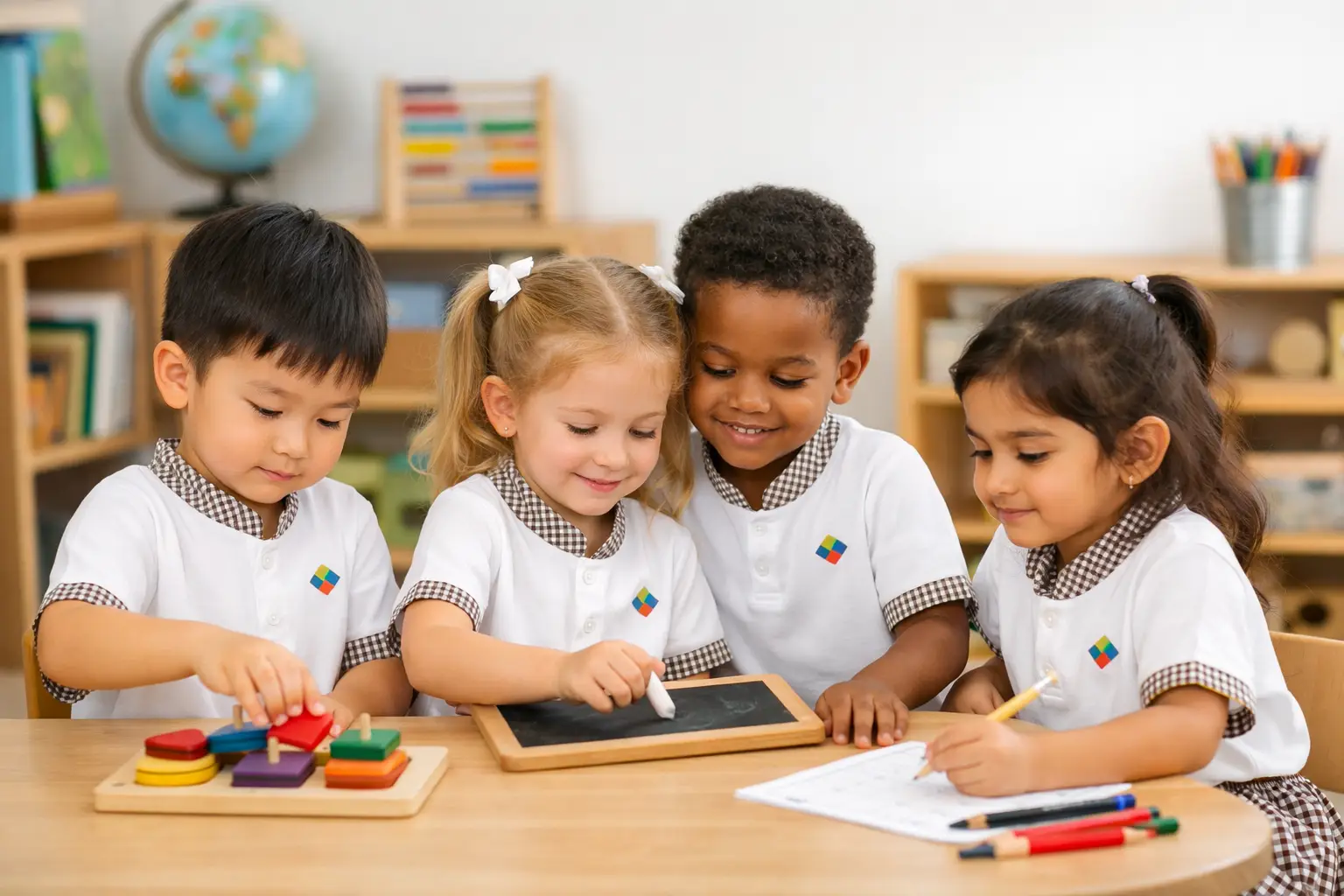
The morning rush tells you a great deal about school readiness. Can your child follow a two-step instruction, put on shoes with some independence, sit for a short activity, and express what they need in words? Before reading worksheets and number drills enter the picture, these everyday abilities are often what help preschoolers settle, participate and thrive.
That is why the best school readiness activities for preschoolers do not aim to make children behave like older pupils. They build the foundations that make learning feel manageable and positive. A child who can listen, communicate, regulate emotions, use their hands well and stay curious is far better placed for a confident start than one who has simply memorised letters by rote.
What school readiness really means
School readiness is broader than academics. It includes language development, early thinking skills, social-emotional maturity, physical coordination, self-help skills and the ability to cope with routines. In practice, that means recognising patterns, listening to stories, taking turns, managing transitions, carrying a bag, opening a lunchbox and asking for help appropriately.
This matters because children enter formal learning as whole individuals. If a child knows the alphabet but struggles to sit briefly in a group, separate from a parent, or understand instructions, the school day can feel overwhelming. On the other hand, a child with strong attention, communication and independence often adapts more smoothly, even if their academic knowledge is still emerging.
12 school readiness activities for preschoolers that truly help
1. Storytime with conversation
Reading aloud remains one of the strongest ways to prepare a child for school, but the real value lies in interaction. Pause to ask what might happen next, how a character feels, or which picture gives a clue. This builds vocabulary, listening, memory and comprehension all at once.
Shorter, lively story sessions are often more effective than trying to finish a book when your child has already lost focus. For some preschoolers, ten engaged minutes is more beneficial than twenty distracted ones.
2. Nursery rhymes, songs and rhythm games
Music supports early language in a powerful way. Rhymes help children hear sound patterns in words, while rhythm strengthens attention and memory. Clapping syllables, echoing simple beats and singing familiar songs all sharpen auditory processing.
This is one reason music-rich learning environments can be so valuable in the early years. When children learn through melody and repetition, they often retain language more easily and develop greater confidence in expression.
3. Simple turn-taking games
Board games for young children, rolling a ball back and forth, or even taking turns to add blocks to a tower help preschoolers practise patience, impulse control and social awareness. These are not small skills. In a classroom, waiting, listening and responding appropriately shape a child’s experience every day.
If your child finds turn-taking frustrating, keep games brief and predictable. The goal is practice, not pressure.
4. Name recognition in meaningful ways
Children enjoy seeing their own name, and that interest can become a gentle early literacy activity. Use name cards, magnetic letters or simple matching games. Let your child spot the first letter of their name on signs or labels.
There is no need to rush handwriting before hand strength is ready. Recognising their name and beginning to understand that print carries meaning is already valuable progress.
5. Fine motor play for hand strength
Cutting with child-safe scissors, threading beads, peeling stickers, using tongs, squeezing playdough and drawing with crayons all strengthen the small muscles needed for writing and classroom tasks. Many parents are tempted to focus on pencil grip too early, but underlying hand control matters more.
A child with stronger fine motor skills will usually find colouring, handling tools and early mark-making less tiring. That leads to better engagement and less frustration.
6. Movement activities that build body control
School readiness also lives in the body. Hopping, balancing, crawling through cushions, throwing beanbags and dancing to action songs develop coordination, spatial awareness and motor planning. These abilities support everything from sitting posture to navigating a classroom safely.
Active children are not necessarily less ready for school. Often, they simply need more purposeful movement built into their day so they can regulate attention more effectively afterwards.
7. Sorting, matching and pattern play
Grouping objects by colour, size or shape lays a foundation for mathematical thinking. So does making simple patterns with blocks or beads and talking about which item comes next. These activities encourage observation, reasoning and early problem-solving.
Keep it hands-on. Preschoolers learn best when they can move and manipulate real objects rather than only looking at abstract symbols on a page.
8. Following instructions through daily routines
One of the most practical school readiness activities for preschoolers is embedded in ordinary life. Ask your child to put their cup in the sink and then fetch a book. Invite them to hang up a bag, wash hands, then sit at the table. These short sequences build working memory and attention.
If your child struggles, reduce the number of steps and gradually increase complexity. Success builds confidence, and confidence supports cooperation.
9. Pretend play with rich language
Role play is more than entertainment. When children pretend to run a shop, care for a baby doll or act out a visit to the doctor, they practise language, sequencing, social understanding and flexible thinking. They also experiment with new vocabulary in a low-pressure way.
Joining in briefly can extend the learning. You might ask, “What does the customer need?” or “What happens first?” without taking over the play.
10. Self-help routines that encourage independence
Can your child open containers, use the toilet with minimal support, manage simple clothing and tidy away belongings? These skills make a genuine difference in the transition to school. Independence supports confidence and reduces stress during busy parts of the day.
This is an area where consistency matters more than perfection. A child does not need to do everything flawlessly, but regular practice helps them feel capable.
11. Emotion coaching and classroom language
Children benefit from words they can use when something feels difficult. Phrases such as “Can you help me?”, “I need a turn”, “I feel upset” or “I need the toilet” give them practical tools for a group setting. Naming feelings also supports self-regulation.
Try pairing emotion words with simple calming strategies such as taking a breath, squeezing hands together or sitting in a quiet corner with a book. Emotional readiness is not about never having big feelings. It is about learning what to do with them.
12. Short focus tasks with a clear finish
Puzzles, matching cards, simple construction challenges and tabletop art activities help children build attention span. The key is choosing tasks with an achievable end point. Completing something successfully teaches persistence.
Some children can concentrate for longer in one-to-one settings than in groups. That is normal. Readiness develops gradually and does not look identical in every child.
How to choose the right school readiness activities for preschoolers
It depends on your child’s current stage. If language is the main challenge, prioritise songs, storytelling and pretend play. If independence is the sticking point, focus on dressing, toileting, tidying and following routines. If your child is bright but easily distracted, movement breaks and short attention-building tasks may help more than extra worksheets.
Parents sometimes worry that play-based activities are too gentle. In reality, well-chosen play can be academically powerful because it develops the brain systems that support later reading, writing and numeracy. The trade-off is that progress can look less obvious day to day. You may not get a neat page to bring home, but you may notice stronger listening, better memory and improved confidence.
When extra support can make a difference
If your child consistently struggles with communication, group participation, attention, fine motor control or emotional regulation, early support is worthwhile. Waiting rarely makes concerns easier to address. A high-quality preschool environment can help by offering structured routines, guided social learning, language-rich interactions and purposeful enrichment.
For many families, the most effective setting is one that nurtures the whole child rather than treating school readiness as a narrow academic race. At A2E Kids, this whole-child approach is reflected in programmes that support communication, creativity, memory, focus and physical development together, including distinctive music enrichment that strengthens listening and attention in meaningful ways.
A more confident start begins before the first school day
The strongest preparation often happens in ordinary moments – singing in the car, setting the table, sharing a story, tidying toys, waiting for a turn and talking through feelings. These are not small tasks. They are the building blocks of resilience, communication and joyful learning.
If you choose school readiness activities with care, your child does not just learn to do more. They begin to feel more capable, more secure and more ready to meet the classroom with confidence.
Leave a Reply