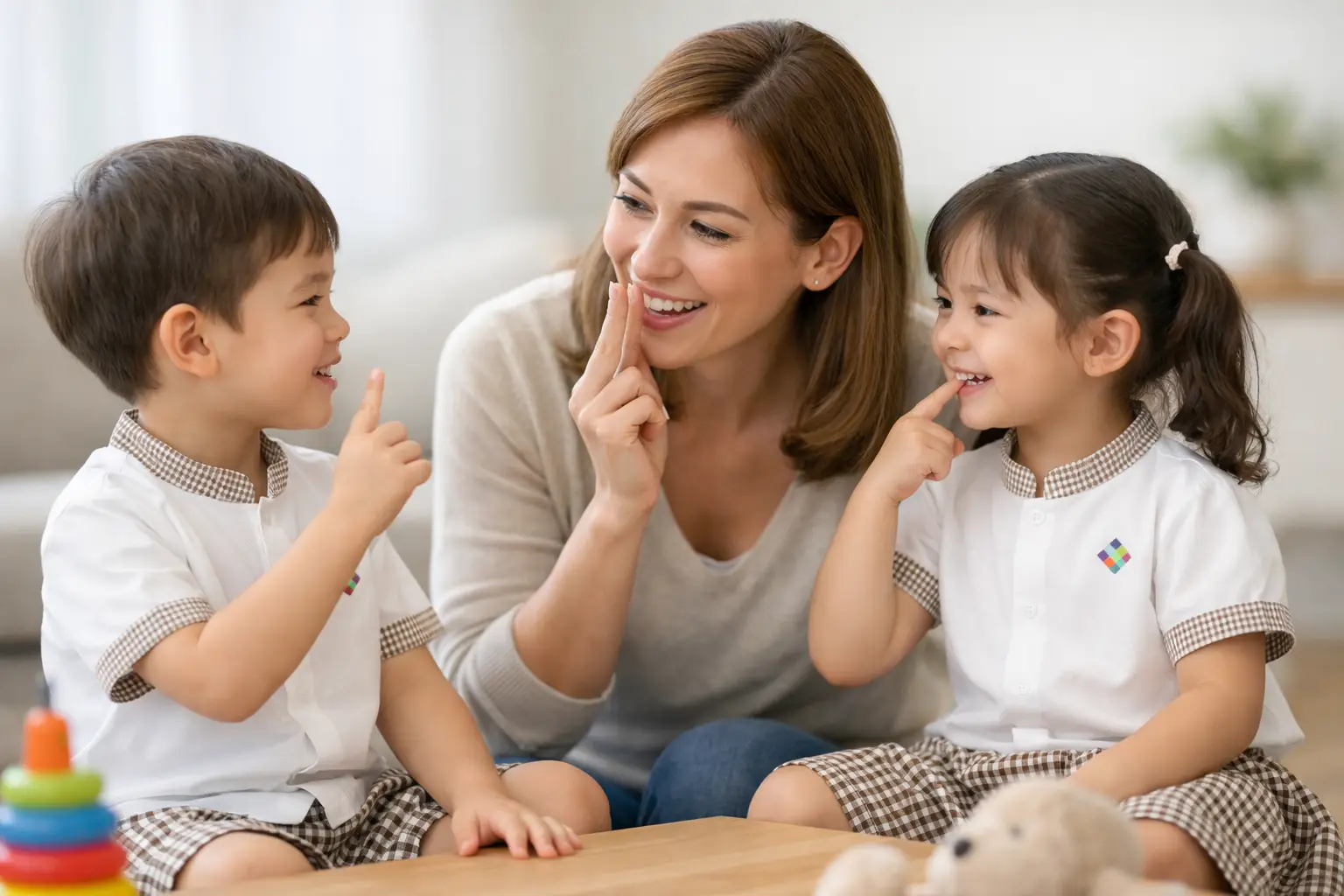
A toddler holding up a banana and looking towards you is already communicating. A point, a sound, a determined shake of the head, or a delighted squeal can all be meaningful attempts to connect. Learning how to encourage toddler communication begins with noticing these small moments and responding as though your child’s message matters – because it does.
Communication is not simply about saying more words. It includes listening, taking turns, using gestures, understanding language, expressing feelings and building the confidence to be heard. For young children, these skills grow most powerfully through warm, repeated interactions with the adults who know them well.
How to encourage toddler communication through connection
Toddlers learn language in relationships. Before they can explain a thought clearly, they need to feel that someone is interested in what they are trying to share. This is why slowing down can be more valuable than asking lots of questions.
When your child points to a bird, follow their gaze and put simple language to the moment: “Yes, a little bird. It is flying.” If they bring you a toy car, join their play: “The blue car is going fast.” This is called responsive interaction. You are recognising their interest first, then adding just enough language for them to hear and absorb.
Try to leave a short pause after you speak. It may feel longer than expected, but toddlers often need time to process words, decide what they want to say and form a response. A child may answer with a word, gesture, look or sound. Treat each attempt as a valuable part of the conversation.
Rather than correcting pronunciation immediately, repeat the word back naturally in its complete form. If your child says “nana”, you might respond, “Banana, yes. You would like banana.” They hear the model without feeling tested or interrupted. Clear speech develops gradually, and confidence should come first.
Build language into ordinary routines
A busy family day contains many opportunities for meaningful talk. Mealtimes, getting dressed, bath time, travelling and tidying up all provide familiar patterns, repeated vocabulary and a reason to communicate. The goal is not to narrate every second. It is to make routine moments more interactive.
At breakfast, offer a genuine choice between two items: “Would you like pear or yoghurt?” Hold both options where your child can see them, then wait. A spoken answer is welcome, but pointing or looking is also communication. You can confirm their choice with words: “Yoghurt. You chose yoghurt.”
During dressing, name actions and body parts: “One sock on. Now your other foot.” At bath time, use playful contrasts such as wet and dry, full and empty, splash and pour. Repetition is useful. Toddlers enjoy hearing familiar phrases, and predictable language helps them begin to join in.
Books can also become conversations rather than performances. You do not need to read every word on every page. Pause over a picture and comment on what your child notices. “The dog is hiding. Where has it gone?” If they turn the page quickly, follow their lead. A positive experience with books builds attention, vocabulary and enjoyment of shared language.
Use play to give words a purpose
Children are far more motivated to communicate when language helps them continue an activity they enjoy. Pretend play is especially rich because it invites children to express ideas, solve small problems and take on roles.
A toy kitchen can become a café where your toddler takes an order. A few blocks can become a tall tower that is “too high”, “falling down” or “one more”. With dolls, animals or figures, children can practise everyday social language: hello, please, help, my turn and goodbye.
You do not need to direct the play or turn it into a lesson. Sit nearby, observe and add a simple comment or question when it fits. If your child is lining up vehicles, saying “The bus is next to the taxi” extends their language while respecting their chosen play. When adults take over too quickly, toddlers can lose the desire to lead the exchange.
Active play supports communication too. As children jump, crawl, balance and move to a beat, they can hear and use action words such as stop, go, up, under, faster and slowly. Physical experiences give words a concrete meaning, which can make them easier to understand and remember.
Make music part of your child’s language environment
Songs, rhymes and musical games naturally develop listening and turn-taking. Their steady rhythm makes language memorable, while repeated lines give toddlers a chance to anticipate a word, sound or action. A child who is not yet ready to speak in a full sentence may happily fill in the final word of a familiar song.
Keep it simple. Sing a short song while washing hands, clap a rhythm for your child to copy, or pause before a favourite action in a rhyme. These pauses create an inviting reason for your child to respond. Musical experiences can also support attention and self-expression, especially for children who communicate readily through movement and sound.
At A2E Kids, structured music education, including violin and piano enrichment, sits alongside bilingual learning and active exploratory experiences because whole-child development is closely connected. When children listen, imitate, remember patterns and share musical experiences with others, they are practising skills that support communication as well as creativity and focus.
Support bilingual communication with consistency
For many Singapore families, more than one language is part of home life. Bilingual exposure does not cause communication difficulties. A toddler may use words from both languages in one sentence, or appear stronger in one language for a period of time. This is a normal part of learning to use the language available in different settings.
What helps most is rich, natural interaction. Speak to your child in the language in which you can be most warm, responsive and expressive. Tell stories from your own childhood, sing songs, describe what you are doing and enjoy conversations at your child’s level. Language is not only vocabulary. It carries family connection, culture and belonging.
Consistency can make routines easier to follow. For example, one caregiver may usually use Mandarin while another uses English, or a family may use one language at home and another in an early learning setting. There is no single formula that suits every household. The best approach is one your family can maintain with genuine conversation, not pressure.
Help toddlers communicate feelings and needs
Frustration is often communication that has not yet found the right words. When a toddler cries because a tower falls or protests when it is time to leave the playground, acknowledge the feeling before trying to solve the problem. “You are upset. You wanted to keep playing.” This helps a child feel understood and gradually gives them language for their inner experience.
Offer short phrases they can use when calm: “Help, please”, “My turn”, “More water”, “All done” or “I am cross.” You may also use gestures alongside words, such as waving for goodbye or holding up a hand for stop. Gestures support language development rather than replacing speech, and they can reduce frustration while spoken language is still emerging.
Avoid insisting that a child says “please” before receiving something they clearly need. Polite language is best learned through modelling and gentle repetition, not by making communication feel like a test. You can say, “More milk, please. Here you are,” and allow your child to copy when ready.
When extra support may be helpful
Children develop at different rates, and comparing toddlers too closely can create unnecessary worry. Some children are naturally observant and quiet before becoming more verbal; others speak early but need more time to listen and follow directions. Progress over time matters more than a single milestone.
However, it is sensible to seek guidance from a healthcare professional or qualified speech and language therapist if your toddler rarely responds to sounds or their name, has lost words or skills they previously used, does not seem to understand simple everyday language, or shows persistent frustration because they cannot make needs known. Early advice can provide reassurance, identify useful next steps and help families act with confidence.
Your child does not need perfect words to deserve a full conversation. Meet each look, gesture, sound and sentence with attention. Over hundreds of ordinary moments, your toddler learns a powerful lesson: my ideas are welcome here – and I can share them with the world.
Leave a Reply