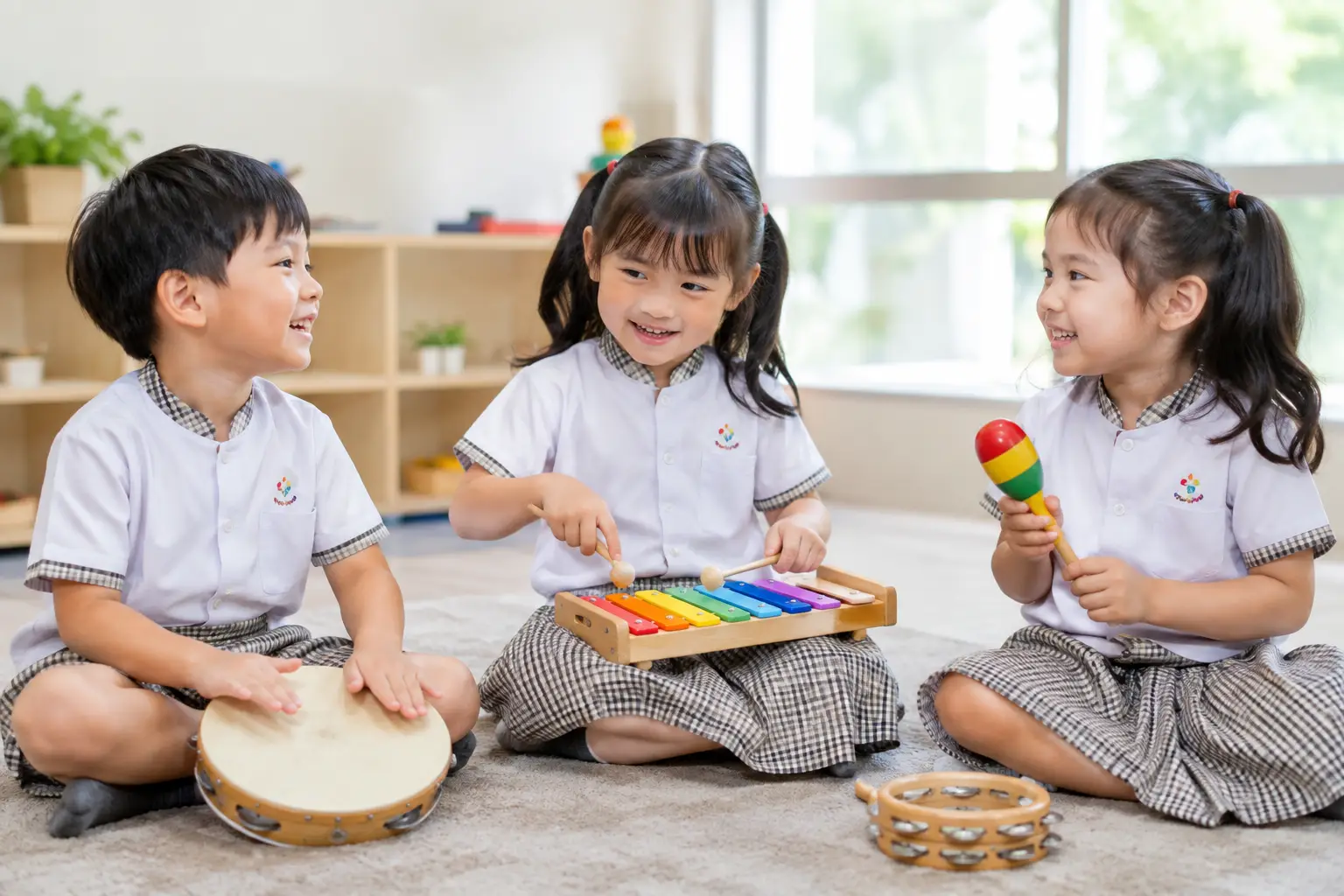
A toddler tapping a steady beat, pausing for a listening cue, then joining a familiar rhyme is doing far more than making a cheerful noise. In that short moment, music education is inviting the child to pay attention, remember a pattern, coordinate movement and share an experience with others. These are small but meaningful building blocks for early learning.
For parents choosing an early childhood programme, music can sometimes appear to be an optional extra. Yet when it is planned with clear developmental purpose, it becomes a powerful way to support communication, confidence, self-regulation and creativity while children remain engaged and joyful.
Why music education matters in early childhood
Young children learn through repetition, movement, imitation and meaningful relationships. Music brings these elements together naturally. A simple welcome song helps children recognise a daily routine. A rhythm game encourages them to wait, listen and respond. Singing words with actions makes language more memorable, particularly for children who are still developing confidence in expressing themselves.
Music also gives children a safe way to participate before they have the vocabulary to explain how they feel. A child may clap enthusiastically, sway gently or choose a sound that reflects excitement. In a warm, responsive setting, these moments help educators understand each child’s interests, temperament and readiness to engage.
The value is not limited to future musical ability. Some children may grow to love performing, while others may prefer listening closely, keeping a beat or exploring an instrument quietly. Both responses matter. The purpose of quality music learning is to nurture the whole child, not to turn every child into a concert musician.
Listening becomes an active skill
Strong listening is central to learning. Before children can follow multi-step instructions, join conversations or recognise the sounds within words, they need opportunities to attend carefully. Music offers this in an enjoyable form.
Children learn to notice when a sound starts and stops, whether it is fast or slow, high or low, loud or soft. They practise responding to a cue and adjusting their actions within a group. These experiences can strengthen the habits of attention that support classroom participation later on.
The approach must suit the child’s age. Infants benefit from gentle voice play, soothing melodies and repeated songs shared face-to-face. Toddlers often respond well to short action songs and simple percussion. Preschoolers are ready for more structured rhythm patterns, instrumental exploration and group activities that involve turn-taking. Asking very young children to sit through lengthy instruction can have the opposite effect; purposeful music should be active, age-appropriate and enjoyable.
Memory grows through meaningful repetition
Children often remember a song long before they can recall an instruction delivered only once. Repetition in music is not empty repetition. It gives children a familiar structure from which they can anticipate what comes next, join in with growing independence and feel successful.
Auditory mnemonics use melody, rhythm and repeated sound patterns to help children remember information. For example, a tune may support the recall of daily routines, vocabulary, number sequences or social phrases. When used thoughtfully, this approach can make learning feel less like a demand and more like an invitation to participate.
It is worth keeping expectations realistic. Music does not replace rich conversation, story time, play or responsive teaching. Instead, it reinforces learning by giving children another route to practise and retrieve what they know. The most effective programmes connect songs to real experiences, allowing children to use new language and ideas beyond the music session.
Music education and communication development
Before children speak in full sentences, they communicate through eye contact, gesture, facial expression, sound and movement. Musical interactions meet children at every one of these stages. A familiar song creates space for a baby to vocalise back to an adult. A pause before the final word of a rhyme encourages a toddler to contribute. A group song gives a quieter preschooler a chance to use language within the security of the group.
Songs are particularly helpful because they slow language down into clear, repeatable phrases. Children can hear the rhythm of words, practise pronunciation and encounter vocabulary in context. When educators add gestures, props, pictures or movement, meaning becomes even more accessible.
For bilingual learners, music can be a welcoming bridge between languages. Children may first join through a familiar rhythm or action, then gradually become comfortable with new words and phrases. This should never pressure a child to perform. Patient repetition, positive encouragement and everyday conversation remain essential to genuine language development.
Confidence is built one turn at a time
A child who chooses an instrument, waits for a turn and contributes a sound to a group is practising confidence in a manageable way. There is no need for a grand performance. The quiet child who taps a drum after watching others has made an important step too.
Group music experiences also introduce early social learning. Children notice that their sound affects the group, learn to respect shared materials and discover the pleasure of creating something together. These are practical foundations for empathy, cooperation and self-control.
Adults play a crucial role here. When educators value effort over perfection, children are more willing to try. Rather than correcting every missed beat, they can acknowledge participation, model the pattern again and offer each child a meaningful role. A supportive environment allows children to take healthy risks without fear of getting it wrong.
From movement to musical understanding
Music is not only heard. Children feel it through their bodies. Marching to a beat, balancing during a slow song, using both hands on a drum or coordinating fingers on a keyboard all connect listening with movement.
This kinaesthetic element is especially valuable during the early years, when children learn best through doing. Movement breaks can help children release energy and return to a calmer activity with renewed focus. Fine motor experiences, such as plucking strings or pressing piano keys, invite careful control and concentration. The benefit depends on thoughtful guidance, however. Children need time to explore freely as well as gentle structure that introduces new skills.
Instrumental learning can be introduced in small, positive steps. Children do not need to read notation immediately to gain from violin or piano experiences. They can begin by learning how to handle an instrument with care, recognise contrasting sounds, copy a short pattern and take pride in steady progress.
What purposeful music learning looks like
A high-quality early childhood music programme is more than a playlist in the background. It has clear intentions, trained educators and regular opportunities for children to revisit skills. It also respects the rhythm of a child’s day, balancing lively participation with quieter listening and reflection.
Parents can look for a programme where music is connected to wider learning rather than separated from it. A song about washing hands can reinforce self-help routines. A rhythm activity can support early number awareness. A story set to sound effects can develop imagination and expressive language. When music is woven into daily learning, children see that knowledge is connected and useful.
At A2E Kids, this developmental approach includes a structured Music Education Programme with Auditory Mnemonics and complimentary violin and piano enrichment, helping children experience music as part of well-rounded growth rather than as an isolated activity.
How families can extend musical learning at home
Home does not need a music room or expensive instruments. A parent’s voice, a few household objects and a few unhurried minutes are enough. Sing the same short song during tidy-up time, clap a pattern for your child to copy, or take turns making fast and slow sounds. The aim is connection, not a polished result.
Notice what your child enjoys. Some may want to repeat one favourite song for weeks. Others may invent new lyrics, dance freely or be fascinated by the sounds made with wooden spoons and containers. Following their interest helps music remain a source of confidence and curiosity.
Most of all, let music be a shared space where your child feels seen, heard and encouraged. When early learning is filled with attentive relationships and purposeful play, each small rhythm, song and sound can become part of a stronger foundation for the years ahead.
Leave a Reply