A child who is learning to speak in full sentences, hold a spoon with control, follow simple routines, recognise patterns, and feel safe with others is not just ‘growing up’. They are building the foundations for life. That is why parents so often ask, what is early childhood education, and why does it matter so much in the first few years.
Early childhood education is the intentional support of a child’s development from infancy through the preschool years. It goes far beyond keeping children occupied or supervised while parents work. At its best, it is a carefully planned approach to nurturing how young children think, communicate, move, relate to others, and understand the world around them.
For families, this distinction matters. Child care provides safety and care. Early childhood education includes that care, but adds purposeful learning experiences that strengthen cognitive, language, social-emotional, physical, and self-help development. In other words, it helps children feel secure while also helping them grow.
What is early childhood education in practice?
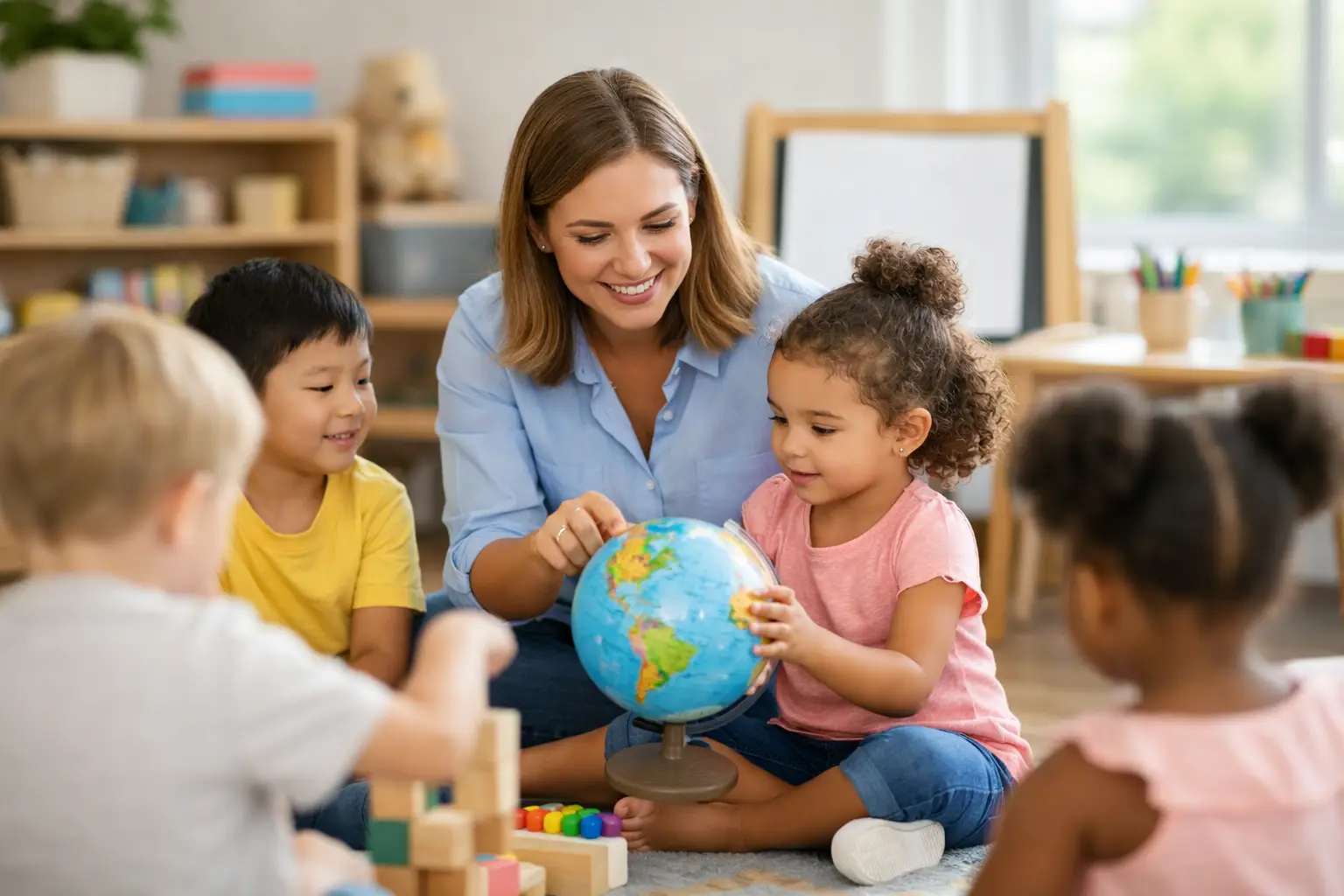
In practice, early childhood education is made up of everyday experiences that are guided by developmental goals. A story session builds listening and vocabulary. Singing strengthens memory and sound awareness. Block play supports problem-solving and fine motor control. Group activities teach turn-taking, confidence, and emotional regulation.
The key difference is intention. High-quality programmes do not leave development to chance. Educators observe children closely, understand what skills are emerging, and plan experiences that move learning forward in a natural, age-appropriate way.
That does not mean children sit at desks or complete formal academic tasks too early. In fact, strong early education respects how young children learn best – through play, movement, repetition, interaction, music, language, and hands-on exploration. A child may appear to be simply clapping to a rhythm or pouring water from one cup to another, but those moments are rich with learning.
Why the early years matter so much
The early years are a period of extraordinary brain development. During this time, children form neural connections at a remarkable pace. Their experiences shape how they learn to pay attention, process language, manage emotions, and respond to new situations.
This is one reason early childhood education has such long-term value. When children are consistently exposed to responsive adults, rich language, meaningful routines, and varied learning experiences, they begin to develop the building blocks for later success in school and beyond.
That said, quality matters more than labels. Not every nursery or preschool delivers the same developmental value. A programme can call itself educational while offering very little depth. Parents are right to look beyond marketing terms and ask how children’s thinking, speech, confidence, creativity, and independence are being supported each day.
The core areas early childhood education develops
A well-designed programme supports the whole child rather than focusing on one narrow outcome. School readiness is part of the picture, but it should not come at the expense of curiosity, well-being, or communication.
Language and communication
One of the clearest benefits of early childhood education is language growth. Young children need frequent conversation, songs, stories, and opportunities to express themselves. They learn not only vocabulary, but also how to listen, ask questions, take turns in conversation, and communicate their needs with confidence.
In a strong setting, language is not limited to one scheduled lesson. It is woven through the day – during meals, transitions, music, play, outdoor exploration, and shared routines. Bilingual exposure can also be especially valuable when it is delivered consistently and meaningfully, helping children become comfortable hearing and using more than one language.
Cognitive development
Cognitive growth includes memory, attention, reasoning, early maths concepts, and problem-solving. Children strengthen these skills when they sort objects, identify sequences, match sounds, notice patterns, and experiment with cause and effect.
Importantly, this should feel engaging rather than pressured. A child who is invited to explore, predict, and try again develops persistence as well as thinking skills. That combination matters. Knowledge alone is not enough if a child struggles to focus, adapt, or cope with challenge.
Social and emotional development
Learning to be with others is a major part of early childhood education. Young children are figuring out how to share space, manage frustration, follow boundaries, and build trusting relationships beyond the family.
Sensitive educators help children name emotions, practise empathy, and feel secure in group settings. These skills are sometimes underestimated because they are less visible than counting or letter recognition, yet they are essential for confidence and classroom adjustment later on.
Physical and kinaesthetic development
Movement is not separate from learning. Active, kinaesthetic experiences support coordination, body awareness, balance, and self-regulation. Fine motor skills develop through drawing, threading, stacking, and manipulating small objects. Gross motor skills grow through climbing, jumping, running, and purposeful movement activities.
For some children, physical engagement is also the route into stronger attention and memory. They learn best when their bodies are involved, not when they are expected to stay still for long periods.
Creativity and expression
Music, imaginative play, storytelling, art, and movement all help children express ideas in ways that go beyond speech. These experiences support creativity, but they also strengthen listening, sequencing, confidence, and pattern recognition.
This is why enrichment should not be seen as an optional extra. In the right programme, music and expressive activities are part of serious developmental work. A child learning rhythm, melody, or vocal control is also developing concentration, auditory discrimination, recall, and communication.
What high-quality early childhood education looks like
Parents often sense when a setting feels warm and well-run, but quality early education goes deeper than atmosphere alone. It combines nurturing relationships with strong pedagogy.
Educators should understand child development, plan with purpose, and adapt to individual needs. The environment should invite exploration while still offering structure and security. Daily routines should feel predictable enough to build confidence, yet flexible enough to respond to children’s interests and pace of development.
There is also a balance to strike. A programme that is too loose may miss key learning opportunities. One that is too rigid may push children before they are developmentally ready. The best approach is structured, but never mechanical. It supports measurable growth without losing sight of joy, attachment, and curiosity.
For many families, the ideal setting is one that combines care with enrichment in a coherent way. Rather than treating music, speech development, movement, and hands-on learning as separate add-ons, these elements work together to support memory, focus, creativity, and confidence. That integrated approach reflects how children actually develop – across many domains at once.
What is early childhood education not?
It is not simply early academics. Teaching children to recite facts, complete worksheets, or memorise content ahead of their developmental stage may look impressive, but it does not always produce deeper understanding.
It is also not passive supervision. A room full of toys is not enough on its own. Children need responsive adult interaction, thoughtful planning, and meaningful engagement if those materials are to become learning tools.
And it is not one-size-fits-all. Some children thrive with verbal instruction, while others need music, movement, repetition, or sensory exploration to absorb new ideas. Effective early education recognises these differences and responds accordingly.
How parents can recognise the right programme
A helpful question is not simply, ‘Is my child happy here?’ although that matters greatly. It is also, ‘How is my child growing here?’ Parents should look for signs that a programme supports communication, independence, curiosity, attention, and relationships as part of daily practice.
Ask how educators track development. Notice whether children are encouraged to speak, move, explore, and participate rather than only comply. Consider whether the environment reflects a whole-child philosophy or only basic care.
If a programme includes specialised enrichment, it is worth asking how those experiences connect to development. For example, music instruction can strengthen listening and memory. Speech-focused activities can support articulation and confidence. Hands-on learning can improve focus and reasoning. When these elements are intentional, they add real value.
This is where a developmental provider such as A2E Kids stands apart for many families. A carefully designed bilingual programme, paired with music, speech, active learning, and holistic developmental goals, can offer far more than routine day care. It can create an environment where children are cared for, challenged, and genuinely empowered.
Early childhood education is, at heart, about giving young children the right start – not by rushing them, but by meeting them thoughtfully at this important stage of life. When care and education work together, children do not just become more prepared for school. They become more confident, more expressive, more engaged, and more ready to grow into themselves.
Leave a Reply